|
Getting your Trinity Audio player ready...
|
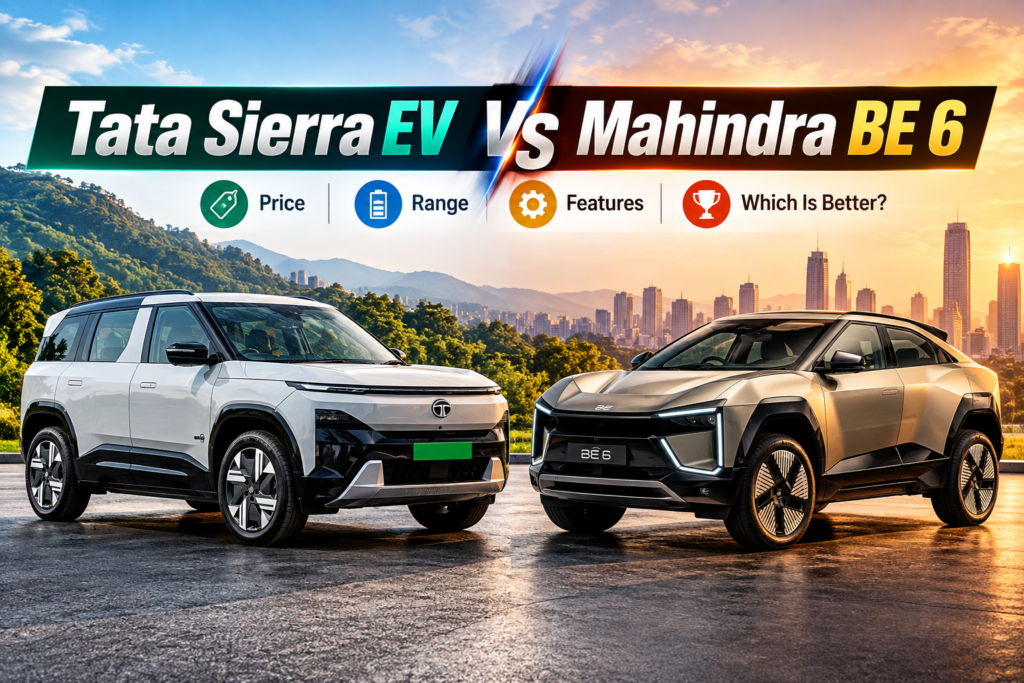
The Tata Sierra EV and Mahindra BE 6 are two electric SUVs competing for buyers who want long driving range, modern technology, strong performance and the practicality of an SUV. Both sit in a price bracket where customers increasingly expect more than just an electric powertrain: they want a premium cabin, fast charging, advanced safety features and enough range for highway journeys.
The Tata Sierra EV combines the familiar Sierra name with a modern electric SUV package, while the Mahindra BE 6 focuses on futuristic styling, sporty performance and a technology-rich cabin. Their prices overlap, but their designs, battery options and feature priorities make them suitable for different buyers.
This comparison looks at their prices, claimed range, battery capacity, charging, features, practicality and value for money to help you decide which electric SUV makes more sense in India.
| Specification | Tata Sierra EV | Mahindra BE 6 |
|---|---|---|
| Starting ex-showroom price | ₹18.79 lakh | ₹18.90 lakh |
| Top variant price | ₹25.99 lakh | Up to ₹28.49 lakh in published comparisons |
| Battery options | 63 kWh, 75 kWh | 59 kWh, 79 kWh |
| Maximum claimed range | Up to 665 km | Up to 683 km |
| Drive options | RWD and AWD | RWD |
| Maximum power | Up to 306 PS | Up to 286 PS |
| Maximum torque | Up to 504 Nm | Up to 380 Nm |
| Fast charging | Supported | Supported |
| Infotainment | Up to three-screen layout | Dual-screen layout |
| Main strength | Comfort, versatility and AWD | Range, performance and sporty character |
Prices are ex-showroom and may change with variant updates, offers and price revisions. The BE 6 price range varies between published sources; check the current variant-wise price with Mahindra before booking. Claimed driving ranges use manufacturer-certified test figures and are not guaranteed real-world distances.
Tata Sierra EV Price in India
The Tata Sierra EV was launched in India at an introductory starting price of ₹18.79 lakh ex-showroom. It is positioned above the Curvv EV in Tata’s electric SUV range and offers a choice of battery capacities, equipment levels and rear-wheel-drive or all-wheel-drive configurations.
The range includes the Pure, Pure S, Adventure, Empowered and Empowered A trims, with powertrain availability depending on the variant. The more affordable versions focus on essential equipment and everyday usability, while higher trims add premium comfort, additional screens, advanced driver assistance features and enhanced parking technology.
The top-specification Sierra EV is particularly interesting because it combines a 75 kWh battery with an available dual-motor all-wheel-drive setup. This gives buyers an option beyond the usual single-motor electric SUV configuration.
However, the ex-showroom price is only the starting point. Buyers should also account for registration, insurance, applicable taxes and the cost of the home charger and installation. Tata’s published information lists the 7.2 kW home charger and installation as an additional cost, so confirm the final on-road quotation with a dealership before making a decision.
Mahindra BE 6 Price in India
The Mahindra BE 6 starts at ₹18.90 lakh ex-showroom in published price lists. It is available with 59 kWh and 79 kWh battery options, spread across different equipment packages. Higher variants add premium audio, more advanced driver assistance features, adaptive suspension and other technology-focused equipment.
The lower-battery versions are aimed at buyers who want an electric SUV with strong performance without paying for the largest battery. The 79 kWh versions are more suitable for customers who prioritise longer claimed range and stronger motor output.
The top variant is priced higher than the entry-level Sierra EV, but it also offers a larger battery and a longer certified range. Its overall value therefore depends on how much importance you place on driving range, acceleration, premium features and the total purchase cost.
As with the Sierra EV, charger costs may be additional. Confirm the selected battery, variant, charger package, delivery-time price and on-road cost before booking.
Battery Capacity and Driving Range: Which SUV Goes Further?
Driving range is one of the most important considerations when choosing an electric SUV. A longer certified range can reduce charging stops on road trips, while a suitably sized battery may help keep the purchase price manageable.
The Tata Sierra EV offers 63 kWh and 75 kWh battery packs. Its published claimed ranges are approximately 565 km for the 63 kWh rear-wheel-drive version, up to 665 km for the 75 kWh rear-wheel-drive version and around 624 km for the 75 kWh all-wheel-drive version. Figures can vary by test protocol and variant, so check the current specification sheet for the exact model.
The Mahindra BE 6 offers 59 kWh and 79 kWh battery packs, with claimed ranges of approximately 557 km and 683 km, respectively. The 79 kWh version is the strongest option in the BE 6 range for buyers who want the longest certified distance per charge.
On paper, the BE 6 has a slight advantage in maximum claimed range. Its 79 kWh battery is larger than the Sierra EV’s 75 kWh pack, and its maximum claimed figure is higher. The Sierra EV, however, offers a compelling alternative with its 75 kWh battery and the option of all-wheel drive.
It is important to remember that certified range and real-world range are not the same. Actual distance depends on driving speed, traffic, air-conditioning use, temperature, road gradient, tyre pressure, passengers and luggage. Frequent high-speed highway driving can reduce range considerably compared with ideal test conditions.
For city commuters, either SUV may offer sufficient range for several days of typical driving. For frequent intercity travel, compare charging infrastructure along your usual routes rather than relying only on the maximum range number.
Performance and Driving Experience
Tata Sierra EV Performance
The Sierra EV is available with rear-wheel drive and, in its higher-specification configuration, dual-motor all-wheel drive. Tata lists up to 238 PS for the rear-wheel-drive setup and a combined output of 306 PS with 504 Nm of torque for the all-wheel-drive version. The AWD model is claimed to accelerate from 0 to 100 km/h in 5.8 seconds.
This configuration gives the Sierra EV two distinct personalities. The rear-wheel-drive versions are suitable for everyday commuting and general family use, while the dual-motor version adds stronger acceleration and traction for more demanding conditions.
Tata also offers terrain-response features in the AWD variant. These are useful for drivers who regularly encounter rough roads, gravel or other challenging surfaces. Although the Sierra EV has an SUV body style and terrain modes, it should not be treated as a substitute for a dedicated off-road vehicle in every situation.
Mahindra BE 6 Performance
The BE 6 is designed to deliver a sporty electric driving experience. Its 59 kWh version produces approximately 231 PS, while the 79 kWh version produces around 286 PS. Both are rear-wheel drive and deliver approximately 380 Nm of torque.
Instant electric torque helps the BE 6 accelerate quickly from a standstill. Its low-mounted battery also helps create a planted driving feel, while selectable driving modes allow the driver to adjust the vehicle’s character.
For someone who enjoys responsive acceleration and a more performance-oriented design, the BE 6 is an attractive choice. The Sierra EV’s AWD configuration, however, provides a distinct advantage for buyers who want additional traction and higher combined torque.
Performance verdict: The BE 6 offers strong single-motor performance, but the Sierra EV AWD is the more versatile choice for buyers who want the benefits of dual-motor traction.
Charging Time and Convenience
Charging convenience can make a major difference to everyday EV ownership. Both SUVs support home AC charging and public DC fast charging, but the supported charging power depends on the selected variant and charger.
The Sierra EV supports AC charging and DC fast charging. Tata advertises the ability to add up to 263 km of claimed range in 15 minutes under suitable fast-charging conditions. This is a manufacturer claim, not a guarantee that every charging station or battery condition will deliver the same result.
The BE 6 supports AC charging options and high-power DC fast charging. Its published specifications list up to 180 kW DC charging, with a claimed 20–80% charging time of around 20 minutes for the 79 kWh version under suitable conditions.
Actual charging time depends on the charger output, battery temperature, state of charge, charging-curve limits and other conditions. A vehicle will not necessarily maintain its maximum advertised charging power throughout the session.
For home charging, both models can be convenient if you have a suitable parking space and access to a properly installed charger. Before purchase, ask the dealer about the supplied charger, installation requirements, electrical load, warranty and any extra fees.
For long-distance travel, check the availability and reliability of fast chargers along your regular routes. A slightly shorter certified range may be less important than dependable charging stops and a charging network that fits your travel habits.
Exterior Design and Road Presence
The Tata Sierra EV and Mahindra BE 6 follow noticeably different design approaches.
The Sierra EV adopts a more upright SUV profile. Its tall body, broad stance and familiar Sierra-inspired styling give it a more traditional family-SUV appearance with modern electric details. Buyers who prefer a substantial-looking SUV rather than a sharply sculpted crossover may find its design appealing.
The BE 6 has a more futuristic appearance, with dramatic bodywork, distinctive lighting and a coupe-like roofline. It is designed to stand out and has a sportier visual identity.
The Sierra EV is taller, while the BE 6 is longer and wider. Published specifications put the Sierra EV at approximately 4,340 mm long and 1,841 mm wide, compared with the BE 6 at approximately 4,371 mm long and 1,907 mm wide. These dimensions contribute to their different road presence and cabin packaging.
Neither design is objectively better. The Sierra EV may appeal to buyers looking for a conventional, upright SUV appearance, while the BE 6 is more suitable for those who prefer a bold, futuristic vehicle.
Interior, Comfort and Technology
Tata Sierra EV Interior
The Sierra EV places a strong emphasis on cabin technology and passenger comfort. Depending on the variant, its features include a triple-screen dashboard layout, a 12.3-inch infotainment touchscreen, a digital driver’s display and a separate passenger screen.
Higher trims offer features such as ventilated front seats, powered driver and front passenger seat adjustments, a panoramic sunroof, wireless smartphone connectivity, a head-up display and a premium JBL audio system with Dolby Atmos. Certain variants also include advanced parking assistance and a 540-degree surround-view system.
The additional passenger screen and powered front passenger seat are notable advantages for buyers who value a technology-rich cabin and rear-seat or front-passenger comfort. However, availability differs by trim, so do not assume every feature comes standard on the entry-level model.
Mahindra BE 6 Interior
The BE 6 has a driver-focused cockpit with a sporty appearance. Its equipment includes dual 12.3-inch screens, wireless Android Auto and Apple CarPlay, ventilated front seats, dual-zone climate control and wireless charging, depending on the variant.
Higher versions offer a 16-speaker Harman Kardon sound system with Dolby Atmos, a head-up display, adaptive suspension, powered tailgate functionality and more advanced driver assistance equipment. The top variant also offers additional features such as augmented-reality head-up display functionality and more comprehensive ADAS capabilities.
The BE 6’s cabin may appeal more to buyers who want a sporty, technology-led environment. Its premium audio system and driver-oriented layout are key attractions.
Interior verdict: The Sierra EV offers a broader passenger-focused screen layout and useful comfort features, while the BE 6 stands out with its premium audio setup and sporty cockpit.
Safety Features and Driver Assistance
Safety equipment should be a major part of any electric SUV comparison. Both models offer modern safety technology, but the exact equipment depends on the selected variant.
The Sierra EV offers features such as six airbags, electronic stability control, all-wheel disc brakes, tyre-pressure monitoring and advanced driver assistance features on higher trims. Its top variants include Level 2+ ADAS and a 540-degree camera system that can help with parking and low-speed manoeuvring. <Cite refs={[“turn763344search0″,”turn763344search2”]} />
The BE 6 includes safety equipment such as airbags, electronic stability control, all-wheel disc brakes, tyre-pressure monitoring and driver assistance systems. Higher variants offer additional radar and camera hardware for more advanced ADAS functions. Equipment and the number of airbags may vary across variant specifications and model updates. <Cite refs={[“turn158177search3″,”turn158177search14”]} />
Features such as adaptive cruise control, lane assistance and automatic parking can support the driver, but they do not replace attentive driving. Buyers should check the exact safety equipment on the variant they intend to purchase and confirm the latest crash-test ratings from the relevant testing authority before deciding.
Practicality, Boot Space and Everyday Use
An electric SUV needs to work well in daily life, not just offer an impressive range figure. Boot capacity, rear-seat comfort, ride quality, visibility and ease of parking all matter.
Published specifications list approximately 450 litres of boot space for the Sierra EV and 455 litres for the BE 6. Both also offer front storage compartments, although the usable capacity depends on the version and specification.
The Sierra EV’s taller body may appeal to families who prefer an upright SUV seating position and a more conventional cabin layout. Its passenger-focused technology and comfort features may also be useful on longer journeys.
The BE 6 is wider and has a slightly longer wheelbase, but its sportier roofline and design may feel different to buyers accustomed to traditional SUVs. A test drive is the best way to judge rear-seat comfort, ingress and egress, visibility and ride quality.
For family buyers, take the people who will regularly travel in the vehicle to the showroom. Check child-seat fitment, luggage capacity, rear-seat access and how easily the SUV can be parked in your home or office.
Tata Sierra EV vs Mahindra BE 6: Which Offers Better Value?
Value for money depends on the variant rather than the model name alone.
The Sierra EV’s starting price is marginally lower than the BE 6’s published entry price. Its top variants also offer a combination of comfort features, a passenger screen and an available all-wheel-drive powertrain that is not available on the BE 6.
The BE 6 makes a strong case for itself with its 79 kWh battery, maximum claimed range of 683 km, sporty character and high-end technology. However, buyers seeking the longest certified range should compare the price of the specific 79 kWh variant with the relevant Sierra EV version rather than comparing only the base prices.
Before choosing, compare the final on-road quotation, battery and motor configuration, included charger, warranty terms, service support and insurance costs. A vehicle that costs less upfront may not be the better choice if it lacks the features or powertrain you actually need.
Which Is Better: Tata Sierra EV or Mahindra BE 6?
The better electric SUV depends on your driving habits and priorities.
Choose the Tata Sierra EV if you want an upright family SUV, a technology-rich cabin, additional passenger-focused comfort features or the option of dual-motor all-wheel drive. It is particularly appealing to buyers who want a blend of everyday practicality and the ability to tackle varied road conditions.
Choose the Mahindra BE 6 if you prefer sporty styling, strong single-motor performance, a larger 79 kWh battery option and a slightly longer claimed range. Its driver-focused cockpit and premium audio system may also appeal to technology enthusiasts.
For most buyers who prioritise family comfort and powertrain versatility, the Sierra EV deserves serious consideration. For those who place greater importance on maximum claimed range and a sporty driving character, the BE 6 is an excellent alternative.
There is no universal winner. The most sensible purchase is the variant that meets your range needs, fits your budget and offers the features you will genuinely use.
FAQs
What is the price of the Tata Sierra EV in India?
The Tata Sierra EV launched at an introductory starting price of ₹18.79 lakh ex-showroom, with higher variants priced up to ₹25.99 lakh in the published launch range. Check the latest dealership quotation for current prices and offers.
What is the price of the Mahindra BE 6?
Published prices start at ₹18.90 lakh ex-showroom. The price of higher variants depends on battery capacity, equipment and the latest price list, so confirm the current variant-wise price with Mahindra.
Which has a longer range, Tata Sierra EV or Mahindra BE 6?
The Mahindra BE 6 has a maximum claimed range of approximately 683 km, while the Tata Sierra EV offers up to approximately 665 km in its 75 kWh rear-wheel-drive version. Actual driving range will vary with conditions.
Which electric SUV has the bigger battery?
The Mahindra BE 6 offers a 79 kWh battery in its larger-battery version. The Tata Sierra EV offers battery options of 63 kWh and 75 kWh.
Does the Tata Sierra EV offer all-wheel drive?
Yes. The Sierra EV is available with a dual-motor all-wheel-drive configuration in a higher-specification variant. The Mahindra BE 6 is offered with rear-wheel drive.
Which is better for long-distance travel?
Both can be suitable for long-distance travel, depending on the route and charging network. The BE 6 has the higher maximum claimed range, while the Sierra EV also offers a long-range battery option. Check fast-charger availability along your regular routes before buying.
Which electric SUV is better for families?
The Sierra EV may suit families who prioritise an upright SUV design, passenger-focused technology and comfort features. The BE 6 can also suit families who prefer a sportier design and a longer-range battery. A test drive is essential to assess cabin comfort and practicality.
Is the Tata Sierra EV cheaper than the Mahindra BE 6?
The Sierra EV has a slightly lower starting ex-showroom price in the published launch figures. The difference at higher trim levels depends on the selected battery, equipment and current pricing.
Final Verdict
The Tata Sierra EV and Mahindra BE 6 are both strong options in India’s premium electric SUV market, but they serve slightly different priorities. The Sierra EV brings an upright SUV design, passenger-focused technology and the added flexibility of all-wheel drive. The BE 6 counters with a larger battery option, a longer maximum claimed range and a sportier driving experience.
Before making a final decision, compare the exact variants, test-drive both vehicles and obtain current on-road quotations. That will give you a more reliable answer than choosing based only on the headline price or maximum range figure.