|
Getting your Trinity Audio player ready...
|
The warning has been issued, and it is not something you should ignore.
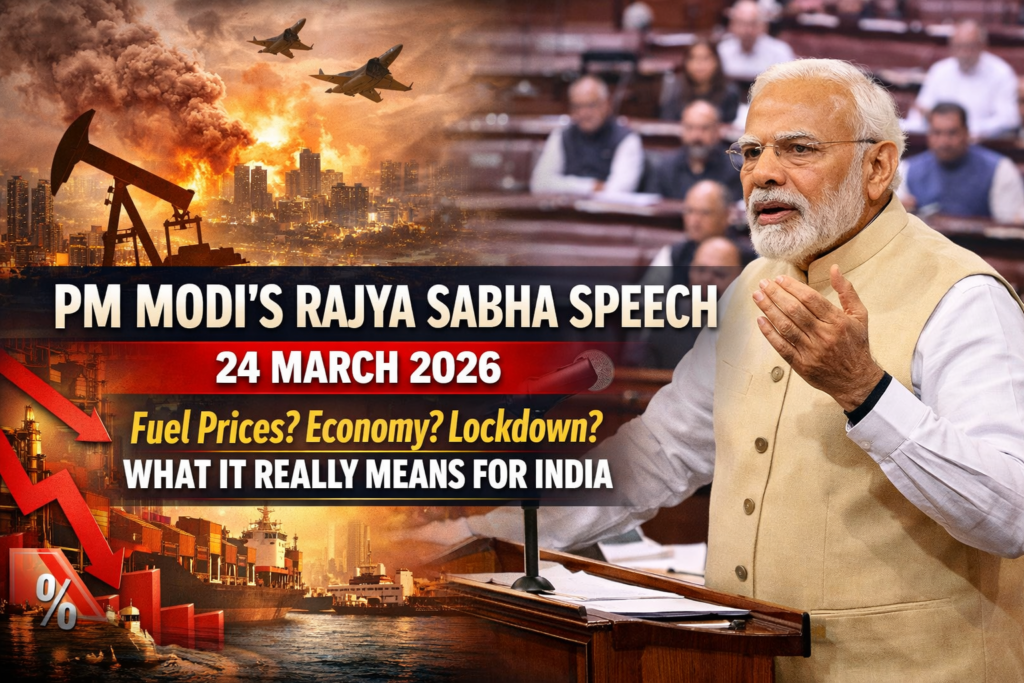
On 24 March 2026 at 2 PM, Prime Minister Narendra Modi addressed the Rajya Sabha with a message that goes far beyond routine politics. While the speech did not announce any immediate crisis, it clearly signaled that India is preparing for serious global uncertainty.
At first glance, this may seem like another geopolitical update. However, when you look deeper, the implications are direct and personal. From fuel prices to job stability, the impact could reach every Indian household.
Why This Speech Matters Now
To begin with, the ongoing tensions in West Asia are not isolated events. Instead, they are deeply connected to India’s economic structure.
India depends heavily on oil imports. At the same time, millions of Indians work in Gulf countries. Therefore, any instability in that region creates a chain reaction.
As a result, global conflict quickly turns into local economic pressure.
Key Highlights from the Speech
1. A Direct Warning on Global Instability
First, PM Modi made it clear that the current situation is serious and evolving. He did not present it as a short-term issue. Instead, he framed it as a long-term global challenge.
He emphasized that:
- Global markets may remain unstable
- Conflicts could expand or intensify
- Countries must stay prepared rather than reactive
Therefore, India is taking a proactive stance instead of waiting for disruption.
2. Fuel Prices Will Be the First Impact
Next, the discussion moved to energy security, which directly affects daily life.
India imports a large portion of its crude oil. Consequently, any disruption in supply routes or producing regions leads to price fluctuations.
The government is already responding by:
- Diversifying oil import sources
- Increasing strategic reserves
- Strengthening supply chains
However, despite these efforts, if the conflict escalates, fuel prices are likely to rise. This will not remain limited to petrol and diesel. It will increase transportation costs, which will then push up prices across multiple sectors.
3. Safety of Indians Abroad Remains a Priority
At the same time, PM Modi addressed concerns regarding Indians living in West Asia.
The government is:
- Monitoring developments continuously
- Keeping evacuation plans ready
- Engaging diplomatically with affected regions
This indicates preparedness, not panic. India is ensuring that its citizens abroad remain protected even if conditions worsen.
4. Trade and Business Disruptions Are Possible
Meanwhile, global trade routes remain at risk. Key shipping lanes could face disruptions if tensions escalate further.
As a result:
- Import costs may increase
- Delivery timelines may extend
- Supply chains may become unpredictable
This will affect industries such as manufacturing, electronics, and retail. Consequently, businesses, especially MSMEs, may experience financial pressure.
Is Lockdown Coming Back?
This is the most common concern, and it needs a clear answer.
No, lockdown is not coming back.
There is no health emergency or pandemic-like situation. Therefore, restrictions similar to COVID-19 are not expected.
However, that does not mean there will be no impact.
If the global situation worsens, India may see:
- Rising fuel prices
- Economic control measures
- Trade adjustments
- Travel advisories
In other words, the challenge will be economic, not physical restrictions.
What This Means for the Indian Economy
When you connect all the points, the real concern becomes clear.
The issue is not sudden disruption but gradual economic pressure.
First, inflation is likely to increase as fuel prices rise.
Second, businesses may face reduced margins due to higher costs.
Third, certain sectors may slow hiring due to uncertainty.
Therefore, the impact will be felt over time rather than instantly.
What Could Happen Next
Best Case Scenario
The conflict stabilizes quickly. Oil prices remain controlled, and global trade continues without major disruption.
Moderate Scenario
Fuel prices increase moderately. Inflation rises, and the government introduces measures to balance the economy.
Worst Case Scenario
The conflict escalates significantly. Oil prices surge, trade routes face disruption, and economic growth slows down.
Even in this scenario, lockdown remains unlikely. The focus will stay on economic management.
What You Should Do Now
Given the situation, taking practical steps is essential.
If you run a business, focus on reducing dependency on unstable supply chains and maintain financial buffers.
If you are employed, prioritize financial stability and avoid unnecessary risks.
If you work in the digital sector, you are relatively insulated, but staying adaptable is still important.
Preparation now will reduce the impact later.
Final Verdict
PM Modi’s speech was not about creating fear. Instead, it was about preparing the nation for possible economic challenges ahead.
India is not heading toward lockdown. However, it is entering a phase where global events will increasingly influence domestic conditions.
The real impact will not be on movement but on money. Fuel prices, inflation, and business stability will define the coming months.
FAQs
1. Will lockdown return in India in 2026?
No, there is no indication of a lockdown. The situation is geopolitical, not related to a health crisis.
2. Will petrol and diesel prices increase?
Yes, if global tensions escalate, fuel prices are likely to rise due to supply disruptions.
3. Is India directly involved in the conflict?
No, India is not directly involved. However, it is economically affected due to global dependencies.
4. What is the biggest risk right now?
The biggest risk is inflation and economic pressure, not lockdown or physical restrictions.
5. Should businesses be concerned?
Yes, especially those dependent on imports or global supply chains. Strategic planning is important.