|
Getting your Trinity Audio player ready...
|
There aren’t many conversations that have the capacity of being at the same time, highly philosophical, yet highly practical. That is exactly what the conversation on the TRS episode with Jay Shetty did.
Jay Shetty is one of the most prominent names in the global self-help domain. Think Like a Monk became a global bestseller. The podcast On Purpose has been listened to by hundreds of millions of people worldwide. And his gift for translating ancient principles into modern-day, practical, actionable advice has impacted individuals from all across the globe.
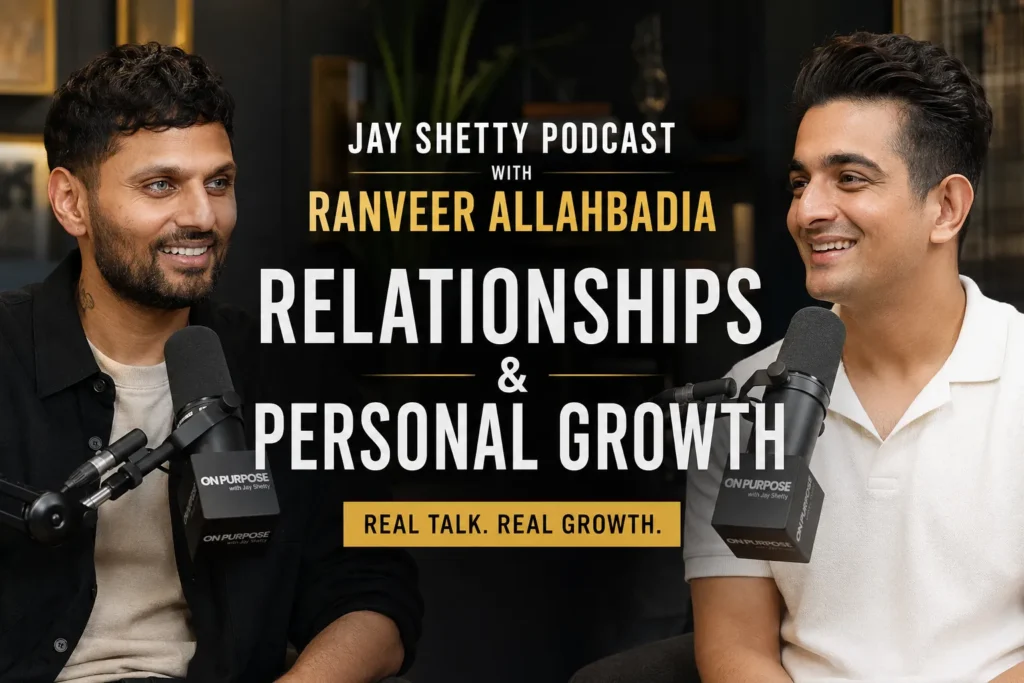
Sitting across from Ranveer Allahbadia, it was nothing short of an insightful, authentic and vulnerable conversation on what a life well-lived truly looks like.
This blog highlights the central themes and learnings from the same.
The Beginning of the Conversation
Jay Shetty begins with his own story, the not-interview version.
He shares with us his experiences as an Indian born and raised as a boy and a teenager in Britain. He was academically bright and was on a traditional career path but still felt empty.
That emptiness pushed him toward the unthinkable career path given where he was from- he moved to India where he lived as a monk in an ashram, spent time studying Vedic principles and helping people and learning how to silence the modern world and all its distractions.
He lived there for 3 years and when he came back out to the world he brought with him his new set of skills that has helped countless people around the world trying to find peace and clear thinking that he discovered.
Ranveer was so relatable to him and this starts off what is to come.
Think Like a Monk – What It Actually Means
Most of the first part of the podcast is all about the premise of Jay Shetty’s book – the idea of thinking like a monk, what it is and why we should all do it.
He explains that monks are not people who have dropped out of the world but they are people who can live within the world without being victims to it, to observe our own thoughts and feelings without being consumed by them.
The practical way he states this will affect our lives is to learn to create space between our stimulus and our response. Most of us automatically react – to stress, to criticism, to failure. The monk mindset is to make internal space for ourselves, so we can decide how we respond.
This was a thought that struck a massive chord with the viewers who recognised themselves in this.
Lessons from the Bhagavad Gita
My favorite part of the podcast was definitely Jay Shetty talking about the Bhagavad Gita and how it relates to everyday life in modern society.
He stated that the Bhagavad Gita is more than a religious text and can even be called one of the most intelligent psychological and philosophical writings in history and its teachings about purpose and identity, as well as responsibility and the mind, are as applicable now as they were then.
He gave specific examples from his teachings and gave solutions to what he knows his audience deals with daily: How can I find purpose? How can I do without attachment to the results? How can I handle rejection and failure and still hold on to my sense of self?
For Indians, it was one of the highlights of the podcast and a reminder that their own traditions hold a vast amount of knowledge and wisdom.
Relationships – The Part Most People Get Wrong
One of the most quoted segments of Jay Shetty’s TRS appearance was his take on relationships.
According to Jay, most people pursue relationships wrong: they are always looking for someone who will complete them, make up for their inadequacies, make them whole, “the solution to their emptiness”. Which is guaranteed to lead to failure.
True relationships, according to Jay, are not based on need, but on choice: it is two whole people choosing to build something together-not two half-empty individuals expecting the other to make up for their shortcomings.
He also goes on to discuss communication and emotional intelligence within relationships-being able to articulate and express one’s emotions clearly, but also listen to one’s partner without becoming defensive, understanding conflict not as a danger to a relationship but as a path towards a deeper understanding of one another.
His commentary really hit home with younger viewers who are pursuing and maintaining relationships in a day and age of social media, swipe culture and constant societal comparison.
Self-Awareness and Emotional Intelligence
There’s one main message that Jay Shetty revisits again and again throughout the podcast- your relation to yourself is at the core of everything.
He emphasizes how most people are afraid of their thoughts for their entire lives. They are always on the go, constantly entertained, always keeping their minds filled with enough background noise to avoid sitting with their thoughts. Self awareness is simply turning that idea around- sitting with yourself and seeing you for what you really are. You don’t have to be tough or harsh with yourself when starting to self discover.
He shares a few key practices that he picked up when he was a monk and perfected since: journaling, meditation, planned solitude and asking yourself who and what you truly want. There are no impossible feats in these practices. Instead, there is a requirement of truthful effort, and a truthful acknowledgment of self, that few people dare to confront.
Why This Podcast Became So Popular
The reason the Jay Shetty episode of TRS went on to become one of the most shared conversations of its history: It answered the question that everyone is asking.
The question of purpose, relationships, self-worth, and happiness: these are not questions for a certain age, race, and gender. They are questions that every single human is grappling with, whether they put it into words or not.
Jay Shetty’s way of talking about those things in both profound, and warm ways-ancient wisdom brought right to your present life-is really what separates him from so many other people in the self-improvement space. And because Ranveer was able to ask so honestly and vulnerably, the conversation was less an interview and more two friends trying to figure shit out.
About Jay Shetty
Jay Shetty is an Indian-British author, podcaster, and motivational speaker who has quickly become one of the most famous names in modern self-help. The author of the New York Times bestseller Think Like a Monk, his highly popular podcast On Purpose is among the most listened-to in the world.
Before turning to the media, he worked as a monk for three years in India where he studied Vedic philosophy and received training from the wisest teachers in that lineage. Time magazine has named him as one of the most influential people on the internet, and his work has collectively earned billions of views across all digital platforms. His work continues to be steeped in ancient Indian teachings-most notably, the Bhagavad Gita and the Vedic philosophy that he gained as a monk-as he shares time-tested advice that he uses to navigate the struggles and demands of contemporary life.
Jay Shetty Organizations and Social Media
Jay Shetty is associated with:
- On Purpose Podcast – Host and Creator
- Think Like a Monk – Bestselling Author
- 8 Rules of Love – Bestselling Author
- Jay Shetty Certification School
- Global Speaking and Educational Programs
Jay Shetty Social Media Accounts:
- Jay Shetty YouTube Channel
- Jay Shetty Instagram Account
- Jay Shetty Twitter/X Account
- Jay Shetty Facebook Account
- Jay Shetty LinkedIn Account
- Jay Shetty Website
Why You Should Watch This Podcast
This episode is for all those that have at some point asked themselves the following questions; “Am I living the correct life?”, “Am I in the correct relationship?” and “Do I even know who I really am?”
Jay Shetty doesn’t have the right answers to these questions. However he offers something much better, which is ancient as well as an extremely relevant way of looking at these questions and a collection of practices that could actually make you move toward the answers that you need.
The episode whether it is for someone in crisis, or someone who just wants to know how to do better, this will give them an ample take away.
Conclusion
The Jay Shetty episode on The Ranveer Show is one of those interviews that one doesn’t stop listening to, even after the audio or video has finished playing.
It’s not just the knowledge, it’s the genuineness of the two people and the importance of what is being discussed that stays with you. The Jay Shetty episode has given a wonderful and vital reminder to everyone out there. It tells us that the greatest journey is the journey within, it talks about developing self-awareness and building relationships that are truly authentic. It makes us find our own purpose rather than just borrowing from other people’s perceptions and beliefs.
This information conveyed with Jay’s warmth and clarity, has had a huge impact and I am certain, will continue to inspire people for the years to come.
1. Who is Jay Shetty?
Jay Shetty is a British-Indian author, podcast host, and former monk best known for Think Like a Monk and his globally popular On Purpose podcast.
2. What does the podcast cover?
The episode covers self-awareness, relationships, lessons from monk life, the teachings of the Bhagavad Gita, emotional intelligence, and finding genuine purpose in modern life.
3. Why is this episode so popular?
Jay Shetty addresses questions that every human being is wrestling with – about purpose, relationships, and self-worth – with a combination of ancient wisdom and modern practicality that is uniquely his own.
4. Is this podcast only for people interested in spirituality?
Not at all. While Jay Shetty draws on spiritual traditions, the content is entirely practical and relevant to anyone interested in living better, building stronger relationships, or developing greater self-awareness.
Watch Full Podcast Here:
Jay Shetty Podcast with Ranveer Allahbadia – Relationships & Personal Growth