|
Getting your Trinity Audio player ready...
|
Right now, there are hardly any human beings in the world more significant than Sam Altman. As the CEO of OpenAI, the publisher of ChatGPT, GPT-4, and a host of other increasingly powerful AI systems that have already turned parts of the world upside down in our workplaces, schools, and minds, he is-and, more than anyone else, always has been-one of the new world’s designers.
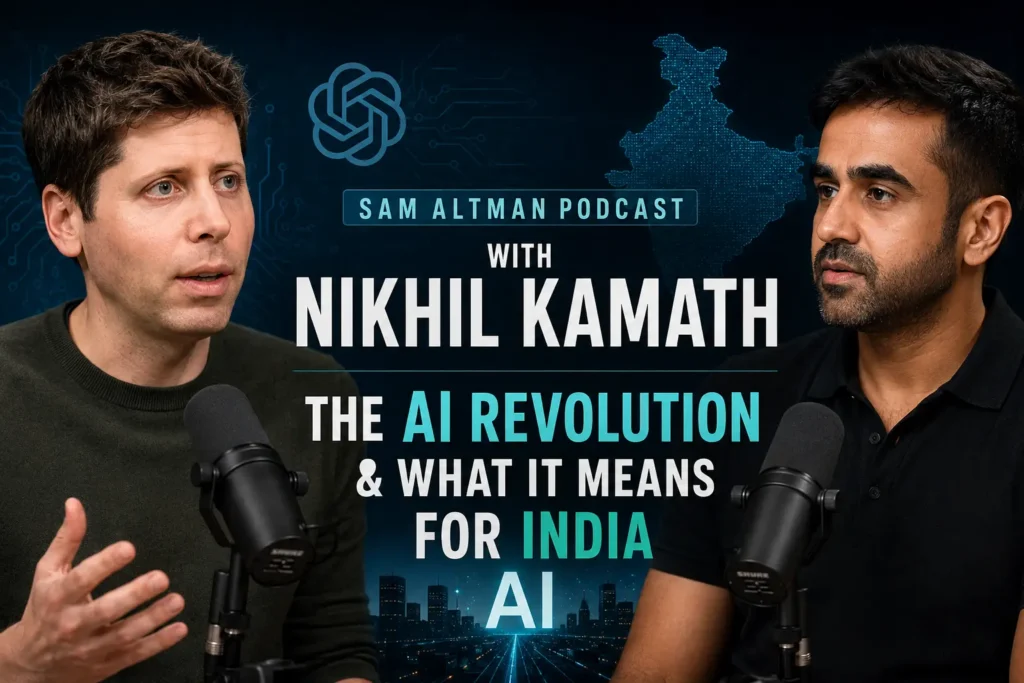
Why he arrived at the WTF is a platform to hold a conversation with Nikhil Kamath, one can only imagine. But the resulting exchange was undoubtedly the most detailed public discussion of AI progress, its risks, its benefits and Indian specificities to have taken place within the Indian public.
Altman has done a number of interviews. But Kamath’s perspective-someone who has started an Indian technology company from scratch, who ponders the country’s economy thoughtfully, and who engages on this topic as a builder rather than a journalist-generated a different conversation. More straightforward, more detail-oriented, and more pragmatic.
The Beginning – What OpenAI Is Actually Building
The dialogue begins with Kamath seeking Altman smooth and simple articulation of what OpenAI aims to achieve – not the official company line but the genuine human aspiration.
Altman’s response is surprisingly candid. Clearly, what OpenAI is concerned with is the development of artificial general intelligence – AI systems that can do anything a human can do intellectually, and, ultimately, anything any other entity can do. They do not want to develop more effective application-specific tools; they want to develop something that is a major step up in terms of intelligence.
He is very aware of how enormously exciting and yet truly perilous this is. Those same technological advances which have the potential to accelerate scientific progress, to provide solutions to climate change, and open up far greater access to expertise for far more people, could also be used in ways which could be extremely damaging. It is about how we navigate that tension that he feels is the core task of his organisation.
The Race to AGI – Why It Matters Who Gets There First
Much of the discussion hinges on one fundamental question: who will reach artificial general intelligence first, and how does it change the world? And Altman’s passionate belief that whoever does so is, “saving everyone in the world that is alive today.”
His position is neither mean-spirited nor nationalistic in a narrow sense. It is principled. He argues that AGI created by organizations that are truly concerned with safety, openness, and general human interest are more likely to create a superior result than AGI created solely out of selfishness..
He discusses the governance issues that arise from this-how do you establish global structures for AI oversight, when the development of the technology outpaces the capacity of political structures to adapt, and how does competitive logic continuously incentivize all companies toward rapid development over safety?
He is not giving answers to these questions. However, the mere fact that he is putting serious thought into these questions and discussing them in a public forum lends the interview an authority many technology interviews lack.
AI and Jobs – The Most Urgent Question
The issue likely to be of greatest concern to most of Kamath’s viewers, namely what AI will mean for employment and economic opportunity is discussed extensively.
Altman is more nuanced. He does not discount the fear that a great deal of current employment will be eliminated – he believes it will be. But his historical comparison is to past waves of technological advance – the agricultural revolution, the advent of industrialisation, the computing age – all of which eliminated categories of job and simultaneously invented others that had not previously existed.
He acknowledges honestly that this transition will be a tough one for many individuals and that the new kinds of work for which we need to prepare them wont necessarily be readily available for everyone who is displaced by automation. He emphasizes the role of education and retraining and social safety nets in helping individuals cope with this transition-and the duty that the companies that build AI have to be involved in these discussions instead of turning them over entirely to governments and society.
This piece is very pertinent for the Indian audience. India will have a huge fresh young workforce joining the labour market in the next few decades. The decisions that we take today on how we use AI, and on how we educate and equip the workforce, will determine whether that demographic dividend becomes a blessing or a curse.
India and AI – The Opportunity and the Urgency
And Altman sounds believable when he talks about India’s potential for this age of AI – with the right amount of reverence, of course, but also with genuine urgency.
He mentions India has such deep technical talent and discusses the size of the Indian market and how India represents an extremely important test case for AI in the developing world, and how Indian AI companies could potentially build products and services not only for India but across the entire south.
He is blunt about the race. There is a limited horizon for achieving AI dominance. Those nations and organizations that must pump money into building talent and infrastructure now will find themselves in a very different place from those that are toing and froing.
His message to Indian entrepreneurs and policymakers is simple-it is already Time to think critically about AI-not as the consumer of some pre-built technology-rather as the participant in the next wave of its creation.
AI Safety – What It Actually Means
Much of this discussion is on AI safety. It is a term that gets thrown around a lot, but few people really know what it means.
Altman describes that AI safety problems are not in fact with what we think of a science-fiction robot nominating ourselves as ruler of the world, but it is to make sure that they turn out right in what they should be doing, that an Ai system is corrigible-inductive corrections, that Ai systems not going for definitions that are out of step with human interests, and that benefits are widely distributed..
He mentions his internal safety research at OpenAI, the problems of testing and assessing AI systems where the performance may dramatically increase in a short period, and the need to establish relationships with governments and international authorities for developing a governance framework that is aligned with the technology.
And he is forthright about the things uncertain including unsure of where his own organization can actually fumble it. This candour more than anything else gets him the credibility that other AI executive interviews lack.
Why This Podcast Matters
The Sam Altman interview is interesting for Indian viewers for one simple reason: AI is not a “they-do-it-in-Silicon-Valley-and-it-will-descend-on-India” phenomenon, but a “you-are-already-having-it” phenomenon. It is happening everywhere – with every decision made today by individual users, companies and governments determining whether India gains the astounding opportunity that AI holds or misses out in remaking the global economy.
Getting to grips with what AI really is, what those developing it really believe in and what the actual dangers and opportunities are can no longer be a choice. It is now vital knowledge for anyone attempting anything over this next decade of work.
About Sam Altman
Sam Altman is the CEO of OpenAI, the leading research organisation developing ChatGPT and the GPT models of AI. He was previously the president of the worlds top startup accelerator Y Combinator. He is generally regarded as one of the most influential people in technology and a leading figure in the current AI revolution.
Sam Altman Social Media Accounts:
Why You Should Watch This Podcast
This episode is a must for anyone trying to figure out where AI is headed, and how it will impact your job, your business, and your country. Altman talks with a surprising openness about the many unknowns (including those that haunt him) and Kamath’s questions are pointed enough to cut through the usual rhetoric.
Conclusion
The Sam Altman interview on Wolf is one of the most important pieces of Nikhil Kamath’s work. It is needed, pressing, and authentic in a manner that most of the AI articles out there are not. For anyone coming to grasp the reality into which they will soon step, it is a must-see.
1. Who is Sam Altman?
Sam Altman is the CEO of Open AI, the company that created ChatGPT and the GPT-4 AI models. He is a major voice in technology worldwide.
2. What’s discussed in the podcast?
We talked about building AGI, the multi-dimensional AI safety landscape, how AI will affect the jobs, the window of opportunity India has in the AI revolution and governance challenges of running a technology that’s growing too fast for the laws of the world to keep up.
3. What did Sam Altman communicate to Indian entrepreneurs?
He urged Indian entrepreneurs and policy-makers to get serious about AI today – not as the recipients of technology built elsewhere, but as its architects.
Watch Full Podcast Here:
Sam Altman Podcast with Nikhil Kamath – The AI Revolution & What It Means for India