|
Getting your Trinity Audio player ready...
|
If for some reason you want to know the truth about how money really works (not the simplified by the books nonsense you are force fed in school, or the blur of what passes for financial media, but the real mechanics behind how wealth is created, consolidated, moved around and eroded there is no one on the planet better than Ray Dalio.)
In 1975, Dalio founded Bridgewater Associates, the world’s biggest hedge fund. He has overseen nearly 50 years of economic highs and lows and global upheaval, during which he has survived numerous financial crises and economic downturns which would have wiped out the vast majority of the investment firms in existence, maintaining an almost unequivocal record in identifying and managing macro-economic forces.
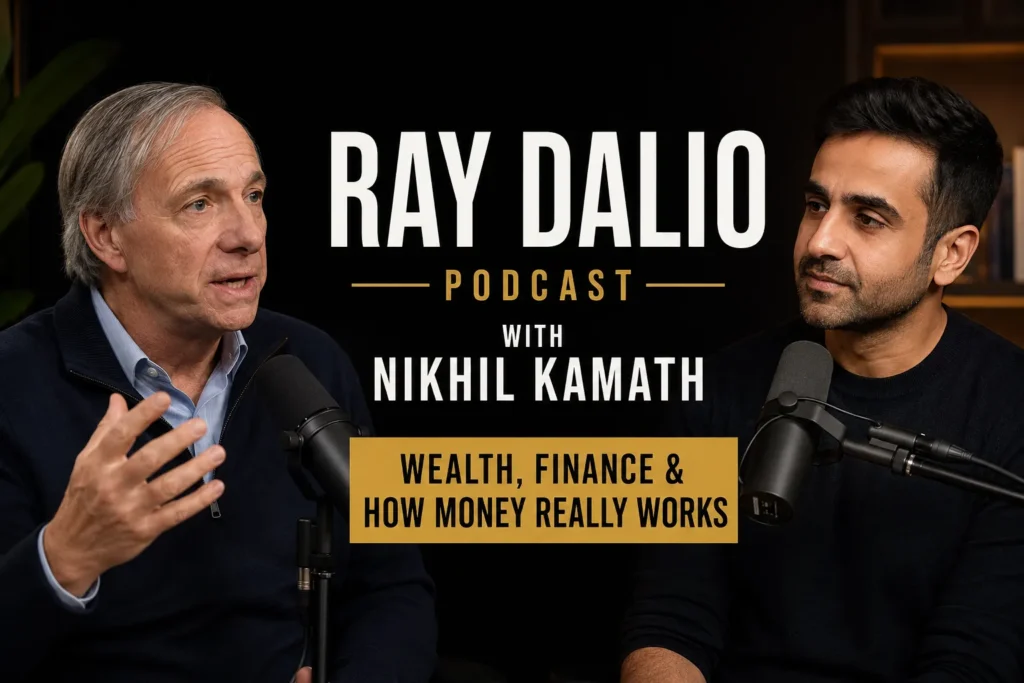
When he appeared on the WTF is Finance series with Nikhil Kamath, the discussion itself was possibly one of the most learned of its kind in Indian finance. Two guys who have accumulated huge fortunes by dint of their own smarts and hard work discussing how the system functions and what people can do to succeed at it.
The Beginning – Why Most People Misunderstand Money
The discussion kicks off with a point by Dalio which frames the rest of the conversation around it, i.e. “most people’s conceptualization around money is fundamentally lacking, and that lack leaves them liable in ways they don’t realize.
What he is revealing is that money is neither just a store of value nor a medium of exchange – rather it is a claim on real goods and services, with the value ultimately measured by the relationship between the quantity of money and the quantity of real goods and services in the economy. When these two discrepancies get out of control, we get chaos.
In this passage he explains the process of money creation by the banking system, through the granting of loans (debt) and subsequent credit system expansion, and the reason, despite being an essential process for growth, for its self-destructing nature that gives birth to financial “bubbles” and crises.
For many in the audience, this was truly enlightening. Few public explanations are as lucid as these about the processes of money creation, and Dalio has that unique talent for explaining what he can while not resorting to oversimplifications.
Asset Bubbles – Why They Form and Why They Always Burst
The article links to one of the main themes of the conversation, namely asset bubbles-their origins, why they are hard to detect in the present, andwhy they ultimately burst.
Dalio opens up the explanation of bubbles by pointing out that bubbles occur when rents on a security break away from their value for the security, causing prices to follow the chase fueled by leverage and the convergence of the crowd. When you see all of your friends making money from an asset, the re-enforcing social pressures to conform and follow the investors-in the peer group becomes overwhelming. None of them want to be left behind and miss out.
The problem, he argues, is that that the very factor that drives prices higher accounts for the severity of the final price correction. The greater leveraged the buyers are at the time of the correction, the more forced selling that will ensue, and the bigger the price decline will be.
He uses examples from history- from the Dutch tulip mania of the 1630s to the global financial crisis of 2008 – to exemplify that this has been the nature of every financial phenomenon in history and would be so regardless of whenever one looks back, as long as our mindsets remain as they are.
The takeaway for the individual investor is not to attempt to call bubbles-practically nobody ever does- but to construct a massively diversified portfolio capable of handling going through corrections without losing everything.
Principles for All-Weather Investing
Much of the discussion revolves around Dalio’s investment approach, his idea of an All Weather Portfolio, designed to do well in a variety of economic conditions.
He says that the majority of investment portfolios are generally more skewed towards risk than clients are aware of. For instance, a portfolio that’s 60 percent equity and 40 percent bond, sounds diversified but is actually far too overweight on equity risks and during a big stock market correction, 40 percent bonds isn’t quite enough.
His method is to consider risk in relation to economic circumstances-upturns, downturns, upturns with inflation, downturns with inflation-and to maintain holdings that do well under each before the alternative climate occurs, so the portfolio is truly balanced across outcomes rather than asset classes.
He argues that this rule applies not only to institutional investors handling billions of dollars, but to anybody trying to construct a retirement nest egg.
The Big Debt Cycle and What It Means for the World Now
Perhaps the most macro-level topic covered in the podcast is what Dalio defines as the Big Debt Cycle-the long-term cycle of debt-addition and deleveraging that takes place over very long periods of time and governs the emergence and decline of economic superpowers.
He discusses the current state of the US – in which it is loaded with levels of debt compared to GDP that have led the other nations to severe strains in the past – and what decisions governments and central banks must make when debt levels are this high.
He is not trying to forecast a particular event. He is not suggesting a crisis is coming but argues that understanding the long cycles gives investors and citizens a framework on which to make better decisions. This pattern in history is clear: debt cycles come to a head. The how remains unanswered:
In the Indian context, this portion of the podcast is more relevant. While India is early in its economy cycle with comparably lesser debt even in the context of the more mature economies. The perspective of the developed economies is an advantage in this situation.
What Individual Investors Should Actually Do
In the course of the episode Nikhil Kamath continually challenges Dalio to distill his high level understanding into actionable tips for the individual investor-and Dalio does so with the typical straightforwardness we expect from him.
Much of his advice is just that-advice. Each investor should maintain a globally diversified portfolio-perhaps more heavily weighted towards emerging markets. Asset classes should be represented in real return terms, (not just currency terms). Investors should be honest with themselves in regard to their risk tolerance. And-never try to time the market.
He also mentions the significance of gold as part of your asset allocation – not because he is expecting it to return the exception, but because it is probably going to most hold value when stocks and bonds are underperforming. For a all-weather portfolio, where that really counts, that can be priceless.
And he’s honest about the risk of one-following the herd: any investment that generates enthusiasm across the mass of investors is almost always a investment that costs the most and provides the lowest forward returns; it takes contrarian skill to save yourself(1) in the long run, you need to be able to think independently and when the evidence suggests, you have to act against the crowd.
Why This Podcast Matters for Indian Audiences
For a lot of Indians, the conversation between Nikhil Kamath and Ray Dalio will be quite meaningful for a few reasons.
India is experiencing an extraordinary era of wealth creation. For the first time, an expanding middle class is entering the financial markets.The mutual fund industry is on a high growth trajectory.A new generation of young Indians is would be investor exploring the world of equities, fixed income, equity substitutes and alternative assets in ways their parents never did.
The majority of these investors are buying into these ‘new’ markets blindfolded since they don’t really understand anything at the core about what actually drives financial markets. They believe in hot performances, Facebook or Twitter recommendations or salespeople who have much to gain from the sale.
Dalio’s theory-a historical, psychologically sincere, and truly curious— rather than predicting-is precisely what those people require.
About Ray Dalio
After its name the first fact is Ray Dalio. The hedge fund was formed in 1975 by Ray Dalio from his New York City apartment. In about a 50-year period of its survival the Bridgewater associates grew up to be the largest hedge fund in the world at the time with its capital at more than $150 billion.
He has written a number of popular books such as Principles, Principles for Navigating Big Debt Crises and The Changing World Order that have been read by investors, policy makers and business men and women all over the world.
He is also a signatory to the Giving Pledge, pledging to give away the majority of his wealth.
Ray Dalio Social Media Account:
Why You Should Watch This Podcast
If you care about your financial future then this episode is a must-see. It is perfect for first-time investors seeking clarity, knowledgeable traders seeking a high level framework to trade by, or just about anyone wanting to understand how the modern financial system really functions.
That’s what Ray Dalio does well, spell out complicated concepts with simplicity, sincerity, without the arrogance that often manifests through the financial education being dished out. And Nikhil Kamath’s questions, sharp enough, threaten to take the discourse where it belongs.
Conclusion
When I think of the best, most educational financial conversations on Indian podcasts, the Ray Dalio episode on WTF is Finance quickly comes to mind. It focuses on the fundamental mechanics of money, debt, and economic cycles behind all the individual financial decisions we make.
To a new generation of Indian investors listening and participating in financial markets ungrounded in those markets’ functioning, what this conversation provides is a way of thinking, not a recipe to follow.
That separation- between knowing and projecting, between models and projections- might be the best thing Ray Dalio has to offer. And this episode lays it out beautifully.
1. Who is Ray Dalio?
Ray Dalio is the founder of bridgewater associates and the world’s largest hedge fund he has also authored some of the best writing on investing and economy such as Principles and The Changing World Order.
2. What is it that the podcast is about?
Our discussion includes the process of currency creation, the causes of asset bubbles and their deflation, the nation-porequity strategy, the Big Debt Cycle, techniques for the private investor.
3. Could beginners do this podcast?
Yes. Dalio is uniquely gifted at making financial concepts clear and understandable. Anyone who has no investing experience will get a lot out of listening to the conversation.
Watch Full Podcast Here:
Ray Dalio Podcast with Nikhil Kamath – Wealth, Finance & How Money Really Works