|
Getting your Trinity Audio player ready...
|
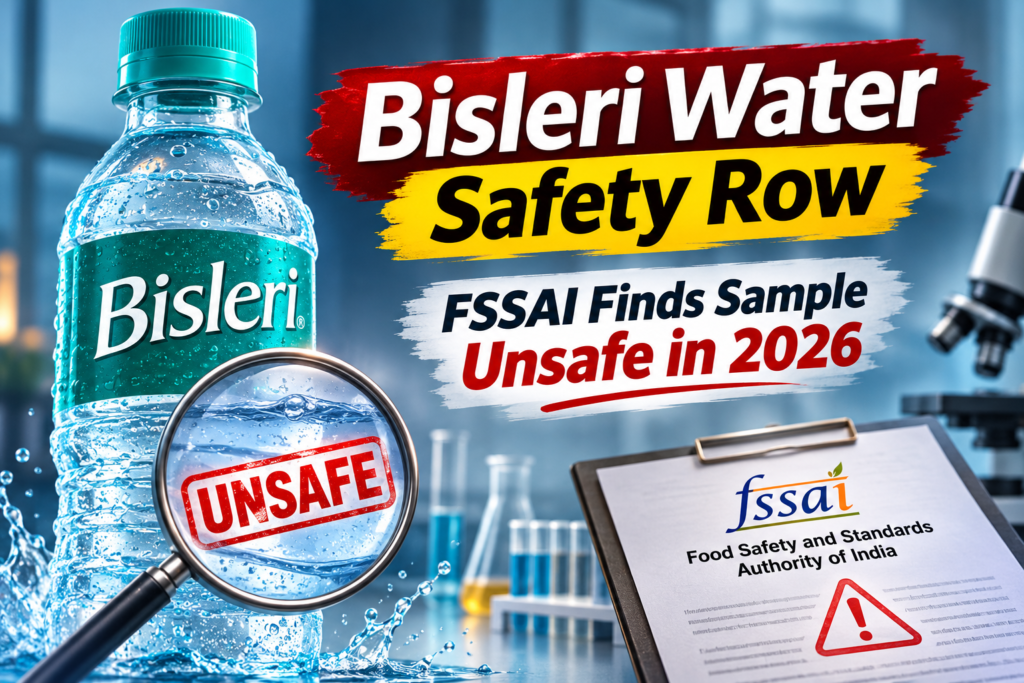
Bisleri, one of India’s most recognised packaged drinking water brands, has come under regulatory scrutiny after the Food Safety and Standards Authority of India (FSSAI) declared a sample of its packaged drinking water unsafe. The development has raised questions about drinking water quality, chemical contamination and the safety standards followed by bottled water manufacturers across the country.
On November 22, 2026, FSSAI announced that it had sanctioned prosecution against Bisleri International Pvt. Ltd. under the Food Safety and Standards Act, 2006. The regulatory action followed laboratory findings involving bromate and Polynuclear Aromatic Hydrocarbons (PAHs) in a packaged drinking water sample collected from the company’s manufacturing premises.
The matter has attracted considerable attention because Bisleri is a widely consumed brand in India, with products available through supermarkets, retail shops, restaurants, hotels and online grocery platforms.
However, the controversy does not mean that every Bisleri bottle sold in India has been declared unsafe. The reported findings concern a specific regulatory sample collected from the company’s Goa manufacturing facility in September 2025. Bisleri has also disputed the findings and maintained that its packaged drinking water is safe for consumption.
The incident has renewed an important discussion about whether packaged drinking water brands are following adequate quality-control procedures and how effectively regulators monitor the products consumed by millions of Indians every day.
What Did FSSAI Find in Bisleri Water?
According to the regulatory information released on November 22, FSSAI collected a sample of packaged drinking water from Bisleri International’s premises for laboratory analysis.
The initial laboratory examination found that the sample did not comply with the prescribed bromate limits. Following this finding, the sample was declared unsafe under the Food Safety and Standards Act, 2006.
Bisleri subsequently appealed against the initial laboratory findings. The sample was then referred to a Referral Food Laboratory for further examination.
According to FSSAI, the referral laboratory also declared the sample unsafe after detecting Polynuclear Aromatic Hydrocarbons (PAHs).
These findings became the basis for the regulator’s decision to sanction prosecution against Bisleri International.
The case involves two different chemical safety concerns:
- Bromate, a chemical by-product that can form during certain water disinfection processes.
- Polynuclear Aromatic Hydrocarbons, a group of chemical compounds that can include substances associated with serious health risks.
The detection of these substances has raised concerns because packaged drinking water is expected to meet strict chemical, physical and microbiological safety requirements before reaching consumers.
Importantly, FSSAI has not publicly released the complete laboratory reports and detailed concentration figures for all the substances involved in the case. Therefore, the available findings should not be interpreted as proof that the entire Bisleri product range is contaminated.
Bisleri Water Report: What Were the Laboratory Findings?
Following the regulatory action, Bisleri issued a statement on November 23, 2026, explaining the background of the case and presenting its version of the laboratory results.
According to the company, the matter dates back to September 30, 2025, when FSSAI collected six water samples from its Goa manufacturing facility.
The company stated that five of the six samples met the applicable standards during the initial testing process. However, the sixth sample recorded a bromate concentration of 12 micrograms per litre, compared with the prescribed limit of 10 micrograms per litre.
This means the initial reported concentration was 20% higher than the permitted threshold.
The following table summarises the information available from the regulator and the company’s statement.
| Particulars | Reported findings |
|---|---|
| Sample collection date | September 30, 2025 |
| Manufacturing location | Bisleri’s Goa facility |
| Total samples collected | 6 |
| Samples initially meeting standards | 5 |
| Sample with initial bromate concern | 1 |
| Initial bromate reading | 12 µg/L |
| Prescribed bromate limit | 10 µg/L |
| Referral laboratory finding | PAHs detected; sample declared unsafe |
| FSSAI action | Sanction for prosecution |
| Bisleri’s position | Disputes findings and maintains product safety |
Source: Bisleri’s November 23 statement and FSSAI’s regulatory announcement.
What Happened After Bisleri Appealed?
Bisleri appealed against the initial findings on November 22, 2025. Following the appeal, the sample was referred to another laboratory for further examination.
The company stated that the referral laboratory found bromate levels within the prescribed limit but separately detected PAHs.
Bisleri subsequently arranged independent testing of the same sample through an FSSAI-approved laboratory. According to the company, this examination also found bromate levels within the permitted limit.
On February 2, 2026, Bisleri submitted the independent laboratory results to FSSAI’s Western Regional Office through a formal letter.
The company claimed that it received no further communication after submitting the results and believed that the matter had been closed.
However, FSSAI announced the prosecution sanction in November 2026, bringing the old laboratory dispute back into the spotlight.
The different laboratory findings and the absence of publicly available complete reports have become important aspects of the controversy.
What Is Bromate and Why Is It Dangerous?
One of the most important chemicals involved in the Bisleri controversy is bromate.
Bromate is a chemical compound that can form during drinking water purification. It is not normally added to packaged drinking water as an ingredient or preservative.
Instead, it can develop as an unwanted by-product when ozone, which is used to disinfect water, reacts with naturally occurring bromide.
Ozone treatment is widely used in water purification because it helps destroy harmful microorganisms, including bacteria and viruses. However, when the treatment process is not properly controlled, the reaction between ozone and bromide can produce bromate.
This creates a challenge for packaged drinking water manufacturers because they must eliminate harmful microorganisms without generating excessive levels of chemical by-products.
What Is the Permissible Bromate Limit in India?
The reported permissible bromate concentration in drinking water is 10 micrograms per litre.
This is equivalent to 10 parts per billion (ppb), meaning only a very small concentration is permitted.
In the Bisleri case, the initial reported reading was 12 micrograms per litre, which exceeded the limit by 2 micrograms per litre.
Although the difference may appear small, drinking water standards are designed to minimise long-term exposure to potentially harmful chemicals.
The World Health Organization (WHO) also recommends a bromate guideline value of 10 micrograms per litre.
Can Bromate Cause Cancer?
Bromate has been classified by the International Agency for Research on Cancer (IARC) as possibly carcinogenic to humans.
This classification is based primarily on evidence from animal studies, where exposure to elevated bromate concentrations was associated with the development of tumours, including those affecting the kidneys and thyroid.
The concern for human health is primarily associated with repeated or prolonged exposure.
However, it is important to understand that a single bottle containing bromate slightly above the prescribed limit does not automatically mean that a consumer will develop cancer or experience immediate health problems.
The risk depends on several factors, including the concentration, duration of exposure and total amount consumed.
The prescribed limits exist to reduce avoidable exposure over time, particularly because drinking water is consumed regularly throughout life.
What Are PAHs Found in the Bisleri Water Report?
Apart from bromate, the second major concern in the Bisleri controversy involves Polynuclear Aromatic Hydrocarbons, commonly known as PAHs.
PAHs are a group of chemical compounds that are generally produced through the incomplete burning of organic materials such as coal, wood, petrol and other fossil fuels.
They can enter the environment through industrial pollution, vehicle emissions, combustion activities and contaminated soil or water.
Some PAHs are considered carcinogenic, while others may cause different health effects depending on their chemical structure and exposure levels.
Why Are PAHs a Concern in Drinking Water?
The presence of PAHs in packaged drinking water is a serious quality-control concern because these substances are not desirable contaminants in water intended for direct human consumption.
Certain PAHs have been associated with:
- Increased cancer risk following prolonged exposure.
- Potential damage to genetic material.
- Adverse effects on the immune system.
- Other toxic effects depending on the specific compound and exposure level.
However, PAHs are a broad chemical group containing several different substances. Their health effects cannot be assessed without knowing exactly which compounds were detected and their individual concentrations.
In the Bisleri controversy, the referral laboratory reportedly detected PAHs, but the complete list of compounds and their measured concentrations has not been publicly disclosed in the available reports.
Therefore, it would be inaccurate to calculate an individual’s cancer risk or claim that drinking a particular Bisleri bottle will cause a specific disease.
What Is Bisleri Saying About the FSSAI Allegations?
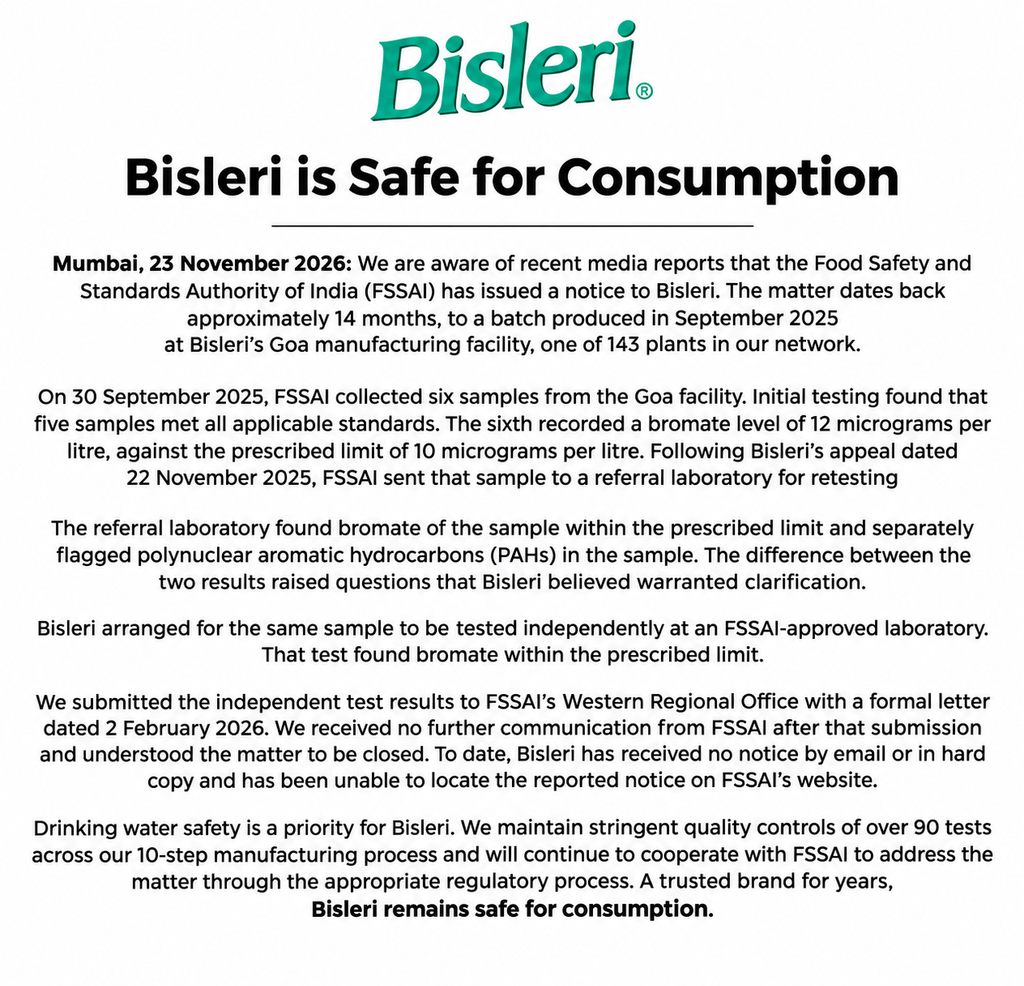
Bisleri International has challenged the regulatory findings and maintained that its packaged drinking water is safe for consumption.
In its November 23, 2026 statement, the company explained that the controversy concerns a batch manufactured in September 2025 at its Goa facility.
The company also highlighted that five out of six samples initially collected by FSSAI met the applicable standards.
Bisleri disputed the bromate findings by referring to subsequent independent laboratory testing, which reportedly found the chemical within the permitted limit.
The company also stated that it conducts more than 90 quality checks through its 10-step manufacturing process.
Another important point raised by Bisleri concerns regulatory communication. The company said it submitted its independent laboratory findings to FSSAI in February 2026 but received no further communication and understood the matter to be closed.
It also claimed that it had not received the reported prosecution notice through email or in physical form.
Bisleri has stated that it will continue cooperating with the regulator and address the matter through the appropriate legal and regulatory process.
The company’s position is important because the laboratory findings are disputed. However, its statements do not independently overturn the regulator’s unsafe-sample determination.
The final outcome will depend on the regulatory process and any subsequent judicial examination of the evidence.
Has FSSAI Banned Bisleri Water in India?
No. The reported action does not amount to a nationwide ban on Bisleri packaged drinking water.
FSSAI has sanctioned prosecution against Bisleri International following the unsafe-sample findings. This means the regulator has approved the initiation of legal proceedings under the Food Safety and Standards Act, 2006.
It is important to distinguish between three different regulatory actions:
1. Unsafe product finding: A particular sample is found to violate applicable food safety requirements.
2. Sanction for prosecution: The regulator approves the legal process to pursue the alleged violation.
3. Product recall or nationwide ban: A specific product or batch may be withdrawn from the market, or a broader restriction may be imposed through the applicable legal process.
These actions are not interchangeable.
Reuters reported, citing a government source, that batches linked to the sample had been recalled and subsequent testing had not identified further quality issues.
However, this does not establish that all Bisleri products or manufacturing facilities have been declared unsafe.
The controversy remains focused on the disputed sample and the regulatory action associated with it.
Will FSSAI Test Other Packaged Drinking Water Brands?
The Bisleri controversy has also raised questions about the quality of other packaged drinking water brands in India.
According to Reuters’ November 22 report, FSSAI plans to widen its checks to include additional samples from Bisleri and other packaged drinking water brands across the country.
This is significant because India has a large packaged drinking water market, with millions of consumers depending on bottled water for daily hydration.
Popular brands such as Kinley, Aquafina, Rail Neer and Bailley also operate in this competitive market.
However, the current Bisleri case does not establish that these brands have similar contamination problems.
Each manufacturer must independently comply with the applicable food safety and packaged drinking water standards.
Wider regulatory sampling can help identify potential problems before contaminated products reach a larger number of consumers.
How Is Packaged Drinking Water Regulated in India?
Packaged drinking water in India is regulated under the Food Safety and Standards Act, 2006, along with the relevant regulations and technical standards.
The Bureau of Indian Standards has also developed IS 14543 for packaged drinking water other than packaged natural mineral water.
This standard covers important quality parameters, including:
- Physical and chemical characteristics.
- Microbiological safety.
- Undesirable substances.
- Toxic substances.
- Radioactive residues.
- Pesticide residues.
- Manufacturing and hygienic requirements.
India also introduced a revised IS 14543:2024 standard, replacing the earlier 2016 version.
Another important regulatory development is the revised FSSAI testing scheme for packaged drinking water and mineral water, which became applicable from January 1, 2026.
The revised regulatory framework strengthens the importance of testing and quality monitoring in the packaged water industry.
Is Bisleri Water Safe to Drink Right Now?
The most important question for consumers is whether they should continue buying Bisleri bottles and 20-litre water jars.
Based on the available information, there is no established evidence that every Bisleri bottle sold across India is contaminated.
The regulatory finding relates to a particular sample collected from the company’s Goa facility in September 2025. Bisleri has disputed the findings and cited subsequent independent testing.
However, consumers should not completely ignore the regulatory concerns.
The presence of potentially harmful chemical contaminants in a drinking water sample is a legitimate food safety issue that requires transparent investigation.
People who regularly purchase packaged drinking water should follow some basic precautions:
- Purchase bottles and jars from authorised and reliable retailers.
- Check the manufacturer’s name, FSSAI licence number and batch details.
- Ensure the cap and safety seal are intact.
- Avoid bottles that have been exposed to excessive sunlight or heat.
- Do not purchase damaged, leaking or suspiciously stored water containers.
- Follow official product recall and food safety advisories.
Consumers should also understand that clear-looking water is not necessarily chemically safe. Bromate and many other chemical contaminants cannot be identified through colour, smell or taste.
Boiling water is also not a reliable method for removing bromate or PAHs.
Anyone concerned about a particular batch can retain its packaging details and contact the manufacturer or the relevant food safety authority.
Bisleri Controversy: What Does This Mean for India’s Bottled Water Industry?
The Bisleri case is more than a dispute involving one packaged drinking water manufacturer. It highlights the importance of independent testing, manufacturing transparency and consumer confidence in India’s bottled water industry.
Packaged drinking water is often purchased because consumers believe it offers a safer alternative to untreated or unreliable water sources.
For many people, especially travellers, office workers, students and households, bottled water has become a regular purchase.
This makes consistent quality monitoring particularly important.
The controversy also highlights a broader challenge in water purification. Treatment technologies such as reverse osmosis, filtration and ozonation are designed to improve water quality. However, manufacturers must ensure that these processes do not introduce unwanted chemical by-products or leave behind contaminants.
A trusted brand name cannot replace independent laboratory testing.
Similarly, a company’s internal quality-control claims should be supported by transparent regulatory compliance and verifiable test results.
The next important development will be whether FSSAI publishes further laboratory information, conducts additional inspections and clarifies the status of the disputed sample.
If broader testing identifies similar problems across multiple manufacturers, the incident could lead to stronger monitoring requirements throughout the packaged drinking water sector.
Conclusion
The Bisleri water controversy has raised legitimate questions about packaged drinking water safety in India.
FSSAI’s decision to sanction prosecution followed laboratory findings involving bromate and PAHs in a sample collected from the company’s Goa facility. The initial reported bromate concentration was 12 micrograms per litre against the prescribed limit of 10 micrograms per litre.
Bisleri, meanwhile, has disputed the findings, referred to subsequent independent testing and maintained that its products are safe for consumption.
At present, the available evidence does not justify declaring every Bisleri bottle in India unsafe. However, the regulatory findings should not be dismissed without proper examination.
Consumers deserve transparent laboratory reports, effective quality checks and clear communication from both manufacturers and regulators.
Ultimately, drinking water safety should never depend only on brand reputation. Every packaged water product must meet the prescribed safety standards, regardless of the company manufacturing it.
FAQs
1. Why is Bisleri water in the news in November 2026?
Bisleri is in the news because FSSAI sanctioned prosecution against the company after a packaged drinking water sample was declared unsafe following laboratory findings involving bromate and PAHs.
2. What chemicals were reportedly found in Bisleri water?
The regulatory findings involved bromate and Polynuclear Aromatic Hydrocarbons (PAHs). Bromate can form during ozone-based water disinfection, while PAHs are a group of environmental chemical contaminants.
3. What was the bromate level found in Bisleri water?
According to Bisleri’s account of the initial laboratory report, the sample recorded 12 micrograms of bromate per litre against the prescribed limit of 10 micrograms per litre. The company subsequently disputed this result.
4. Has FSSAI banned Bisleri in India?
No nationwide ban has been established by the reported action. FSSAI has sanctioned prosecution against Bisleri International over the unsafe-sample findings. This is different from a nationwide product ban.
5. Is Bisleri water safe to drink?
The available findings do not establish that all Bisleri bottles are unsafe. The company maintains that its products are safe, while FSSAI has declared the disputed sample unsafe. Consumers should follow official safety advisories and check product and batch details.
6. Which other bottled water brands are available in India?
Popular packaged drinking water brands in India include Kinley, Aquafina, Rail Neer and Bailley. However, the Bisleri findings do not establish any safety violation involving these brands. Each product must meet applicable quality standards.