|
Getting your Trinity Audio player ready...
|
The Indian automotive industry is in the middle of a major transformation. Over the past few years, electric vehicles (EVs) have gained significant attention as consumers and governments look for cleaner alternatives to traditional petrol and diesel cars. However, despite the growing popularity of EVs, concerns around charging infrastructure, range anxiety, and long-distance travel continue to prevent many buyers from making the switch.
This is where Chinese automaker BYD believes it has found the perfect solution.
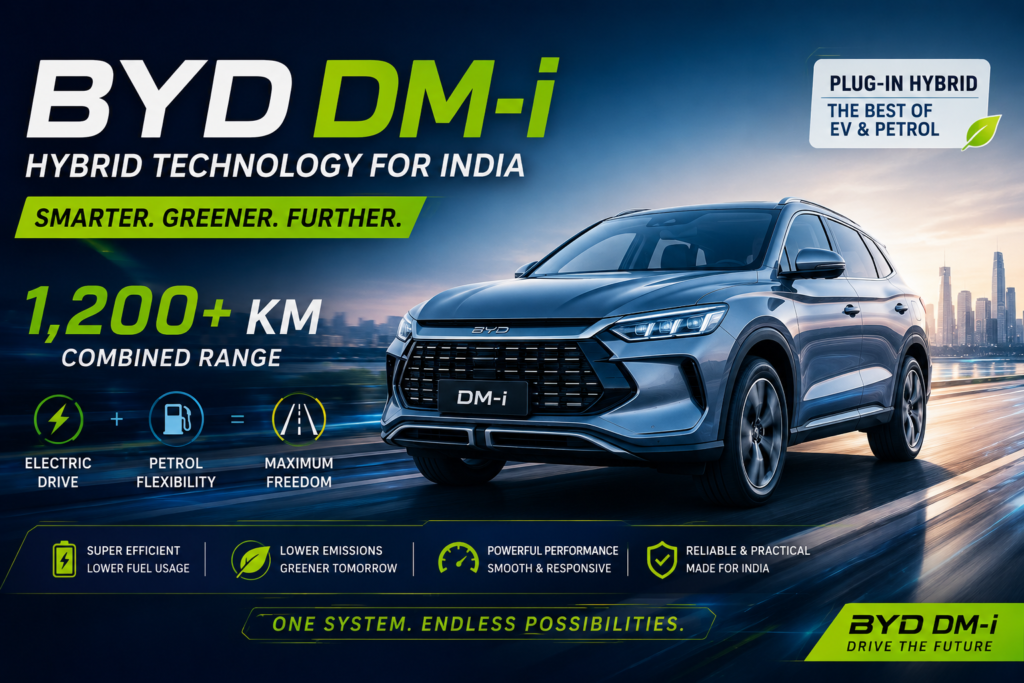
BYD recently introduced its revolutionary DM-i hybrid technology to the Indian market, a system that promises an astonishing driving range of more than 1,200 kilometers on a single tank and charge combination. The technology combines electric mobility with the convenience of a petrol engine, creating a vehicle that offers the best of both worlds.
For Indian consumers who want lower running costs but are not yet ready to rely entirely on charging stations, BYD’s DM-i technology could represent a major turning point. More importantly, it could challenge established hybrid leaders such as Toyota while creating a new category between conventional hybrids and fully electric vehicles.
As India’s automobile sector moves toward a greener future, BYD’s arrival with DM-i technology raises an important question: Is this the hybrid solution Indian buyers have been waiting for?
- Understanding BYD's DM-i Technology
- Why DM-i Is Different from Conventional Hybrids
- The 1,200 km Range Claim
- Solving India's Biggest EV Challenge
- Why India Is an Ideal Market for DM-i
- BYD's Growing Presence in India
- Competition: Can BYD Challenge Toyota?
- The Environmental Impact
- Potential Challenges
- What This Means for India's EV Future
- Could Plug-In Hybrids Become Mainstream?
- FAQs
Understanding BYD’s DM-i Technology
DM-i stands for “Dual Mode Intelligent,” BYD’s advanced plug-in hybrid electric vehicle (PHEV) system designed to maximize efficiency while maintaining practicality.
Unlike traditional hybrid systems, where both the petrol engine and electric motor frequently share propulsion duties, BYD’s DM-i technology primarily relies on electric power for driving.
The petrol engine serves a different role. Instead of constantly powering the wheels, it often functions as a generator that recharges the battery when necessary. This approach allows the vehicle to behave much more like an electric car during daily driving while eliminating concerns about battery depletion during longer journeys.
The result is a highly efficient system capable of delivering impressive fuel economy and exceptional driving range.
This strategy has already proven successful in China, where BYD has become one of the world’s largest manufacturers of new energy vehicles.
Why DM-i Is Different from Conventional Hybrids
Many consumers are familiar with hybrid vehicles from brands such as Toyota and Honda. These systems combine an internal combustion engine with an electric motor to improve fuel efficiency.
However, BYD’s DM-i system takes a significantly different approach.
In conventional hybrids, the petrol engine remains the primary power source in many driving situations. The electric motor assists when necessary, particularly during low-speed operation or acceleration.
With DM-i technology, the electric motor becomes the dominant source of propulsion.
For most urban driving conditions, the vehicle operates much like a fully electric car. The petrol engine intervenes mainly to generate electricity or assist during demanding conditions.
This distinction creates several benefits:
Drivers experience smoother acceleration, quieter operation, and lower fuel consumption while still retaining the flexibility of a conventional fuel tank.
The overall driving experience feels closer to an EV than a traditional hybrid.
The 1,200 km Range Claim
Perhaps the most attention-grabbing aspect of BYD’s DM-i technology is its claimed driving range of more than 1,200 kilometers.
For context, most electric vehicles currently available in India offer ranges between 300 and 600 kilometers per charge. While this is sufficient for daily commuting, long-distance travel often requires careful route planning and charging stops.
DM-i vehicles significantly reduce this concern.
The combination of a large battery pack and an efficient petrol engine enables extremely long journeys without frequent refueling or recharging.
For Indian drivers who regularly travel between cities or cover significant distances for work, this capability could prove highly attractive.
A 1,200 km range means a driver could potentially travel from Delhi to Mumbai with minimal interruptions, something that remains challenging for many pure electric vehicles.
Solving India’s Biggest EV Challenge
Range anxiety remains one of the biggest barriers to EV adoption in India.
Although charging infrastructure is improving rapidly, many regions still lack adequate public charging facilities. This issue becomes even more significant in rural areas and smaller towns.
DM-i technology addresses this challenge directly.
Because the vehicle can continue operating using its petrol-powered generator, drivers do not need to worry about locating charging stations during every journey.
This flexibility may encourage consumers who are interested in electric mobility but remain hesitant about depending entirely on charging networks.
For many buyers, DM-i could serve as a bridge between conventional combustion engines and fully electric vehicles.
Why India Is an Ideal Market for DM-i
India presents a unique opportunity for plug-in hybrid technology.
The country’s automotive landscape is characterized by diverse driving conditions, varying infrastructure quality, and highly cost-conscious consumers.
Urban residents may benefit from electric-only driving during daily commutes, while rural and highway users can take advantage of the extended range provided by the hybrid system.
Furthermore, fuel prices continue to fluctuate, making efficiency an increasingly important consideration for buyers.
DM-i’s ability to dramatically reduce fuel consumption while maintaining flexibility could make it particularly appealing to Indian consumers.
Unlike some developed markets where charging infrastructure is already widespread, India remains in a transitional phase. Plug-in hybrids may therefore play an important role in accelerating the shift toward cleaner mobility.
BYD’s Growing Presence in India
BYD has steadily expanded its footprint in India over the past few years.
Initially recognized for its electric buses and commercial vehicles, the company later entered the passenger vehicle market with models such as:
- BYD Atto 3
- BYD Seal
- BYD eMAX 7
These products helped establish BYD as a serious competitor in India’s emerging EV segment.
The introduction of DM-i technology represents the company’s next strategic move.
Rather than focusing solely on fully electric vehicles, BYD is now targeting consumers who seek efficiency without sacrificing convenience.
This broader approach could significantly expand the company’s potential customer base.
Competition: Can BYD Challenge Toyota?
Toyota has long been regarded as the leader in hybrid technology.
Models such as the Toyota Camry Hybrid and Urban Cruiser Hyryder have helped popularize hybrid vehicles in India.
However, BYD’s DM-i technology introduces a new level of competition.
While Toyota’s systems prioritize fuel efficiency, BYD emphasizes electric-first driving combined with extended range.
This distinction could appeal to buyers who want a more EV-like experience.
The competition between Toyota’s proven hybrid expertise and BYD’s innovative plug-in hybrid technology may ultimately benefit consumers through better products and faster innovation.
The Environmental Impact
Reducing emissions remains a major objective for governments worldwide.
Although fully electric vehicles produce zero tailpipe emissions, widespread adoption depends on infrastructure development and energy availability.
Plug-in hybrids offer an intermediate solution.
By enabling significant electric-only driving, DM-i vehicles can substantially reduce fuel consumption and emissions compared to conventional vehicles.
For urban commuters who travel relatively short distances each day, petrol usage may become minimal.
This could contribute to cleaner air quality while supporting India’s broader sustainability goals.
Potential Challenges
Despite its advantages, DM-i technology is not without challenges.
One concern is pricing.
Advanced hybrid systems often cost more than conventional petrol vehicles due to the inclusion of batteries, electric motors, and sophisticated control systems.
Indian consumers remain highly price-sensitive, meaning BYD must carefully position its products.
Government policies may also influence adoption rates. Incentives have traditionally favored fully electric vehicles, and future regulations could impact the attractiveness of plug-in hybrids.
Another challenge involves educating consumers.
Many buyers remain unfamiliar with plug-in hybrid technology and may require greater awareness regarding charging practices, maintenance, and operational benefits.
What This Means for India’s EV Future
The arrival of DM-i technology highlights an important reality: the future of mobility may not be entirely electric overnight.
While EV adoption continues to grow, the transition will likely involve multiple technologies working together.
Battery electric vehicles, hybrids, plug-in hybrids, and alternative fuels may all contribute to reducing emissions during the coming decades.
BYD’s DM-i system demonstrates that innovation can address many of the concerns preventing consumers from embracing cleaner transportation.
If successful, it could encourage other manufacturers to introduce similar technologies tailored to Indian conditions.
The result could be greater competition, improved efficiency, and faster progress toward sustainable mobility.
Could Plug-In Hybrids Become Mainstream?
Industry experts increasingly believe that plug-in hybrids could play a crucial role during the next phase of automotive evolution.
They provide a practical solution for markets where charging infrastructure is still developing while offering many of the benefits associated with electric driving.
For India, this balance may prove particularly valuable.
Consumers want cleaner vehicles, but they also require affordability, convenience, and flexibility.
DM-i technology attempts to satisfy all three requirements.
Whether it becomes a mass-market success will depend on pricing, consumer awareness, government policy, and BYD’s execution strategy.
However, the technology undoubtedly introduces an exciting new option into India’s rapidly evolving automotive landscape.
Conclusion
BYD’s DM-i hybrid technology arrives at a pivotal moment for the Indian automobile industry. With its electric-first approach, impressive efficiency, and claimed range exceeding 1,200 kilometers, the system offers a compelling alternative to both traditional hybrids and fully electric vehicles.
For consumers concerned about charging infrastructure yet eager to reduce fuel expenses, DM-i could provide the ideal balance between sustainability and practicality.
While challenges remain, including pricing and market education, BYD’s latest innovation has the potential to reshape conversations around hybrid mobility in India.
As the country moves toward a greener future, DM-i technology may prove that the journey to electrification does not have to happen in a single leap.
FAQs
What is BYD DM-i technology?
BYD DM-i is a plug-in hybrid electric vehicle system that primarily uses electric power for driving while utilizing a petrol engine to generate electricity and extend range.
How much range does BYD DM-i offer?
BYD claims that its DM-i technology can deliver a combined driving range of over 1,200 kilometers under ideal conditions.
How is DM-i different from traditional hybrids?
Unlike conventional hybrids, DM-i prioritizes electric driving and uses the petrol engine mainly as a power generator rather than the primary source of propulsion.
Is DM-i better than a fully electric vehicle?
It depends on the user’s needs. DM-i offers greater flexibility and eliminates range anxiety, while fully electric vehicles provide zero tailpipe emissions.
Will BYD launch DM-i vehicles in India?
BYD has introduced the technology in India and is expected to evaluate market opportunities for future DM-i-powered models.
Can DM-i help increase EV adoption in India?
Yes. By reducing concerns related to charging infrastructure and range anxiety, plug-in hybrids like DM-i could encourage more consumers to transition toward electrified mobility.