|
Getting your Trinity Audio player ready...
|
Chetan Bhagat is one of the most unusual success stories of contemporary Indian culture. He comes from IIT Delhi and IIM Ahmedabad, the best possible schools in the country, went on to become an investment banker at Goldman Sachs in Hong Kong, and then quit everything to become a writer of novels aimed at the young Indian population, a demographic that had hitherto not seen itself represented in fiction.
His decision appeared crazy to everyone around him. Conventional Indian career thinking placed investment banking and fiction writing at almost opposite ends of the status/income continuum. Yet, his debut novel Five Point Someone became one of the most successful English language novels in Indian publishing history and he has gone on to become one of the most-read writers in the country.
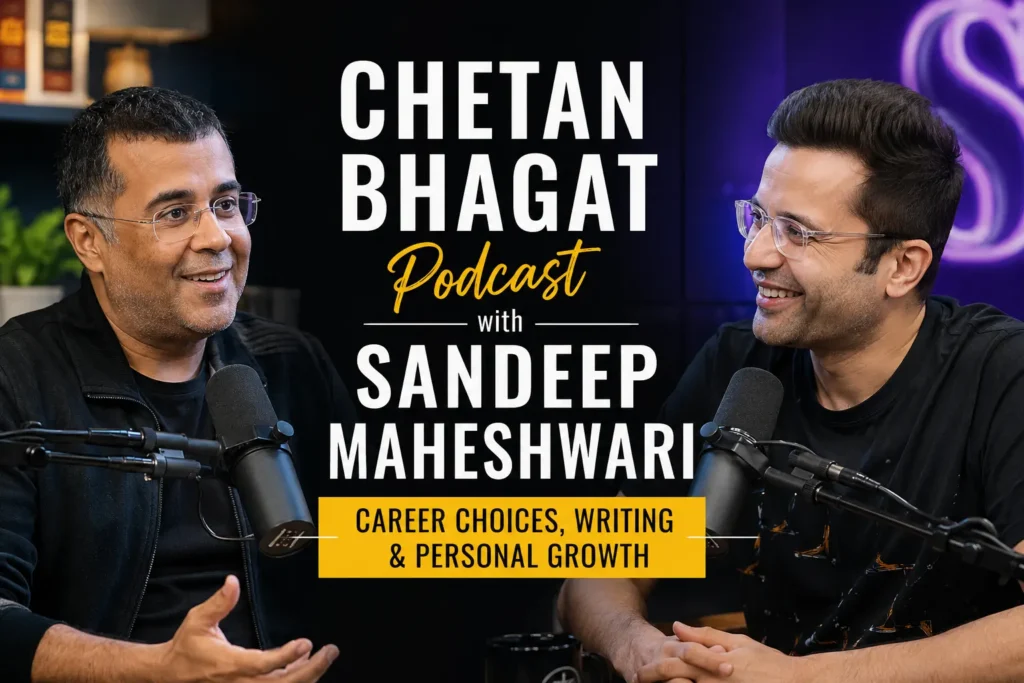
His discussion with Sandeep Maheshwari traces in some detail what goes into taking unexpected decisions, carving out a creative profession and self-growth through creation.
The Beginning – From IIT to Bestseller
The opening of the podcast sees Chetan Bhagat discuss the path from engineering to banking to writing and, more importantly, the internal journey he was going through below the radar of those external decisions.
He discusses a feeling of alienation at IIT, even though he was one of the brightest students in India at a prestigious academic institution – it felt like he was just playing a part, even as he excelled.
Investment banking added money to this core alienation – on the surface he was doing perfectly, and yet he was deeply unhappy.
The act of writing simply came from realizing there are no books on what it’s like to be a young Indian from the inside out as I know it to be. And so he just wrote the book that he felt was needed. There was no thought about it making any money.
Sandeep Maheshwari immediately resonated with this as the underlying truth to countless life stories, the ability to act on the inner signal regardless of the external signals is the root of real work.
Writing – What It Actually Is
Arguably the most interesting part of the conversation is Chetan Bhagat’s candid insight into the craft of writing – far more candid than is typical in such conversations.
He addresses the feeling of being exposed by putting the contents of your interiority into a text which hundreds of thousands will then read and assess. He explains the craft of fiction requires digging into areas that we normally try very hard to keep private; our fears, obsessions and experiences we have not come to terms with. He contends that the books that are most impactful are ones where the author is brave enough to lay down their honest feelings about something personally difficult to write about.
Bhagat also touches on the skill of construction and the long development of an ability to tell a story with a gripping flow from start to finish. The common image of creativity portrays it as solely a phenomenon driven by inspiration; however, Bhagat states the exact opposite is true: ‘inspiration is sparse, discipline is omnipresent.’ Good writing, in this context, is about working through even when it doesn’t feel inspired.
Maheshwari relates his own story creation, and points out that the work that helped most people is rarely the work in which he felt most inspired when he created it, but where he was most authentic and deliberate.
Career Choices – The Pressure Young Indians Face
A large part of the conversation revolves around the particular pressures young Indians are under to make particular career choices – a subject both the speakers have thought very deeply about from their own experiences, and from observing and interacting with millions of young Indians.
Chetan Bhagat refers to the excessively narrow, engineering-medicine-management view of a successful career that pervades Indian middle-class thinking – and how the rest of us pay through the nose, when millions of young people have actual aptitudes and interests outside that limited definition.
He is quick to avoid framing alternative career paths as universally better. Not everyone who quits a “safe” course for something that feeds his soul has a Chetan Bhagat story to tell. There are millions of young people who jump into unconventional careers based on impulses rather than foresight and suffer for it.
His argument is more measured – the career decision framework needs to be more nuanced than either blindly following parents, or passionately following dreams without preparation. The question isn’t just “what do you love”, but “what is it that you actually can build on, and are willing to slog through to develop?”.
Creativity – Something Everyone Has
Arguably one of the most relatable parts of the podcast to the general public is Chetan Bhagat’s point that creativity isn’t the gift of artists and writers alone, but an essential human capacity that the majority of people have learned to suppress.
He describes how convergent thinking-finding the one “right” answer to the clearly framed problem-which dominates much of the Indian educational system, trains divergent thinking-the very definition of creativity-out of people. By the time people have finished school, their creativity has atrophied due to neglect.
The problem, he argues, can be rectified like most other capacities through practice, not to the level of producing art for public consumption perhaps, but to the level that it may contribute to a richer and more engaging work and personal life: fresh insights, unique connections, ways of relating that inform and enthrall rather than simply pass over.
Sandeep Maheshwari expands upon this with the concept of self-expression as authenticity-an individual who is capable of sharing what they think and feel, in whatever manner suits them best, lives a richer life than the one who only knows how to perform the functions expected of him or her.
Personal Growth – The Work That Never Ends
The most reflective part of the conversation is about personal development, and both participants are frank in admitting it’s genuinely hard, genuinely never ending, and seldom as straightforward as the self-help gurus would have us believe.
Chetan Bhagat discusses the blind spots success can impose. He says that it becomes harder to develop further after you’ve accomplished something important, simply because you are already who you are. He discusses the significance of having the beginner’s mind. He stresses how vital it is to remain willing to be wrong, and be courageous enough to revise things you once truly believed but which might not be true for you anymore.
Sandeep Maheshwari echoes this by stressing that real development involves being willing to feel uncomfortable, something people generally try and avoid; comfortable insights don’t generally tend to alter people deeply.
About Chetan Bhagat
Chetan Bhagat is a leading Indian author, columnist, and screen writer. Bhagat graduated from IIT Delhi and IIM Ahmedabad and was a successful investment banker until he quit the industry to start writing professionally. Five Point Someone, 2 States, and Half Girlfriend are a few of the ten novels by him which have already achieved total sales of tens of millions and several major Bollywood films have already been made on his books. He is one of the biggest selling authors of the 21st century and the most widely read author in the English language in India’s history.
Chetan Bhagat Social Media Account:
- Chetan Bhagat Instagram Account
- Chetan Bhagat Twitter/X Account
- Chetan Bhagat Facebook Page
- Chetan Bhagat Website
Why You Should Watch This Podcast
This is a crucial episode for students and young professionals struggling to figure out their career path, for all aspiring writers and creators trying to decipher what a creative career entails, and frankly, for anyone who has ever struggled between what the world expects and what you feel compelled to create.
Conclusion
The Chetan Bhagat and Sandeep Maheshwari conversation is one of the most insightful conversations about creativity, careers and self-development in the Indian digital space. They put into question most people’s assumptions about how they should build successful careers and provide, instead, a far more realistic and practical way for them to go about making life-decisions.
1. Who is Chetan Bhagat?
Chetan Bhagat is among India’s best-selling authors. An IIT and IIM graduate and a former investment banker, he gave up his corporate career to pen a string of novels that have become national best-sellers, sold in millions, and been turned into some of Bollywood’s most successful movies.
2. What topics does the podcast touch upon?
The conversation touches on career decisions, the craft of writing, creativity as an ability every human possesses, self-development, and the importance of audacity when dealing with uncharted territory.
Watch Full Podcast Here:
Chetan Bhagat Podcast with Sandeep Maheshwari – Career Choices, Writing & Personal Growth