|
Getting your Trinity Audio player ready...
|
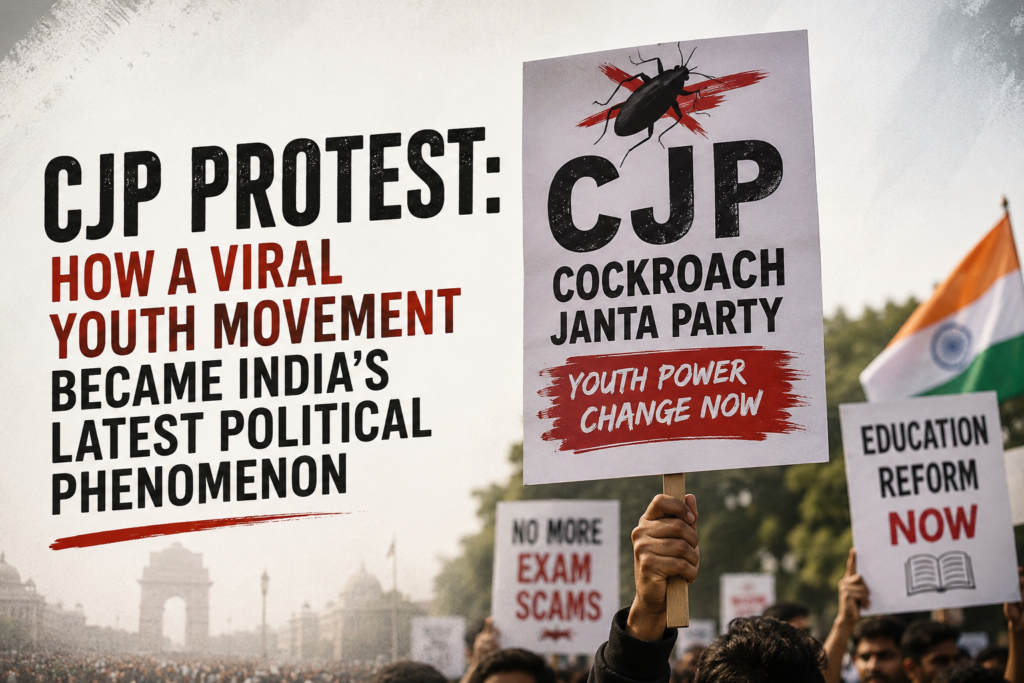
India has witnessed numerous student movements, youth-led campaigns, and political protests over the decades. However, few have emerged as quickly and captured public attention as the recent CJP Protest. What began as an internet-driven movement transformed into one of the most discussed youth-led campaigns in the country, attracting millions of followers and generating nationwide debate.
The Cockroach Janta Party (CJP), initially viewed as a satirical online movement, rapidly evolved into a platform through which students and young professionals voiced concerns about education, examinations, employment opportunities, and governance. The movement gained extraordinary momentum across social media, particularly among Generation Z, eventually leading to a large-scale protest at Jantar Mantar in New Delhi. The protest’s central demand focused on accountability within India’s education system and called for reforms in examination processes that many students believe have become increasingly unreliable.
As the movement continues to grow, many observers are asking whether the CJP Protest represents a temporary online trend or the beginning of a larger youth-driven political awakening in India.
The Origins of the CJP Movement
The story of the Cockroach Janta Party is unlike that of traditional political organizations. It did not emerge from established political circles, student unions, or ideological groups. Instead, it began online through memes, satire, and social commentary that resonated with frustrated young Indians.
The movement was founded by Abhijeet Dipke, who transformed what started as a humorous concept into a powerful social media movement. Within a remarkably short period, CJP attracted millions of followers who identified with the frustrations being expressed regarding unemployment, educational challenges, and perceived institutional failures. Reports indicate the movement accumulated more than 22 million followers on Instagram, making it one of the fastest-growing youth-led digital movements in India.
The name “Cockroach Janta Party” itself became symbolic. Supporters embraced the label as a representation of resilience and survival despite difficult circumstances. What could have been dismissed as internet humor quickly became a serious platform for civic engagement.
Why Students Joined the Movement
The success of the CJP Protest cannot be understood without examining the concerns that motivated young Indians to participate.
In recent years, examination controversies have repeatedly dominated national headlines. Allegations involving examination leaks, administrative irregularities, scoring disputes, and logistical failures have led many students to question the fairness of competitive examinations.
The CJP movement positioned itself as a voice for these concerns. It highlighted issues surrounding examinations such as NEET, CUET, CBSE-related controversies, and other recruitment examinations that directly impact millions of students and job seekers. Many participants felt that their futures were increasingly dependent on systems that appeared vulnerable to errors and irregularities.
For many young people, the protest became about more than examinations. It evolved into a broader discussion about transparency, accountability, and opportunities available to India’s youth.
The Road to Jantar Mantar
As online support increased, organizers decided to take the movement beyond social media.
The decision to hold a protest at Jantar Mantar marked a critical turning point. Jantar Mantar has historically served as one of India’s most significant public spaces for demonstrations and civic activism. Organizing a protest there signaled that CJP intended to become a real-world movement rather than remain confined to digital platforms.
Ahead of the event, organizers released detailed instructions encouraging participants to maintain discipline, remain peaceful, carry books and the national flag, and avoid confrontation. Supporters were repeatedly urged to focus on constructive civic engagement rather than political conflict.
These preparations helped portray the protest as a serious public demonstration rather than an internet spectacle.
The Main Demands of the Protest
The protest centered on several demands related to India’s education system.
One of the most visible demands was the resignation of Union Education Minister Dharmendra Pradhan. Organizers argued that repeated controversies surrounding examinations required greater accountability from leadership. Protesters also sought stronger safeguards against examination irregularities and called for reforms designed to improve transparency and fairness.
Beyond immediate political demands, participants emphasized the need for long-term educational reforms. Many students expressed concerns about the growing pressure associated with competitive examinations and the consequences of administrative failures.
The movement’s messaging suggested that educational reforms should prioritize student welfare and restore public trust in examination systems.
Government and Police Response
As the protest gained attention, questions emerged regarding permissions and security arrangements.
Delhi Police eventually granted permission for the protest at Jantar Mantar, while implementing extensive security measures to maintain order. Authorities monitored developments closely due to the large number of supporters expected to attend.
The heightened attention surrounding the protest reflected the movement’s rapid growth and the possibility that it could attract participants from across India.
Security preparations became a significant news story in themselves, demonstrating how seriously officials viewed the event.
The Role of Social Media
One of the most fascinating aspects of the CJP Protest is its relationship with social media.
Unlike traditional political movements that rely heavily on organizational structures, CJP leveraged digital platforms to mobilize supporters. Memes, short videos, viral campaigns, and online discussions helped spread its message to millions of users.
The movement’s ability to communicate in a language familiar to Generation Z proved particularly effective. Instead of formal political messaging, it used humor, relatability, and direct engagement to build a community.
This digital-first strategy enabled rapid growth and helped transform online frustration into real-world participation.
Support from Public Figures
The movement received attention from several public figures and activists.
Among the most notable supporters was Sonam Wangchuk, who publicly expressed support for the protest. Reports indicated that he planned to participate and even warned of a prolonged hunger strike if key organizers were detained.
Support from well-known figures helped bring additional credibility and media attention to the movement.
It also expanded the conversation beyond examination-related concerns to broader discussions about governance and youth participation in democracy.
Why the CJP Protest Matters
The significance of the CJP Protest extends beyond its immediate demands.
India is one of the youngest countries in the world, with a substantial proportion of its population under the age of thirty. This demographic reality means that issues affecting students and young job seekers have enormous social and political implications.
The protest highlighted a growing desire among young citizens to participate in public discourse and demand accountability from institutions. Whether or not all of the movement’s demands are fulfilled, the event demonstrated the power of digitally connected youth communities.
It also revealed how social media can transform public sentiment into organized civic action.
Challenges Facing the Movement
Despite its popularity, the movement faces several challenges.
Maintaining momentum beyond a single protest will be difficult. Many viral movements struggle to convert public attention into lasting organizational influence.
Additionally, critics argue that online popularity does not necessarily translate into effective policymaking or political success.
The movement will likely need to develop clear strategies, leadership structures, and long-term objectives if it hopes to sustain its impact.
At the same time, supporters believe that the protest has already achieved one important objective: bringing youth concerns into the national conversation.
Conclusion
The CJP Protest represents one of the most unique youth-led movements India has witnessed in recent years. Emerging from internet culture and evolving into a nationwide campaign, it demonstrated the growing influence of digitally connected citizens.
What began as satire became a serious platform for students seeking accountability, transparency, and educational reform. The protest at Jantar Mantar symbolized a new form of activism in which social media communities can rapidly organize around shared concerns and bring them into the public sphere.
Whether the movement ultimately reshapes policy or remains a symbol of youth frustration, its impact on public discourse is undeniable. The CJP Protest has already shown that India’s younger generation is willing to raise its voice, challenge institutions, and demand a greater role in shaping the country’s future.
FAQs
What is the CJP Protest?
The CJP Protest is a youth-led demonstration organized by the Cockroach Janta Party, focusing on education reforms and examination-related concerns.
Who founded the Cockroach Janta Party?
The movement was founded by Abhijeet Dipke, who initially built the organization through social media platforms.
Why was the protest held at Jantar Mantar?
Jantar Mantar is one of India’s most recognized locations for public demonstrations and civic activism.
What were the main demands of the protest?
Participants demanded greater accountability in the education system, examination reforms, and the resignation of the Union Education Minister.
Why has the CJP movement become popular?
The movement gained popularity by addressing concerns shared by many students and young professionals while effectively using social media to spread its message.