|
Getting your Trinity Audio player ready...
|
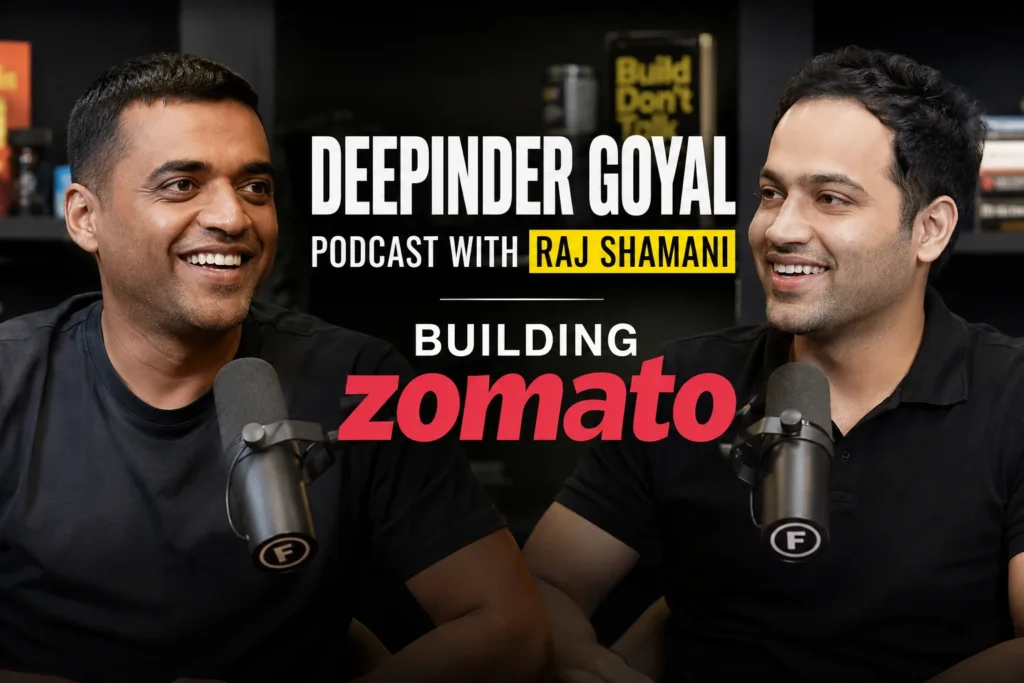
Meet Deepinder Goyal who recently joined Raj Shamani’s podcast for a mindblowing startup discussion.
In contrast to motivational business podcasts that highlight only success stories, we got to hear the faces behind one of the biggest technology firms in India.
The episode covered:
- The rise of Zomato
- Startup pressure
- Funding challenges
- Leadership
- Scaling businesses
- Competition
- Failure and criticism
- Decision-making during difficult phases
This podcast seemed very real and down to earth for millions of young Indians wanting to venture and start up.
Zomato is now India’s most popular food delivery service, however the story of how it was built is one of uncertainty, cost pressure and hard business decisions.
At the same time, Goyal was honest about how entrepreneurship can be a lot more emotionally draining than most of us think.
That honesty proved to be the most powerful reason behind the podcast striking a chord with entrepreneurs, startup founders, and business lovers.
- Who Is Deepinder Goyal?
- The Beginning of Zomato
- The Struggles Behind Startup Growth
- Competition in the Food Delivery Industry
- Leadership and Decision-Making
- Funding, Growth, and Financial Pressure
- Raj Shamani's Interview Style
- Why Young Entrepreneurs Connected With This Podcast
- Key Lessons From the Podcast
- Impact of the Podcast
- Final Thoughts
Who Is Deepinder Goyal?
Deepinder Goyal is the founder and CEO of Zomato, among India’s largest online restaurant search & food ordering services.
Before Zomato, Deepinder used to work in some regular corporate job. When he used to work there, he observed a simple yet irritating problem that no office worker can tolerate – the restaurant menus are difficult to find when ordering food.
From this little observation Zomato was born.
What started off as a basic menu-scanning website eventually became India’s single biggest technology startup.
Today, Zomato at a huge scale changed the way millions of Indians around the world find restaurants and order food online.
But even during the podcast, it was evident that it wasn’t a walk in the park for the duo.
The Beginning of Zomato
One of the most intriguing parts of the discussion was learning how Zomato got its start.
Deepinder said, the way we built the company wasn’t one of a huge business plan. This started by solving small problems from the real world.
At the beginning, the idea was straightforward:
Supply menus online so they are freely available.
The adoption of smartphones and digital food platforms was just starting in India during this period. The startup ecosystem was one-tenth of what it is today.
But Deepinder understood that convenience would be tremendously important later on.
Such skill in predicting consumer behavior in advance was ultimately among the major factors leading to growth of Zomato’s business.
He also addressed the way early-stage startup ideas grow into large companies, caused by entrepreneurial teams becoming intimate with what their potential customers need, within the course of the podcast.
The Struggles Behind Startup Growth
Nothing resonated stronger than the emotional burden of entrepreneurship, as present in the podcast.
Social media often glamorizes startup culture by showing:
- Funding announcements
- Billion-dollar valuations
- Luxury lifestyles
- Rapid growth stories
Want to know the ugly truth about building companies? Deepinder Goyal will tell you.
He explained how entrepreneurs constantly deal with:
- Stress
- Uncertainty
- Financial pressure
- Competition
- Criticism
- Fear of failure
This honesty made the dialogue highly applicable for startup founders and the youth entrepreneurship.
Instead of trying to glamorize entrepreneurship 24/7, the podcast showed what it’s like to go through the intense emotional ups and downs of trying to create something from nothing.
Competition in the Food Delivery Industry
The food delivery business is one of the most competitive businesses in India.
On the podcast, Deepinder mentioned how tough it was for Zomato to make it through high market competition.
Food delivery companies operate in a highly complex environment involving:
- Logistics
- Technology
- Customer experience
- Delivery operations
- Restaurant partnerships
- Pricing pressure
Due to competition, Zomato was forced to continually evolve and adapt.
The above discussion has pointed out how startups always have to innovate due to the high change in the market.
One takeaway from this section was that top notch companies always learn and get better.
Leadership and Decision-Making
The leadership was the other central theme discussed in the podcast.
Deepinder Goyal described the tough decisions entrepreneurs frequently face with limited data.
Founders are always uncertain and in many cases decisions are made around high risk.
- He discussed:
- Managing teams
- Handling pressure
- Building company culture
- Staying calm during crises
- Taking responsibility for failures
What was very valuable in this piece of the conversation was to prove that leadership is not only a matter of confidence – it is also equal to emotional strength and to making the right decisions when you are under pressure.
The podcast demonstrated that to successfully develop a company at scale it’s about (to paraphrase Steven) having the “head for the numbers” and “heart for the people”.
Funding, Growth, and Financial Pressure
Moreover, the conversation discussed startup investments as well as financial strain.
Deepinder spoke about how scaling technology companies requires balancing:
- Growth
- Customer acquisition
- Operational costs
- Investor expectations
- Market competition
A subtle theme in startup culture today is to scale fast. It’s the name of a book by four startups, and nearly all VCs are investing in startups to get to scale as soon as possible. Yet, you see in the podcast that the inability of companies to go to scale so fast. Can cause serious stress.
In other words, Deepinder described the environment as follows:
This piece of the work painted a truer picture to the audience regarding the way in which the economics of startups function.
Customer Obsession and Product Thinking
Perhaps the greatest learning from the podcast was the value of deep customer knowledge.
Deepinder kept going on about how. In demand businesses are built around solving real consumer issues.
Zomato succeeded because it focused heavily on:
- User experience
- Convenience
- Accessibility
- Simplicity
This customer-first approach enabled the company to grow at an extraordinary rate.
The podcast pointed towards the importance of founders staying obsessed with product mastery and not being pulled away by outside hype.
Handling Criticism and Public Pressure
With the growth of Zomato, public criticism was also raised about the company’s operations.
During the podcast, Deepinder discussed how difficult it can be to handle:
- Internet criticism
- Social media backlash
- Public expectations
- Business controversies
Lived out in the information age,… startup founders are under public scrutiny.
The discussion encompassed everything in its discovery of how managers would need to ‘unlearn’ their emotional vulnerabilities if they want to make lucid decisions.
It is quite a relatable section as I think many of us have a hard time receiving criticism and the pressure we have from the outside world even if we are not in business.
Raj Shamani’s Interview Style
One of the contributing factors to why this episode became so interesting was the conversational interview style by Raj Shamani.
Instead of turning the discussion into a formal corporate interview, Raj focused on:
- Real experiences
- Honest emotions
- Practical lessons
- Personal struggles
This made the dialogue seem natural and genuine.
Raj’s talent for minimizing startup discussion proved useful for college students trying to understand complicated business issues.
That’s one of the biggest reasons that his podcast platform has blown up.
Why Young Entrepreneurs Connected With This Podcast
The episode resonated well with young Indians because entrepreneurship is slowly becoming widely accepted in India.
Today, more people are interested in:
- Building startups
- Creating businesses
- Becoming founders
- Solving problems through technology
But all too often, these entrepreneurs are only seeing the best of entrepreneurship, online.
This podcast was more up my alley.
It showed that entrepreneurship involves:
- Stress
- Failure
- Emotional pressure
- Difficult decisions
- Long-term consistency
It is that honesty that made the interview real and interesting.
Key Lessons From the Podcast
From the episode, one of the main messages I took away was that success has to be built up over time – through perseverance and clinical problem solving.
The conversation highlighted how:
- Tiny concepts can turn into huge businesses
- Entrepreneurship requires emotional resilience
- Customer understanding is critical
- Leadership involves difficult decisions
You have to be under pressure and be criticized to succeed.
In other words, these lessons made the podcasts more applicable for not only entrepreneurs but also students, makers, and professionals.
Impact of the Podcast
As a result the Deepinder Goyal podcast became one of India’s most respected startup podcasts by eschewing fake motivation and covering real entrepreneurship.
The conversation inspired viewers to think differently about:
- Startup culture
- Leadership
- Business growth
- Problem-solving
- Long-term thinking
It brought the audience closer to the human part of what it takes to build a billion dollar company.
Final Thoughts
The talk between Deepinder Goyal and Raj Shamani was way more than a startup interview.
It was a very deep discussion about entrepreneurship, the importance of being emotionally tough, the leadership, and the growth of a business.
The podcast didn’t just sing the praises of startup success but took us through the hassles, hazards, risk and sacrifices that entrepreneurship entails.
That realism is the chief reason why the episode struck such a chord with the millions of people who watched it.
As India’s startup ecosystem develops at such a pace, such discussions are ever more essential to both aspiring entrepreneurs seeking to build a sustainable business and those who are already doing so.
1. Who is Deepinder Goyal?
Deepinder Goyal is the founder and CEO of Zomato, a leading food search and delivery service company in India.
2. Why did the Deepinder Goyal podcast become popular?
It became successful because it was more open and honest about the pains of start-ups, leadership, business growth, competition and the pressure of being an entrepreneur.
3. What is Zomato?
Zomato is a restaurant search engine and food ordering platform that transformed the way millions of Indians order food online.
4. What topics were discussed in the podcast?
The discussion included:
- Building Zomato
- Startup growth
- Leadership
- Funding
- Competition
- Customer experience
- Entrepreneurship pressure
- Business challenges
5. What can entrepreneurs learn from this podcast?
– Entrepreneurs can discover how to lead, obsess over their customers, handle upset emotionally, focus on the long-term, and cope with the inevitable pressure of starting out.
6. Why do people relate to Deepinder Goyal’s story?
Individuals can relate to his story because it demonstrates how something simple, with gradual and determined action, has the potential to turn into a huge entrepreneurial venture.
Watch Full Video Here:
Deepinder Goyal Podcast with Raj Shamani – Building Zomato
Deepinder Goyal Instagram Account