|
Getting your Trinity Audio player ready...
|
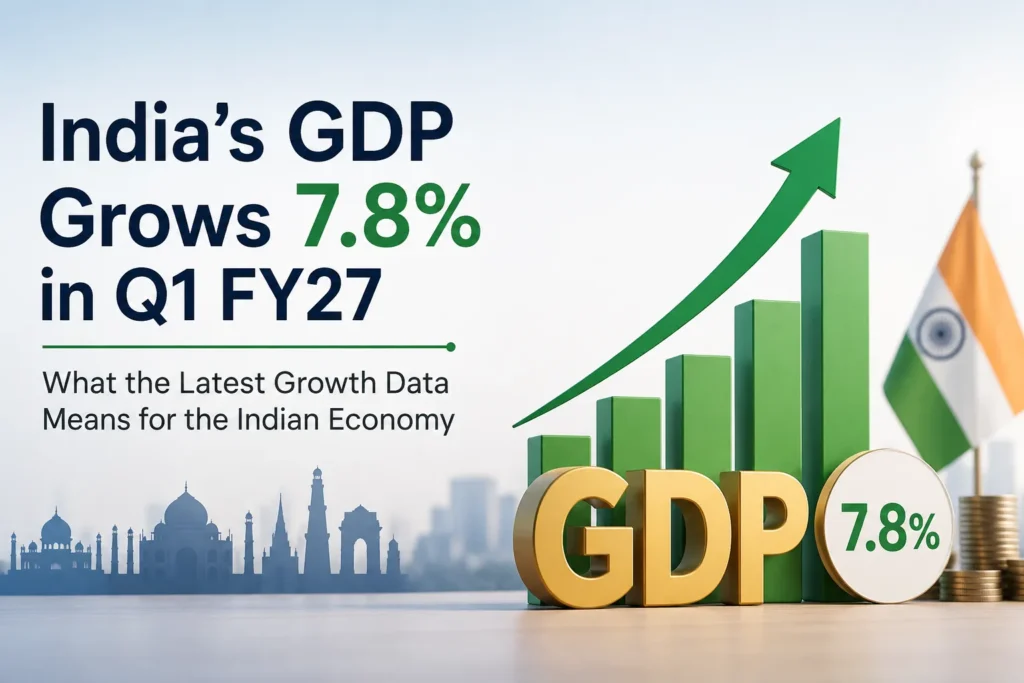
India’s economy started the financial year 2026-27 on a strong note, with real GDP growing 7.8% year-on-year during the April-June quarter, or the first quarter of FY27.
The latest growth figure came in above several market expectations and also exceeded the central bank’s earlier projection for the quarter. The performance highlights the continued strength of India’s domestic economy at a time when rising energy costs, geopolitical tensions and global trade uncertainty have created challenges for economies around the world.
The biggest support to growth came from a combination of strong investment activity, manufacturing, services and domestic consumption.
India GDP Growth at 7.8% in Q1 FY27
The Indian economy recorded 7.8% real GDP growth in April-June 2026, compared with 6.9% growth in the same quarter of the previous financial year.
Real Gross Value Added, or GVA, grew even faster at 8.2% during the quarter.
The latest data also showed:
- Real GDP growth: 7.8%
- Real GVA growth: 8.2%
- Nominal GDP growth: 10.3%
- Private consumption growth: 7.1%
- Government consumption growth: 4.3%
- Gross fixed capital formation growth: 11.9%
- Real exports growth: 12%
- Real imports growth: -1.1%
At constant prices, India’s real GDP for the April-June quarter was estimated at approximately ₹81.36 lakh crore, while nominal GDP reached around ₹88.27 lakh crore.
GDP Growth Beats Expectations
The 7.8% expansion was stronger than many economists had expected.
Market estimates were around 7.1%, while the central bank had projected approximately 7% growth for the quarter.
The better-than-expected result suggests that domestic economic activity remained stronger than anticipated despite external pressures, including higher energy prices and geopolitical disruptions affecting global supply chains.
The latest data is particularly significant because the April-June quarter marked the beginning of FY27. A strong start does not guarantee that the same pace will continue throughout the year, but it provides a positive foundation for the economy.
Investment Was One of the Biggest Drivers of Growth
One of the most important parts of the latest GDP data was the sharp increase in investment activity.
Gross Fixed Capital Formation, or GFCF, grew by 11.9%, compared with 5.8% growth in the corresponding quarter a year earlier.
GFCF broadly measures spending on assets that can support future production, including:
- Infrastructure
- Buildings and construction
- Machinery
- Equipment
- Industrial capacity
Strong investment is important because it can increase the economy’s productive capacity over time.
The latest numbers indicate that investment was a major contributor to economic growth during the quarter. Activity related to capital goods, electrical equipment and machinery also supported the broader investment cycle.
The data does not fully separate how much of the increase came from private companies, the government or households. However, the overall acceleration in fixed investment was one of the clearest positive signals in the April-June GDP report.
Manufacturing Gives India’s Economy a Major Boost
Manufacturing remained another important driver of growth.
The sector expanded by around 9.2% during the quarter, supported by continued industrial activity and investment demand.
Strong manufacturing growth is significant because the sector plays an important role in:
- Employment
- Industrial production
- Exports
- Investment
- Supply chains
The performance also indicates that domestic demand and industrial capacity expansion continued to support production despite an uncertain global environment.
Services Sector Continues to Power Economic Growth
India’s services sector remained one of the strongest contributors to the economy.
The broader services sector showed strong momentum, with financial, real estate, information technology and professional services growing by 12.1%.
This was among the fastest-growing major parts of the economy during the quarter.
Strong services activity matters because services account for a large share of India’s overall economic output. Growth in financial services, technology-related activities, professional services and real estate can have a significant impact on jobs, incomes and business activity.
The combination of strong services growth and manufacturing expansion helped keep the economy on a solid footing in the first quarter of FY27.
Private Consumption Remains Supportive
Private Final Consumption Expenditure grew by 7.1% during the April-June quarter.
This was slightly higher than the 6.8% growth recorded in the corresponding quarter a year earlier.
Private consumption remains one of the most important components of India’s economy because household spending drives demand across sectors such as:
- Retail
- Consumer goods
- Housing
- Transport
- Services
- Travel and leisure
The latest numbers show that consumption continued to support economic activity. However, investment growth was considerably stronger during the quarter, making capital formation a more important driver of the overall acceleration.
Government consumption grew by 4.3%, showing more moderate growth compared with private consumption and investment.
Exports Show Strength Despite Global Uncertainty
India’s real exports grew by 12% during the April-June quarter.
At the same time, real imports declined by 1.1%.
The export performance is notable because the global economy has been facing uncertainty from geopolitical tensions, higher energy costs and disruptions in international trade and supply chains.
A combination of stronger domestic activity and resilient exports helped India maintain growth momentum despite these external pressures.
How Did India Grow Despite Global Challenges?
The 7.8% GDP growth rate came at a time when global conditions remained challenging.
India has faced pressure from:
- Rising crude oil and energy costs
- Geopolitical tensions in West Asia
- Global supply-chain disruptions
- Uncertainty in international trade
- Inflation risks
India is particularly sensitive to higher oil prices because the country depends heavily on imported crude oil.
Despite these challenges, strong domestic demand, investment activity, government spending and services growth helped offset some of the external pressure.
The latest GDP numbers therefore point to the relative resilience of domestic economic activity during the first quarter of FY27.
What Does 7.8% GDP Growth Mean for the Indian Economy?
A 7.8% growth rate is a positive signal for the Indian economy for several reasons.
1. Investment Is Accelerating
The 11.9% growth in fixed investment indicates stronger activity in areas that can increase future production capacity.
2. Manufacturing Remains Strong
Manufacturing growth of around 9.2% shows continued momentum in industrial activity.
3. Services Are Expanding Rapidly
Financial, real estate, IT and professional services remained among the strongest-performing areas.
4. Consumer Spending Is Still Supporting Growth
Private consumption continued to expand, providing support to domestic demand.
5. The Economy Has Shown Resilience
The growth performance came despite global uncertainty and pressure from higher energy prices.
Together, these factors suggest that India’s economy entered FY27 with relatively strong momentum.
Why Is GVA Growth Higher Than GDP Growth?
The latest data showed 8.2% growth in real GVA, compared with 7.8% growth in real GDP.
This does not mean the two figures contradict each other.
GVA measures the value created by producers across different sectors of the economy.
GDP is calculated by adding net product taxes, meaning taxes minus subsidies, to GVA.
During the quarter, the difference between GVA and GDP growth reflected slower growth in net taxes compared with the growth generated by the producing sectors of the economy.
For investors and economists, GVA can provide a useful picture of how different sectors are performing, while GDP remains the broader measure of total economic output.
Will India Maintain This Growth Rate for the Full Year?
The strong Q1 performance has improved confidence about India’s growth outlook, but several risks remain.
The full-year growth rate will depend on factors including:
- Crude oil prices
- Inflation
- Global economic conditions
- Geopolitical developments
- Monsoon and agricultural performance
- Private investment
- Consumer demand
- Government capital expenditure
The central bank’s broader FY27 growth projection remains below the 7.8% pace recorded in the first quarter.
This means that while Q1 has provided a strong start, maintaining such a high growth rate throughout every quarter may be difficult.
Economists will closely watch whether the investment cycle continues and whether consumer demand remains strong in the coming months.
India GDP Growth Q1 FY27: Key Numbers
| Indicator | Q1 FY27 Growth |
| Real GDP | 7.8% |
| Real GVA | 8.2% |
| Nominal GDP | 10.3% |
| Private Consumption | 7.1% |
| Government Consumption | 4.3% |
| Gross Fixed Capital Formation | 11.9% |
| Real Exports | 12% |
| Real Imports | -1.1% |
| Manufacturing | 9.2% |
| Financial, Real Estate, IT & Professional Services | 12.1% |
India GDP Growth: What Happens Next?
The next few quarters will show whether India’s strong start to FY27 can be sustained.
The key areas to watch will be investment, manufacturing, consumer spending and inflation.
Investment growth is particularly important because the latest quarter showed a significant acceleration in capital formation. If companies and other economic sectors continue to invest in infrastructure, technology, manufacturing and capacity expansion, it could provide support for future growth.
At the same time, higher energy costs and global uncertainty remain potential risks.
For now, the Q1 FY27 GDP data provides a strong signal that the Indian economy entered the new financial year with substantial momentum.
Conclusion
India’s economy grew 7.8% in the April-June quarter of FY27, beating expectations and marking a strong start to the financial year.
The growth was supported by rapid investment expansion, strong manufacturing, robust services activity and continued growth in private consumption.
The 11.9% rise in fixed investment was one of the biggest highlights of the quarter, while manufacturing grew 9.2% and key services categories expanded by 12.1%.
The data also showed that India maintained strong economic momentum despite global uncertainty and higher energy-related risks.
However, the coming quarters will be important. Inflation, oil prices, global developments and the strength of domestic demand will determine whether India can maintain its growth momentum through the rest of FY27.
For now, the latest GDP data gives the Indian economy a strong opening to the new financial year.