|
Getting your Trinity Audio player ready...
|
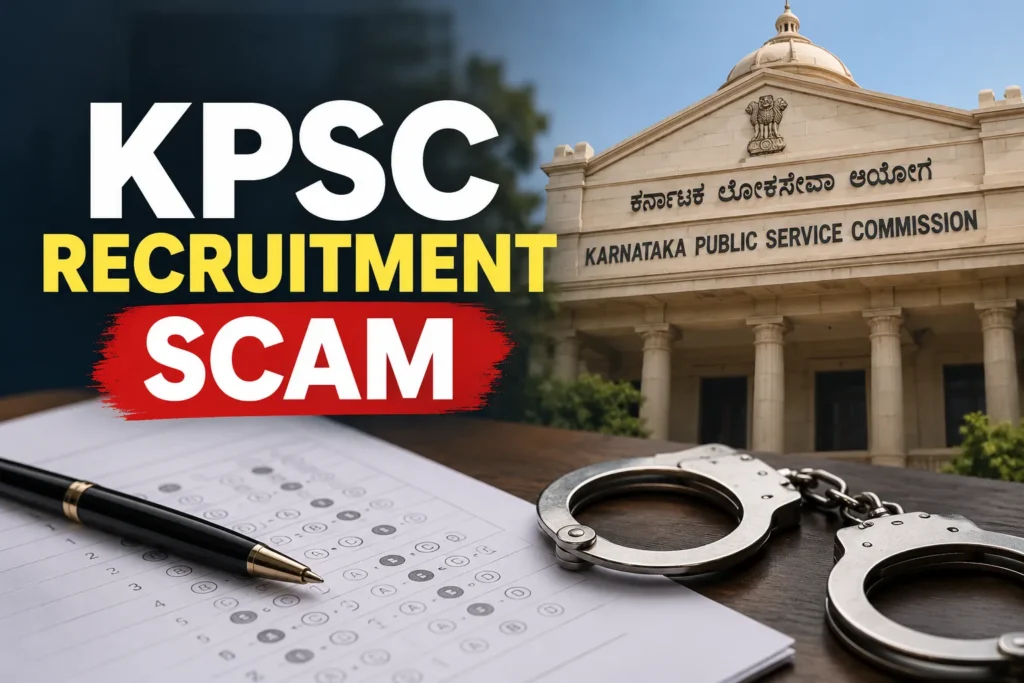
The KPSC recruitment scam has raised serious questions over the recruitment of Veterinary Officers in Karnataka. The Enforcement Directorate (ED) has taken up a money-laundering investigation linked to the alleged leakage of the Veterinary Officers’ Recruitment Exam question paper.
According to the ED, its Bengaluru office arrested Basavaraj Kannale on September 17, 2026, and Gyanendra Kumar Gangwar, IAS, on September 18, 2026. Gangwar served as the Controller of Examination of the Karnataka Public Service Commission (KPSC).
What Is the KPSC Recruitment Scam?
The case centres on the alleged leakage of the question paper for the KPSC Veterinary Officers’ Recruitment Exam.
The ED says the accused allegedly leaked the examination question paper in exchange for illegal payments from candidates. According to the agency, candidates allegedly paid between ₹30 lakh and ₹40 lakh per candidate to obtain access to the leaked paper.
The investigation focuses on the alleged flow of money connected with the recruitment process and the suspected proceeds generated through the alleged paper leak.
Who Has Been Arrested in the KPSC Paper Leak Case?
The ED’s official update confirms two arrests in the case:
- Basavaraj Kannale — arrested on September 17, 2026
- Gyanendra Kumar Gangwar, IAS — arrested on September 18, 2026
The ED says both were arrested in connection with the alleged leakage of the Veterinary Officers’ Recruitment Exam question paper in return for illegal gratification. A Special PMLA Court subsequently remanded both to 14 days of ED custody.
How Much Money Was Allegedly Involved?
The ED has stated that candidates allegedly paid between ₹30 lakh and ₹40 lakh each for the leaked examination paper.
This figure is important because it shows the scale of the alleged financial transactions under investigation. However, the allegations remain part of an ongoing investigation, and the arrests themselves do not establish guilt.
Why Is the KPSC Veterinary Officer Exam Under Investigation?
The Veterinary Officers’ Recruitment Exam forms the central part of the ED’s current investigation.
The agency’s official statement specifically links the arrests to the leakage of the question paper and alleged illegal gratification paid by candidates.
The investigation also examines the money generated through the alleged recruitment racket under the provisions of the Prevention of Money Laundering Act (PMLA), 2002.
What Happens Next in the KPSC Scam Case?
The investigation will determine the wider financial trail and the role of people allegedly connected with the recruitment process.
The ED has already taken custody of the two accused named in its official update. Further investigation may establish how the alleged question-paper leak took place, how money moved between the people involved and whether additional individuals played a role.
At this stage, readers should distinguish between allegations under investigation and facts established by a court.
KPSC Recruitment Scam: Key Facts
| Detail | Information |
| Exam under investigation | Veterinary Officers’ Recruitment Exam |
| Investigating agency | Enforcement Directorate |
| Case law | Prevention of Money Laundering Act, 2002 |
| Arrested | Basavaraj Kannale |
| Arrest date | September 17, 2026 |
| Arrested | Gyanendra Kumar Gangwar, IAS |
| Gangwar arrest date | September 18, 2026 |
| Alleged payment per candidate | ₹30 lakh–₹40 lakh |
| Allegation | Question-paper leakage for illegal gratification |
| Court | Special PMLA Court |
KPSC Scam Latest Update
The KPSC recruitment scam investigation remains ongoing. The ED’s official update confirms that the agency has arrested the alleged middleman Basavaraj Kannale and former KPSC Examination Controller Gyanendra Kumar Gangwar in connection with the alleged Veterinary Officers’ Recruitment Exam paper leak.
The investigation will be important for determining the full extent of the alleged recruitment irregularities and the financial transactions connected with the case.
Important: Arrest or investigation does not by itself establish guilt. The allegations will ultimately have to be tested through the legal process.