|
Getting your Trinity Audio player ready...
|
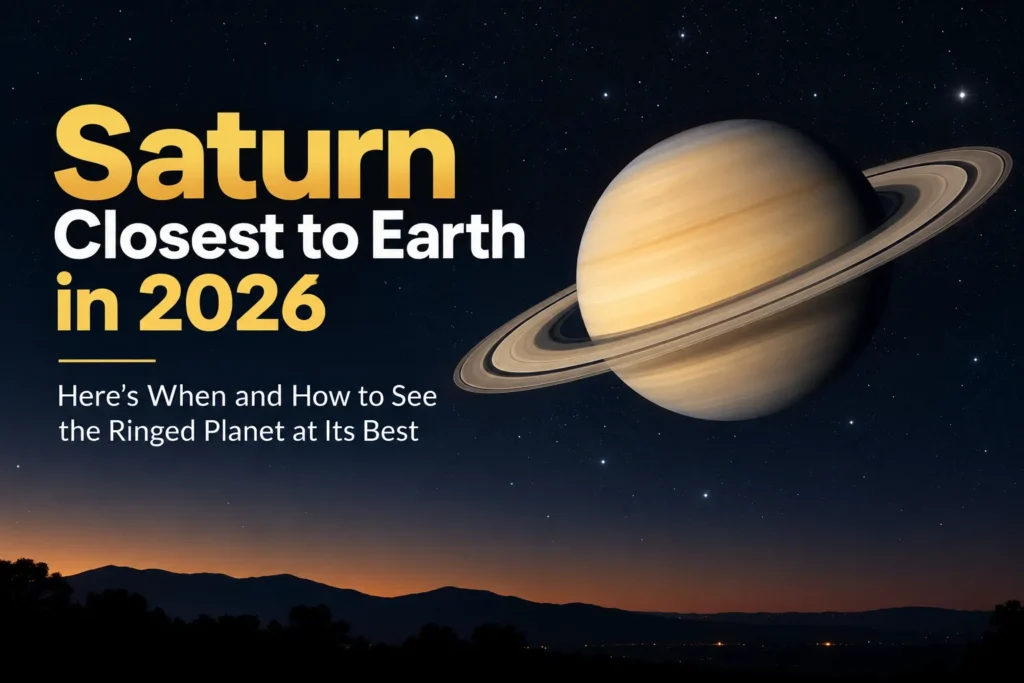
Saturn is about to give skywatchers one of the best chances of 2026 to observe the famous ringed planet. On October 4, Saturn will reach opposition, placing it opposite the Sun in Earth’s sky and making it especially favorable for observation.
If you have ever wanted to see Saturn and its iconic rings, early October offers a good opportunity to look up.
When Is Saturn Closest to Earth in 2026?
Saturn will reach opposition on October 4, 2026, according to NASA’s 2026 skywatching calendar.
During opposition, Earth comes between the Sun and Saturn. This alignment makes Saturn appear particularly bright and keeps the planet visible for much of the night.
Saturn does not suddenly move unusually close to Earth on this date. Instead, its position relative to Earth and the Sun creates favorable viewing conditions.
NASA lists Saturn’s October 4 opposition among the notable astronomical events of 2026.
Why Is Saturn So Bright During Opposition?
Saturn shines by reflecting sunlight rather than producing its own light.
When Saturn reaches opposition, Earth has a favorable viewing position. Saturn appears opposite the Sun in the sky, which means the planet can remain visible from around sunset through the night.
This combination makes opposition one of the best periods of the year to observe Saturn.
NASA data shows that Saturn’s average distance from Earth at opposition is about 1.277 billion kilometers, although the exact distance changes from one opposition to another.
Can You See Saturn Without a Telescope?
Yes. Saturn is bright enough to see without a telescope under suitable sky conditions.
However, your eyes alone will not reveal the planet’s famous rings.
A telescope can provide a much more impressive view. Even a small telescope can make Saturn’s rings easier to distinguish, although the exact appearance depends on the telescope, observing conditions and Saturn’s position.
What Will Saturn Look Like?
To the naked eye, Saturn can look like a bright, steady point of light.
Through a telescope, however, Saturn becomes much more interesting. Its distinctive ring system can appear around the planet, making it one of the most recognizable sights in the night sky.
NASA identifies Saturn as the sixth planet from the Sun and one of the solar system’s gas giants.
Is October 4 the Only Night to See Saturn?
No.
October 4 marks the opposition, but skywatchers do not need to observe Saturn at one exact moment.
The planet remains a good target around the opposition period, giving observers several opportunities to find it in the night sky.
For the best experience, choose a clear night and find a location with a good view of the sky.
Why Is Saturn’s 2026 Opposition Important?
Saturn’s opposition gives skywatchers a chance to see the ringed planet when its position in the sky is particularly favorable.
NASA includes the event among the major astronomical highlights of 2026, making October an exciting month for people interested in planets and night-sky observation.
The event also gives beginners a simple reason to start exploring the night sky: Saturn is bright enough to locate without specialized equipment, while a telescope can reveal details that the naked eye cannot see.
Saturn Closest to Earth 2026: Key Facts
- Opposition: October 4, 2026
- Planet: Saturn
- Type: Gas giant
- Position: Opposite the Sun in Earth’s sky
- Visibility: Visible through much of the night around opposition
- Naked-eye viewing: Possible under suitable conditions
- Telescope viewing: Best way to see Saturn’s rings
- Average Earth-Saturn distance at opposition: About 1.277 billion kilometers
Final Takeaway
Saturn’s October 4, 2026 opposition is one of the year’s notable opportunities to observe the ringed planet. Saturn will appear particularly favorable for night-sky observation, and people with a telescope can try to spot its famous rings.
So, if you have been waiting for a good time to look for Saturn, October 4 is a date worth marking on your calendar.