In the age of social media, a single moment can transform from an ordinary conversation into a nationwide debate within hours. This is exactly what happened with the now-famous ₹370 Biryani controversy, a viral incident that began during a stand-up comedy show and quickly evolved into one of the most discussed topics across social media platforms in India.
The controversy generated conversations about dating culture, consent, comedy, accountability, social media outrage, and the responsibilities of public figures. What initially seemed like an offhand remark at a comedy show soon became a topic discussed by influencers, journalists, celebrities, and everyday internet users.
As hashtags trended and opinions flooded social media, the incident demonstrated the immense power of viral content in shaping public discourse. It also highlighted how audiences increasingly expect entertainers and content creators to be mindful of the messages they amplify.
This article explores the complete story behind the ₹370 Biryani controversy, why it became so significant, the reactions it generated, and the broader lessons it offers about modern internet culture.
- What Is the ₹370 Biryani Controversy?
- Why Did the Video Go Viral?
- Understanding the Consent Debate
- The Role of Comedy in the Controversy
- Social Media's Influence on Public Opinion
- Public Reactions Across India
- The Impact on Personal Reputation
- Dating Culture in Modern India
- Lessons for Content Creators
- The Bigger Conversation About Internet Accountability
- FAQs
What Is the ₹370 Biryani Controversy?
The controversy originated during a crowd-work segment at a stand-up comedy performance. Crowd work is a common format in stand-up comedy where comedians interact directly with audience members, often creating spontaneous humor based on audience responses.
During the interaction, an audience member shared a story involving a date where he had spent ₹370 on biryani for a woman. He then made comments suggesting that because he had spent money on the date, he expected something in return from the woman.
The statement immediately generated laughter within the venue and became part of the crowd-work conversation. However, once clips from the show reached social media, viewers began interpreting the remarks very differently.
Many users felt that the comments implied a transactional view of relationships and intimacy. Critics argued that spending money on a meal does not create any obligation for physical affection, intimacy, or romantic involvement.
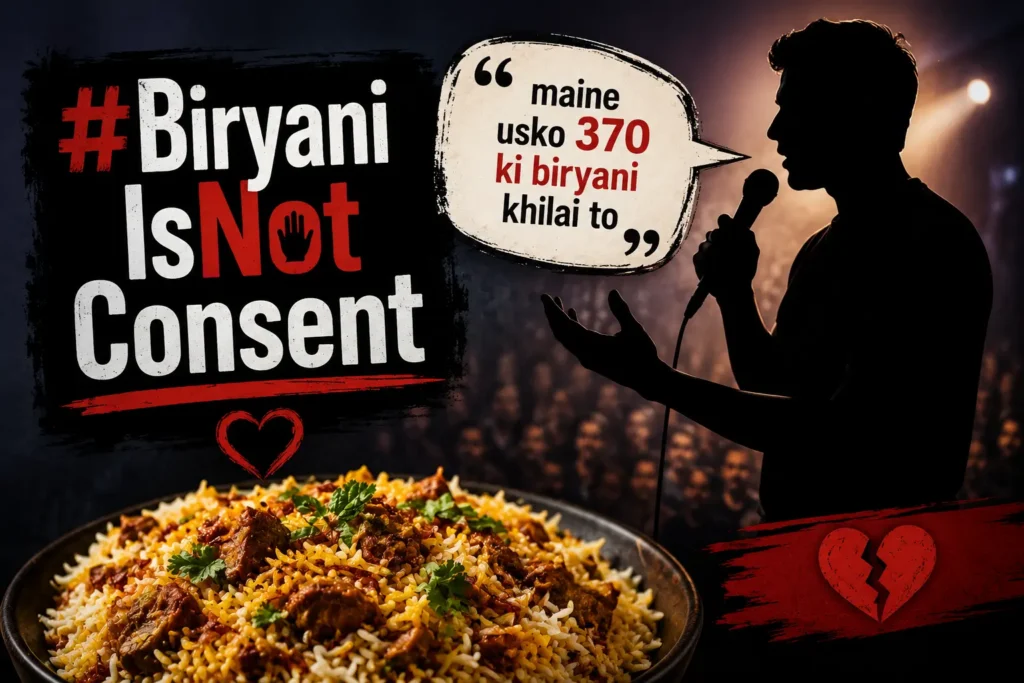
As the clip spread online, the phrase “₹370 Ki Biryani” quickly became a viral symbol representing discussions around consent, dating expectations, and gender dynamics.
Why Did the Video Go Viral?
Social media thrives on content that sparks emotional reactions, and the ₹370 Biryani clip contained several ingredients that typically fuel virality.
First, the topic touched on modern dating culture, something millions of people can relate to. Whether individuals agreed or disagreed with the audience member’s comments, many felt compelled to express their opinions.
Second, the clip involved comedy, which often exists in a gray area between entertainment and social commentary. This naturally encouraged debate about where humor should end and accountability should begin.
Third, the clip was short and easy to share. Modern social media platforms favor concise, emotionally charged content that can be consumed quickly and shared instantly.
Within days, thousands of users were discussing the incident across platforms. Reactions ranged from outrage and criticism to debates about freedom of expression and comedy.
The phrase itself also played a major role in the controversy’s spread. “₹370 Ki Biryani” was memorable, easy to repeat, and instantly recognizable, making it an ideal viral catchphrase.
Understanding the Consent Debate
At the center of the controversy was a larger discussion about consent.
Many critics argued that the audience member’s remarks reflected a problematic mindset in which financial spending during a date creates expectations of intimacy. This perspective was widely challenged online.
Consent advocates emphasized that gifts, meals, dates, or financial investments do not create obligations. Every individual retains the right to make independent decisions regarding relationships and physical intimacy regardless of how much money has been spent.
As discussions intensified, many social media users began using the phrase “Biryani Is Not Consent” to reinforce this message.
The debate expanded beyond the specific incident and evolved into a broader conversation about dating norms in contemporary society. People shared personal experiences, viewpoints, and opinions regarding expectations that sometimes emerge during dating interactions.
For many observers, the controversy became less about one individual comment and more about the social attitudes that such comments may reflect.
The Role of Comedy in the Controversy
Comedy has long occupied a unique space in society. Comedians often tackle sensitive subjects, challenge norms, and push boundaries in pursuit of humor.
Supporters of the comedy community argued that stand-up performances frequently involve exaggerated statements and spontaneous interactions that should not always be interpreted literally.
Others disagreed.
Critics maintained that while comedy should remain creative and unrestricted, performers also bear some responsibility when audience comments promote potentially harmful ideas.
This disagreement led to an important question: Should comedians be held accountable for remarks made by audience members during crowd-work sessions?
There is no universally accepted answer.
Some believe comedians are facilitators rather than endorsers of audience comments. Others argue that a comedian’s reaction can influence how viewers interpret a statement.
The ₹370 Biryani controversy brought this debate into the spotlight and encouraged deeper reflection on the relationship between humor and responsibility.
Social Media’s Influence on Public Opinion
One of the most fascinating aspects of the controversy was how quickly social media transformed a localized event into a national discussion.
Before the rise of digital platforms, a joke told at a comedy club would likely remain within the venue. Today, however, every moment has the potential to reach millions.
Algorithms prioritize engagement, and controversial content often generates more comments, shares, and reactions than ordinary posts.
As a result, incidents like the ₹370 Biryani controversy can spread at remarkable speed.
Social media also changes how people consume context. A short viral clip may represent only a fraction of a larger conversation, yet audiences often form opinions based solely on the snippet they see.
This phenomenon raises important questions about context, interpretation, and digital accountability.
The controversy demonstrated how internet users increasingly participate in shaping narratives rather than simply consuming them.
Public Reactions Across India
Public responses to the controversy varied significantly.
Many users strongly condemned the comments and viewed them as reinforcing outdated attitudes toward women and relationships.
Others argued that the backlash itself was excessive and represented a growing tendency to scrutinize every joke made in public.
Influencers, journalists, activists, and content creators joined the discussion, each bringing their own perspective.
Some focused on consent education.
Others focused on freedom of speech.
Still others discussed the broader impact of social media outrage on individuals and careers.
The diversity of opinions revealed how complex the issue had become. What started as a simple crowd-work exchange had evolved into a multifaceted national conversation touching on ethics, entertainment, relationships, and online culture.
The Impact on Personal Reputation
One of the most immediate consequences of viral controversies is reputational damage.
In today’s digital environment, public perception can change rapidly. A single clip can influence how millions view an individual, brand, or public figure.
The ₹370 Biryani controversy illustrated how quickly online criticism can escalate.
Public figures often find themselves navigating intense scrutiny, with every statement analyzed and debated.
This environment creates significant challenges for entertainers and content creators.
While social media provides unprecedented opportunities for visibility and growth, it also exposes individuals to immediate and large-scale criticism whenever controversies arise.
The incident serves as a reminder that reputation management has become an essential part of public life in the digital era.
Dating Culture in Modern India
The controversy also sparked broader conversations about evolving dating expectations.
As dating apps and social media continue to reshape relationships, discussions around financial expectations on dates have become increasingly common.
Some individuals believe the person initiating a date should pay.
Others prefer splitting expenses equally.
Still others view payment decisions as situational and dependent on mutual understanding.
The viral debate highlighted how different people approach these issues and how misunderstandings can emerge when expectations are not clearly communicated.
Importantly, many commentators emphasized that financial generosity should never be viewed as a transaction that guarantees romantic or physical outcomes.
Healthy relationships rely on mutual respect, communication, and consent rather than financial exchanges.
Lessons for Content Creators
The controversy offers several valuable lessons for content creators, comedians, influencers, and public personalities.
The first lesson is that every public interaction can potentially become viral content.
The second lesson is that audience interpretation often matters as much as original intent.
The third lesson is that online audiences increasingly expect accountability from public figures.
Modern creators operate in an environment where clips can be isolated from their original context and distributed globally within minutes.
As a result, understanding audience perception has become a critical component of content creation.
This does not necessarily mean avoiding controversial topics altogether. Instead, it highlights the importance of considering how content may be interpreted by diverse audiences.
The Bigger Conversation About Internet Accountability
Perhaps the most significant outcome of the ₹370 Biryani controversy is the broader discussion it initiated about accountability in the digital age.
Today, individuals are more connected than ever before. Every comment, joke, and opinion can potentially reach millions of people.
This reality has transformed how society thinks about public speech and responsibility.
Supporters of accountability argue that public criticism helps challenge harmful ideas.
Critics of online outrage argue that social media can sometimes encourage disproportionate reactions.
The truth likely exists somewhere between these perspectives.
The challenge for modern society is finding a balance between encouraging responsible discourse and preserving freedom of expression.
The ₹370 Biryani controversy serves as a compelling example of this ongoing struggle.
Conclusion
The ₹370 Biryani controversy began as a seemingly ordinary moment during a stand-up comedy show but quickly evolved into a nationwide conversation about consent, dating culture, comedy, accountability, and social media influence.
Its rapid rise demonstrates how powerful digital platforms have become in shaping public discussions. The incident also highlights the increasing expectation that public figures, entertainers, and content creators carefully consider the messages associated with their content.
Beyond the specific individuals involved, the controversy opened important conversations about relationships, consent, audience responsibility, and the role of humor in modern society.
Whether viewed as a lesson in accountability, a case study in viral culture, or a reflection of changing social values, the ₹370 Biryani controversy will likely remain one of the most talked-about internet debates of recent years.
FAQs
What is the ₹370 Biryani controversy?
The ₹370 Biryani controversy refers to a viral stand-up comedy clip in which an audience member suggested that spending ₹370 on biryani during a date created expectations of something in return, sparking widespread debate online.
Why did the controversy become so popular?
The incident touched on sensitive topics including consent, dating culture, comedy, and social responsibility, making it highly shareable and discussion-worthy across social media platforms.
What does “#BiryaniIsNotConsent” mean?
The phrase emphasizes that paying for food, gifts, or dates does not create any obligation for romantic or physical intimacy.
How did social media influence the controversy?
Social media amplified the clip, allowing it to reach millions of viewers and transform a local comedy show interaction into a national discussion.
What lessons can content creators learn from this incident?
Creators can learn the importance of understanding audience perception, managing public reputation, and recognizing how quickly content can spread in the digital age.