|
Getting your Trinity Audio player ready...
|
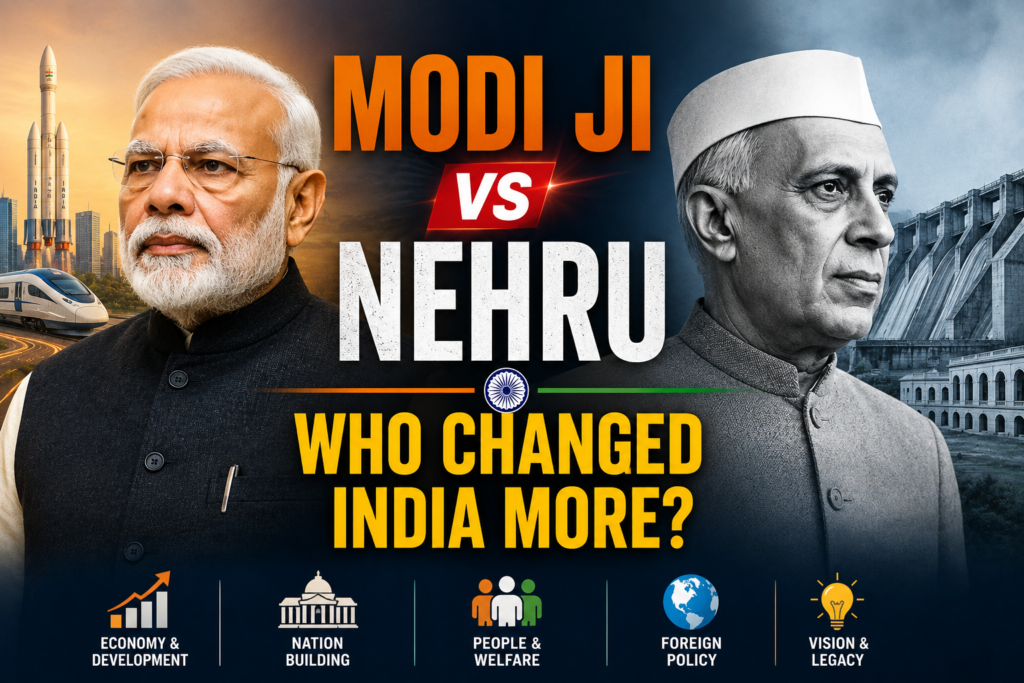
India’s political history has been shaped by many influential leaders, but few have left as profound an impact as Jawaharlal Nehru and Narendra Modi. Both leaders served long tenures as Prime Minister and governed India during critical periods of transformation. While Nehru laid the foundation of a newly independent nation, Modi has led India through an era of globalization, digitalization, and rapid economic change.
The debate over who changed India more has become increasingly popular, especially after Narendra Modi became India’s longest-serving elected Prime Minister. Supporters of both leaders point to significant achievements, transformative policies, and lasting legacies. However, comparing two leaders from entirely different eras requires a deeper understanding of the challenges they faced, the opportunities available to them, and the impact of their decisions.
This comparison explores the leadership styles, economic policies, social reforms, foreign relations, and long-term influence of both Prime Ministers to understand how they shaped modern India.
- Understanding the Historical Context
- Nehru's Vision for a New India
- Modi's Vision for a New India
- Economic Development: Two Different Approaches
- Infrastructure Transformation
- Education and Human Capital
- Foreign Policy and Global Standing
- Technology and Innovation
- Social Impact and Welfare
- Leadership Style
- Measuring Legacy
- Who Changed India More?
- FAQs
Understanding the Historical Context
Any comparison between Nehru and Modi must begin with the circumstances in which they assumed office.
When Jawaharlal Nehru became India’s first Prime Minister in 1947, the country had just gained independence after nearly two centuries of British colonial rule. India faced widespread poverty, low literacy rates, weak infrastructure, food shortages, and communal tensions following Partition.
Nehru inherited a nation that needed institutions, industries, governance structures, and a vision for the future.
Narendra Modi, on the other hand, became Prime Minister in 2014. India was already a major democracy, one of the world’s fastest-growing economies, and an increasingly influential global player. However, challenges such as unemployment, corruption concerns, infrastructure gaps, bureaucratic inefficiencies, and economic reforms remained significant.
Both leaders entered office during pivotal moments, but the nature of their challenges was fundamentally different.
Nehru’s Vision for a New India
Jawaharlal Nehru believed that India’s future depended on scientific thinking, industrial development, and democratic institutions.
One of his greatest contributions was establishing the framework of modern Indian democracy. While many newly independent nations experienced military coups or authoritarian rule, India maintained democratic governance and regular elections.
Nehru strongly supported parliamentary democracy and worked to strengthen constitutional institutions. The survival and growth of Indian democracy during its early years remains one of his most significant achievements.
His vision also emphasized education and scientific advancement. During his tenure, institutions such as the Indian Institutes of Technology (IITs), major research centers, and public sector enterprises were established.
Nehru believed that scientific development would help India overcome poverty and become self-reliant.
The large dams, steel plants, and industrial projects built during his administration were often described as the “temples of modern India.”
Modi’s Vision for a New India
Narendra Modi’s leadership has focused heavily on economic modernization, technology adoption, infrastructure development, and global influence.
His vision emphasizes transforming India into a developed nation through innovation, entrepreneurship, digital governance, and large-scale reforms.
One of the defining aspects of Modi’s tenure has been the push toward Digital India. Government services, financial transactions, and public welfare schemes have increasingly shifted to digital platforms.
The rapid expansion of digital payments has changed the way millions of Indians conduct everyday transactions. India has become one of the world’s leading digital payment ecosystems under Modi’s administration.
Modi has also prioritized infrastructure development. Highways, expressways, airports, railway modernization projects, and urban development initiatives have expanded significantly during his tenure.
His government has repeatedly emphasized speed, scale, and efficiency in executing major infrastructure projects.
Economic Development: Two Different Approaches
Economic policy represents one of the biggest differences between Nehru and Modi.
Nehru favored a mixed economy with significant government control over key industries. Influenced by socialist principles, he believed the state should play a central role in economic development.
Public sector enterprises dominated sectors such as steel, energy, transportation, and heavy industry. The objective was to build industrial capacity and reduce dependence on foreign powers.
While this approach helped establish core industries, critics argue that excessive regulation later contributed to economic inefficiencies and slower growth.
Modi’s economic philosophy is more market-oriented. His government has encouraged private investment, startup growth, manufacturing expansion, and foreign direct investment.
Initiatives such as Make in India, Startup India, and Production-Linked Incentive schemes aim to boost industrial competitiveness and attract global businesses.
Supporters argue that Modi’s policies have improved India’s business environment and strengthened its position in the global economy.
Infrastructure Transformation
Infrastructure development offers another interesting comparison.
Nehru’s era focused on foundational projects. Major dams, power plants, factories, and industrial centers formed the backbone of India’s early development.
Projects such as the Bhakra Nangal Dam symbolized the country’s aspirations for modernization and self-sufficiency.
Modi’s infrastructure strategy focuses on connectivity and modernization. New highways, freight corridors, metro systems, high-speed rail projects, airports, and logistics networks have become central to national development.
The scale and speed of infrastructure construction have significantly increased during his tenure.
While Nehru built the foundations, Modi has focused on expanding and modernizing those foundations for a twenty-first-century economy.
Education and Human Capital
Education has been a priority for both leaders, though their approaches differ.
Nehru emphasized higher education and scientific research. Institutions created during his tenure continue to produce some of India’s brightest engineers, scientists, and innovators.
His emphasis on science and technology laid the groundwork for India’s future achievements in space research, information technology, and engineering.
Modi’s government has focused on expanding educational access, digital learning, skill development, and educational reform.
The National Education Policy introduced during his tenure aims to modernize India’s education system and improve learning outcomes.
Technology-driven education initiatives have also increased educational accessibility across rural and urban areas.
Foreign Policy and Global Standing
Nehru played a critical role in defining India’s foreign policy after independence.
He championed the Non-Aligned Movement, which sought to maintain independence from both Western and Soviet blocs during the Cold War.
His foreign policy emphasized peace, cooperation, and strategic autonomy.
Modi’s foreign policy has been more assertive and economically focused.
India’s global engagement has expanded significantly through stronger diplomatic relationships, international partnerships, and participation in global forums.
Under Modi, India has increased its visibility on the world stage and strengthened relationships with major powers while continuing to advocate for strategic independence.
Supporters argue that India’s international influence has grown considerably during his tenure.
Technology and Innovation
Technology represents one area where historical context greatly influences the comparison.
Nehru’s contribution was creating institutions that would eventually fuel India’s technological growth.
The scientific ecosystem established during his administration laid the foundation for future advancements.
Modi’s era has witnessed the practical application of technology on a massive scale.
Digital governance, fintech innovation, online public services, and digital infrastructure have transformed daily life for millions of Indians.
The rise of India’s startup ecosystem has further accelerated innovation and entrepreneurship.
Social Impact and Welfare
Both leaders sought to improve living standards, but through different methods.
Nehru focused on nation-building through institutional development, industrial growth, and long-term planning.
His policies aimed to create the structures necessary for sustained development.
Modi has emphasized direct benefit delivery, financial inclusion, housing, sanitation, healthcare access, and social welfare programs.
Large-scale welfare schemes have targeted vulnerable populations while using technology to improve implementation.
Supporters argue that digital governance has reduced inefficiencies and increased transparency in public service delivery.
Leadership Style
Perhaps the most noticeable difference between Nehru and Modi lies in their leadership styles.
Nehru was known for his intellectual approach, emphasis on debate, and commitment to democratic processes.
His speeches often focused on ideals, vision, and long-term national aspirations.
Modi is known for his strong communication skills, direct engagement with citizens, and emphasis on execution.
His leadership style is often characterized by decisive decision-making and extensive use of technology and media to connect with the public.
Both styles have resonated with different generations of Indians.
Measuring Legacy
Determining who changed India more depends largely on how change is measured.
If nation-building, institution creation, democratic foundations, and industrial development are the primary criteria, Nehru’s contributions are difficult to overstate.
Without the institutions established during his tenure, India’s later growth may have been far more difficult.
If modernization, digital transformation, infrastructure expansion, global influence, and economic reforms are the focus, Modi’s impact becomes equally significant.
His supporters argue that he has accelerated India’s progress during a period of rapid technological and economic change.
The reality is that both leaders transformed India in different ways and during very different historical periods.
Who Changed India More?
The answer ultimately depends on perspective.
Jawaharlal Nehru helped create modern India. He built institutions, established democratic traditions, and laid the foundations of industrial and scientific development.
Narendra Modi has focused on transforming India for the future through digital innovation, infrastructure expansion, economic modernization, and global engagement.
Nehru shaped the birth of the nation.
Modi is shaping its evolution in the twenty-first century.
Rather than viewing their contributions as competing legacies, it may be more accurate to see them as different chapters in India’s ongoing development story.
Both leaders responded to the demands of their times and left marks that will influence India for generations.
FAQs
Who served longer as Prime Minister, Modi or Nehru?
Narendra Modi recently became India’s longest-serving elected Prime Minister, surpassing Jawaharlal Nehru’s record for consecutive elected tenure.
What was Jawaharlal Nehru’s biggest contribution?
Nehru’s biggest contribution was laying the foundation of modern India through democratic institutions, industrial development, and scientific advancement.
What is Narendra Modi’s biggest achievement?
Supporters often cite digital transformation, infrastructure development, and India’s growing global influence as some of Modi’s most significant achievements.
How are Modi and Nehru different in economic policy?
Nehru favored a mixed economy with strong government involvement, while Modi supports market-oriented reforms, entrepreneurship, and private-sector growth.
Who had a greater impact on India’s global image?
Both leaders enhanced India’s international standing in different ways. Nehru shaped India’s role during the Cold War, while Modi has expanded India’s influence in a globalized world.
Can Modi and Nehru be compared fairly?
Comparisons are challenging because they governed during very different historical periods. Each faced unique opportunities and challenges that shaped their leadership decisions.