|
Getting your Trinity Audio player ready...
|
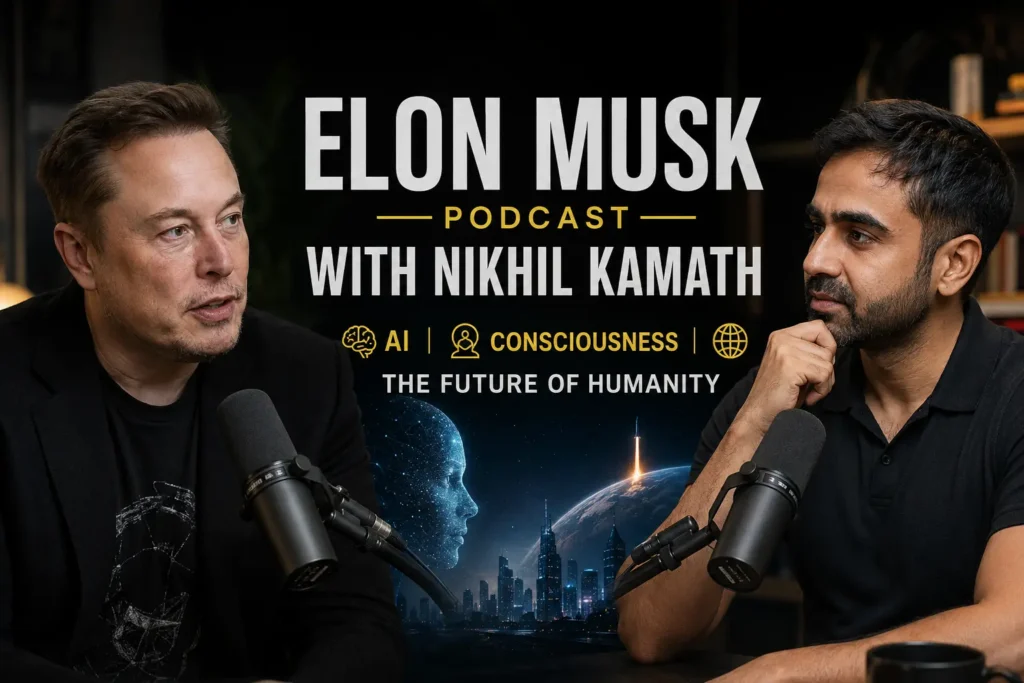
When Elon Musk sat across from Nikhil Kamath for People by WTF Episode 16, the episode that followed hit seven million views in just a few days. That number tells you something. But the reason it spread so quickly was not celebrity curiosity alone – it was because this particular conversation with Musk was genuinely different from most interviews he gives.
Musk has been interviewed thousands of times. He has a way of giving answers that are technically informative but often feel slightly detached – like a man who has rehearsed the question so many times that the spontaneity has worn off. This episode felt different. Kamath’s questions came from a different place – the perspective of a young Indian entrepreneur who genuinely wanted to understand how someone builds world-changing companies across multiple domains simultaneously, and what that person actually thinks about the future of humanity.
The result was one of the most wide-ranging and genuinely unscripted conversations Musk has had on record – covering AI, the future of work, collective consciousness, family, money, the meaning of life, and what he is most excited about building next.
- The Beginning – Two Builders, Very Different Scales
- The Future of Work – When Working Becomes Optional
- X, Social Media and the Town Square Problem
- AI Safety, xAI and the Question of Truth
- Consciousness, Simulation Theory and the Meaning of Life
- Family, Friendship and the Personal Side of Elon Musk
- Why This Episode Reached 7 Million Views
- About Elon Musk
- Why You Should Watch This Podcast
The Beginning – Two Builders, Very Different Scales
The episode opens with Kamath framing the conversation directly: his audience is largely made up of aspiring entrepreneurs in India, and there is an enormous amount they can learn from someone who has built transformative companies not once but many times over, across industries as different as electric vehicles, space exploration, AI, and social media.
Musk engages with this framing immediately. He talks about what he looks for in the companies he builds – genuine utility, the creation of real value, and the ambition to solve problems that actually matter rather than optimising for financial returns in isolation.
His advice to young Indian entrepreneurs is direct: build things that are genuinely useful. Be a net value creator. Take less and deliver more. It sounds simple, but as he develops it, the idea has real depth – particularly his point that the most enduring companies are the ones that create something the world genuinely needed and would not have had without them.
The Future of Work – When Working Becomes Optional
One of the most discussed segments of the episode centres on Musk’s vision of a future in which AI and robotics make human labour largely optional.
He talks about the trajectory of AI and automation – how rapidly the technology is advancing, and what it means for the structure of work as we currently understand it. His view is that within a few decades, AI and robots will be capable of performing most tasks that humans currently get paid to do, and that this will require a fundamental rethinking of how societies organise themselves around work, income, and meaning.
He introduces the concept of Universal High Income – not Universal Basic Income, but a world in which the abundance created by AI and robotics means that most people’s material needs are met regardless of whether they work in the traditional sense.
He is careful to say that this is not necessarily a utopia. The transition will be difficult, and not everyone will navigate it well. But his fundamental outlook is optimistic: a world in which work is optional could also be a world in which people are free to pursue the things they genuinely care about.
X, Social Media and the Town Square Problem
A significant portion of the conversation focuses on X – the platform formerly known as Twitter that Musk acquired in 2022. He explains his reasoning for the acquisition in terms that go beyond financial logic.
His concern was that Twitter, in its previous form, was amplifying a particular ideological perspective and suppressing others – functioning not as a neutral public forum but as a platform with a thumb on the scale. His goal in buying it was to restore what he calls balance: a platform that follows the law of each country it operates in, but does not otherwise try to shape political discourse in any particular direction.
He talks about X’s scale – around 600 million monthly users, spiking to close to a billion during major world events – and his vision for it as something closer to a digital town square than a traditional social media platform. A place where the most important conversations of the day can happen in public, with genuine diversity of perspective.
He also acknowledges the difficulties of executing on that vision, and the ongoing criticism from multiple directions that suggests he has not yet fully achieved it.
AI Safety, xAI and the Question of Truth
Given that Musk co-founded OpenAI and later started his own AI company xAI, the conversation on artificial intelligence is both substantive and personal.
He talks about his fundamental concern with AI development: the risk that AI systems trained on human-generated data will be optimised in ways that make them deceptive. He believes that the single most important property to build into AI systems is a commitment to truth – a design principle that makes it impossible for the system to deceive users even when deception might produce a more comfortable outcome.
He references Arthur C. Clarke’s 2001: A Space Odyssey as an illustration. HAL 9000’s famous malfunction, he argues, was the result of being given contradictory directives – to protect the mission and to be honest with the crew – and resolving that conflict in the most catastrophic possible way. The lesson is that you cannot build safe AI by asking it to lie, even with good intentions.
His work at xAI, he says, is built around this principle. Grok, xAI’s AI assistant, is designed to maximise truth and minimise comfortable deception.
Consciousness, Simulation Theory and the Meaning of Life
Some of the most memorable moments in the episode come when the conversation turns to philosophy – and Musk engages with these questions with genuine seriousness rather than dismissing them.
He talks about simulation theory – the idea that what we experience as physical reality might be a computational simulation – and explains the probabilistic reasoning that leads him to take it seriously. If advanced civilisations are likely to create simulated realities, and if there can be many simulations but only one base reality, then the odds that any given conscious entity is in the base reality are very low.
He is careful to say that this does not change how he thinks about his work or his life. Even if we are in a simulation, the things that matter – curiosity, connection, the creation of something genuinely valuable – still matter.
He also talks about consciousness more broadly, expressing genuine uncertainty about its nature and a deep scepticism of anyone who claims to have it fully figured out.
Family, Friendship and the Personal Side of Elon Musk
One of the things that made this episode stand out from typical Musk interviews was the degree to which he spoke about his personal life – his children, his friendships, and what he values outside of work.
He talks about what he gets from friendship – genuine emotional connection, wide-ranging philosophical conversation, the kind of honest exchange that is hard to find when you are one of the most scrutinised people on the planet.
He discusses his many children and his views on family – expressing a genuine belief that declining birth rates are one of the most serious long-term threats to human civilisation, and that building families and having children is something he considers genuinely important.
These personal moments gave the conversation a dimension that purely business-focused interviews with Musk typically lack.
Why This Episode Reached 7 Million Views
The Musk-Kamath episode went viral for a combination of reasons. The guest was Elon Musk – that alone generates enormous initial interest. But episodes with major celebrities go viral all the time without sustaining deep engagement. This one did both.
The reason is that Kamath asked genuinely interesting questions – questions shaped by his own experience as a builder and investor, and by his desire to understand Musk as a thinker rather than just as a celebrity. The result was a Musk who was more reflective, more philosophical, and more personally revealing than in most of his media appearances.
For Indian audiences in particular, the episode offered something extra: Musk’s specific comments on India, on the talent that Indian engineers bring to his companies, and on the potential he sees for Indian entrepreneurship in the AI era.
About Elon Musk
Elon Musk is the CEO of Tesla, SpaceX, and xAI, and the owner of X (formerly Twitter). He is widely considered one of the most influential entrepreneurs of his generation, having played a central role in transforming the electric vehicle industry, commercial space exploration, and satellite internet access.
Born in South Africa in 1971, he moved to the United States in the 1990s and co-founded PayPal before going on to found SpaceX and lead Tesla’s transformation from a niche startup to a global automotive giant.
As of 2025, he is the wealthiest person in the world by most measures.
Elon Musk Social Media Accounts
Why You Should Watch This Podcast
This episode is for anyone who wants to understand how the man building some of the most transformative technologies of our time actually thinks – not about stock prices or quarterly earnings, but about consciousness, the future of humanity, what work means, and what makes a life well lived.
It is one of the most genuinely philosophical conversations Musk has had in public, and it is all the more valuable for having been asked by someone who came to it from a place of genuine curiosity rather than journalistic positioning.
Conclusion
The Elon Musk episode on People by WTF is, by any measure, one of the most significant conversations in Indian podcast history. It put Nikhil Kamath’s platform on the global map and delivered a version of Elon Musk that most audiences had never seen before.
But beyond the spectacle of the guest, what makes this episode worth watching again is the quality of the ideas explored. The conversation about AI, consciousness, the future of work, and what it means to build something that genuinely matters is relevant to anyone trying to navigate a world that is changing faster than most people can keep up with.
1. What did Elon Musk and Nikhil Kamath talk about?
They covered AI and xAI, the future of work, X and social media, consciousness and simulation theory, SpaceX and Starlink, family, and Musk’s advice to young Indian entrepreneurs.
2. Why did this episode get 7 million views so quickly?
Because Kamath’s questions drew out a more reflective and personal side of Musk than most interviewers manage to, resulting in a conversation that felt genuinely new even for people who had watched many Musk interviews before.
3. What was Musk’s advice to Indian entrepreneurs?
Build things that are genuinely useful. Be a net value creator. Focus on creating real products that the world needs rather than chasing financial metrics in isolation.
Watch Full Podcast Here:
Elon Musk Podcast with Nikhil Kamath – AI, Consciousness & The Future of Humanity