|
Getting your Trinity Audio player ready...
|
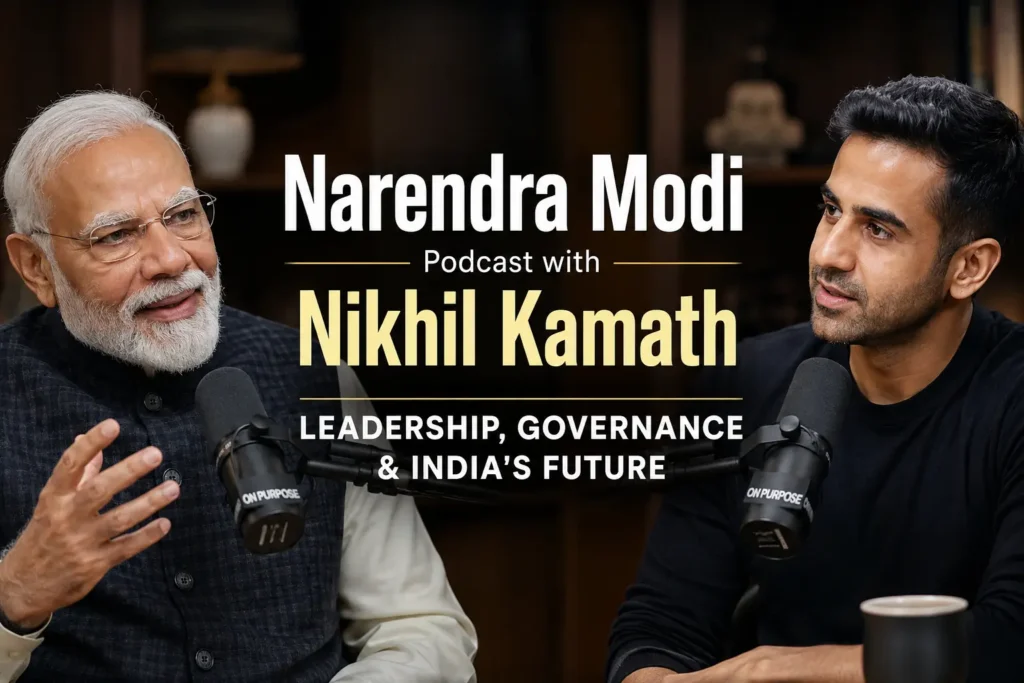
There are unforgettable episodes to a country’s public life that feel just historic when they take place. The moment when People by WTF’s January 2025 podcast episode with Prime Minister Narendra Modi was shot was one such.
For a Prime Minister who had held more press conferences, formal interviews, and televised speeches than most of us can remember for over a decade during office, a podcast was apparently a new means of communication. It reflected how the media in India had evolved, what the key audience was that would determine the course of the country, and the nature of the discussion that a sitting head of government was prepared to have in the open.
What happened next was an hour and 45 minutes of talk that ranged from Modi’s childhood in the jungle, to his philosophy on governing, to India’s unimaginable digital revolution, to world wars and the huge, aspirational India of tomorrow. It was an interview as informal as it gets, yet as penetrating as it had been in years.
This blog highlights all the high points, themes, and take-home messages from that conversation.
The Beginning – A Prime Minister on a Podcast
Nikhil Kamath began the episode by validating what, obviously, everyone listening already knew-this was the first time a sitting Indian Prime Minister had done a podcast. They had no idea about the format and Kamath explained he was a bit unsure about how to host such a high-profile person:
What surprised me about the first ten minutes was how naturally both men got into a real discussion. Modi was not prepared with a prepared speech and regurgitated his point of view, he listened to the questions and replied in a manner that sometimes was hesitant, which did not seem premeditated but rather reflective and introspective.
One was about Vadnagar, where he was born, and grew up modestly-experiences that would eventually influence his perspective on simplicity, dedication, and serving the nation. It was not till he shared a few stories about himself selling tea as a boy, in context instead of as just another political anecdote.
It established an aura of genuineness that persisted throughout the discussion.
Leadership – What It Actually Requires
One of the most fascinating segments of the podcast is how Modi describes leadership: what it practically takes to lead a nation of 1.4 billion people, filled with such extraordinary variety and complexity, with frenzied competing agendas.
He referred to the ‘new government’ adjustment period that inevitably follows leadership change. In his first term, he reflected, both he and the citizens were still getting to know one another – setting expectations, establishing confidence and determining what farmer-government entrepreneur relationship can or should be like.
He was refreshingly honest about the isolation inherent in high office. Public decisions are seldom straightforward, a battle of good versus evil. More often than not, there is a choice between contradictory, less than perfect alternatives, in a state of chaos, with the knowledge that, whatever you do, it will shape millions of lives and the knowledge that some of those lives will disagree anyway.
He went on to speak about the significance of remaining in touch with everyday people – not by means of orchestrated public events, but by genuinely trying to comprehend the effects of policy on real families.
India’s Digital Transformation – The Story Most People Don’t Know
Much of the discussion was dedicated to India’s digital revolution over the last 10 years – and it is a story that even for viewers who have a more-than-hands-on interest in Indian Business & technology was quite enlightening.
Modi discussed India Stack, the multi-layered digitized architecture including Aadhaar, the UPI and DigiLocker, and the expanding web of digital public goods his administration chose to fund at the start of its term-and which is now coming true in ways nobody anticipated.
He explained how UPI has revolutionized the mundane act of financial transaction for hundreds of millions of Indians, who earlier didn’t even have access to bank accounts. How Aadhaar has made direct delivery of government benefits to people a reality without the leakage suffered by older delivery methods. How the digital backbone is unlocking opportunities in health-care, education and farmers those would have been unimaginable decades ago.
He was also sober about what continues to be needed. Access to digital is still patchy. Not every part of the country is yet digital. And the speed of change itself is fraught with pitfalls, as well as opportunities.
India and the World – A Nation at an Inflection Point
Modi’s more global perspective represented one of the most in-depth portions of the podcast, and it generated quite a bit of discussion once the episode was published.
As for India’s foreign policy philosophy-he talked on strategic autonomy, multi-alignment, and the idea that India should “try to retain in international relations engagement with all major powers on the basis of the best national interest.”
He spoke directly on the international conflicts, and very clearly presented the fact that he is for peace, and that India’s voice in international platforms will be that of peace. He talked of how he has chatted with leaders of different nations facing conflicts, and how India can be the voice of talks and peace in global meetings.
He was also candid about the competitive pressures of today’s world order – the reorganization of global supply chains, the technology competition, energy security – and about how India must move to be ready for what’s next.
Youth, Entrepreneurship and India’s Future
Some of the most hope-filled discussion centers around India’s youthful population and what the energy and ambition of its young people might mean to the country’s future.
Modi also touched on his urging for Indians under 40 to get involved in public life,not necessarily politics but all fields which can help build something of significance.Modi genuinely felt that India’s next generation had the combination of achievement, ambition and Westward knowledge that earlier generations simply did not have.
Discussions on startup eco-system, the need to develop domestic champions in technology and manufacturing and creating an environment so that talented young people see building a business in India as their best option rather than leaving for greener pastures.
This part of the podcast struck a chord with Kamath’s actual base — young Indians, entrepreneurs, engineers and professionals invested in answering the question of what India is turning out to be.
Why This Podcast Became So Popular
The Modi-Kamath episode (referred to as Kumar) was viewed by tens of millions of times within days of its posting and became one of the most watched political communications in India’s digital history. It is worth exploring why.
First off, the format worked. A podcast discussion is a different beast than a sterile, staged interview. No studio audience, no inbuilt editorial timeframes, a firmer conversational beat, all led to an openness that most political interviews can’t sustain.
Secondly, the audience was truly fresh. A substantial number of viewers for this episode were young Indians who had never experienced a normal political interview. Kamath’s format reached them on familiar grounds.
Third, the content delivered. Modi was able to talk on a deeply personal level that most political interviews do not cater to. When taken together, his autobiography, policy talk, and true engagement with the subject of leadership displayed the potential for real substantive interaction between interviewers and interviewees.
About Narendra Modi
Narendra Damodardas Modi was born on 17 September 1950, in Vadnagar, Gujarat. He was the 14th Chief Minister of the Indian State of Gujarat from 2001 to 2014 and has been the Prime Minister of India since 2014. He was re-elected as Prime Minister for a second time in 2019 and on 13 May 2024 as 15 th Prime Minister for the second time.
With his leadership, India rose up to become the world’s fifth largest economy, rolled out huge programs in digital infrastructure, clean energy, manufacturing and space exploration, and gained a much higher standing in geopolitics.
And he’s also one of the most followed world leaders on social media, with several hundred millions of followers.
Narendra Modi Social Media Account:
- Narendra Modi Instagram Account
- Narendra Modi Twitter/X Account
- Narendra Modi YouTube Channel
- Narendra Modi Facebook Account
- Narendra Modi Website
- Narendra Modi LinkedIn
- Narendra Modi App
Why You Should Watch This Podcast
This particular episode is a must-watch for those wanting an insight into the mind and thought process of India’s most important politician of the last decade. Not in the guise of any political ideology but more direct without any filter.
Even if you don’t agree with the politics or Modi, the podcast is a great way to hear his thoughts on leadership, governance, the new India and the road ahead in a considered way that simply would not be possible in a normalized news interview.
Conclusion
The Narendra Modi episode of People by WTF was a groundbreaking moment for Indian digital media. It proved that the medium of podcasting had truly arrived as a modern, meaningful public space where communities could hold engaged debates of significant political and historical value.
This was a validation that encapsulated everything Nikhil Kamath had been working towards. For people in India, it was a reminder that several important conversations are taking place today through YouTube, and no longer on television.
And for those who care about leadership, governance and this incredible historic epoch of India – it is among the most valuable hours of material available on the net.
1. Was this truly a number file.Mailing?
Yes. The January 2025 episode of People by WTF with Nikhil Kamath was PM Narendra Modi’s first podcast appearance ever.
2. What did they talk about?
We discussed the childhood of Modi, his way of leadership, the digital Indian story UPI and Aadhaar, World conflicts, Youth Entrepreneurship and the future of India on the world platform.
3. Why are there so many views for this episode?
It was a historic first – a Prime Minister doing a podcast – and it was filled with genuine content, heart-felt, sincere.. And appealed directly to a young audience that often felt disconnected from standard political coverage.
Watch Full Podcast Here:
Narendra Modi Podcast with Nikhil Kamath – Leadership, Governance & India’s Future