|
Getting your Trinity Audio player ready...
|
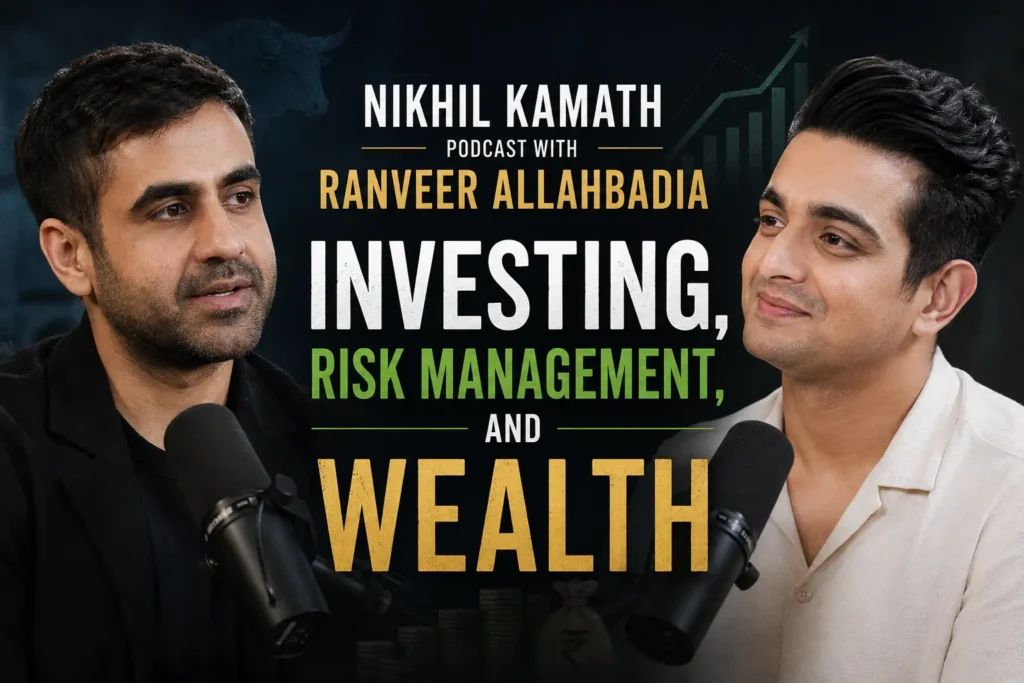
Some talks about money are transactional, some talk about money is transformative. The episode of The Ranveer Show with Nikhil Kamath definitely belongs to the latter,
Nikhil Kamath is no standard geek of finance. He didn’t go to a top-rated college for studying economics and didn’t then proceed to make his name in an established investment bank. Hailing from a humble background, he left high school after Class 10, taught himself how to trade stocks, created India’s foremost retail stockbroker from the ground up, and was a billionaire long before most on his level had even decided where to commence life from. This unorthodox journey means he brings a distinctly unique outlook to financial affairs.
While sitting across from Ranveer Allahbadia on TRS, he delivered one of the most candid and simple sessions on money creation, money discipline, and the mind of a successful investor ever to come out of Indian youtube.
This blog will highlight the main themes, takeaways, and lessons learned from that episode.
- The Beginning of the Conversation
- Understanding the Stock Market – What Most People Get Wrong
- Financial Literacy – Why It Is Never Taught
- Wealth Creation – The Long Game
- Entrepreneurship and Building Zerodha
- Money, Happiness and the Question of Enough
- Why This Podcast Became So Popular
- About Nikhil Kamath
- Nikhil Kamath Organisations and Initiatives
- Why You Should Watch This Podcast
The Beginning of the Conversation
The series begins with Nikhil Kamath, who just shares his story – and it’s a story that will immediately resonate with a large chunk of Ranveer’s global listenership.
He shares about his middle class upbringing in Bengaluru, his decision to drop out of school due to the system not being designed to work the way his brain was functioning and his market journey into stock trading somewhat serendipitously. He began trading with minuscule capital, lost some, learned from it and evolved significantly over time where he truly had an edge in reading markets.
The lack of bravado in this telling of his story. He admits to luck and timing playing a role, to having gone wrong initially, and to his Road not being prescriptive. His candor informs the rest.
Ranveer relates instantly but with a certain distance, it is a story which echoes ‘the kind of unconventional, self-driven life that our young Indian audiences are trying to forge for themselves’, he says.
Understanding the Stock Market – What Most People Get Wrong
Probably the most interesting part of the podcast is Nikhil explaining, in simple terms, what actually happens in the stock market and why the majority of retail investors fail to beat the market.
He suggests that the biggest error most investors make is to approach the stock market as if it were a lottery, indulging in a few quick hits of high risk investing. You hear a great story about some fellow making x times what you are without much effort over a month or two, you throw some money into a fund without really knowing what you are buying, and when the market moves against you you are so worried about losing you sell at the worst possible time.
What he’s really saying is that any successful approach to investing represents a profound shift in mentality-that you are not speculating on price movement. Rather, you are purchasing an interest in actual businesses. And the long-term fortune of those businesses is subject to the kind of analysis you are capable of doing.
Another issue he addresses is the mental burden of investing – individuals’ feeling of greed and fear (leading intelligent people to make wrong calls). According to him, it is at least as crucial as learning to read financial statements.
This portion of the podcast is not to be missed by a generation of young Indians, stepping out into the markets for the very first time.
Financial Literacy – Why It Is Never Taught
One of the key messages that continually points out in the show is the huge disconnect between the significance of financial literacy in life and the utter lack of it in Indian education.
Nikhil highlights the fact that 80% of Indians spend 12 years or more of fundamental schooling without any intention of learning how to budget, deal with credit, think about savings or make investments in a smart manner, bare graduate into a world crammed with financial services designed to drain value out of the unenlightened, totally unarmed.
He claims this is no accident. Financial literacy is not provided, because a financially illiterate population is easier to sell costly, shoddily designed products. Everyone involved in selling financial products benefits from clients who don’t know what they’re signing up for.
The solution, he says, is to be autonomous over your own money education: Reading, making money small, asking uncomfortable questions, do not put our trust in anyone who earns a commission on your investments unless you know exactly what they are selling you.
Has a strong impact on such new/early money managers.
Wealth Creation – The Long Game
Nikhil Kamath is very eloquent when describing what it takes to accumulate wealth over a lifetime and it is far away from the shortcut promotions common to the vast majority of content on the internet.
He discusses the effect of compounding; which is a case of mathematics showing that “steady small returns over a period of years with produce results that will seem far beyond reach until you crunch the numbers.” The difficulty is that the effect of of compounding is that it takes time, and the culture of internet and social media trading actively works against the pace of patience.
He covers another point – income and not investment. Too many people focus on potential investment returns and completely forget that how much you invest in the first place is just as significant. Cultivating your earning potential – your skills, your contacts, your market value – is just as important to wealth creation as investing in stocks.
He is also straightforward about risk. When it comes to investing, “there’s no such thing as a high return without a high degree of risk,” anyone who promises you otherwise is “uninformed or out to sell you something.” Recognizing risk, gauging it accurately, and accepting only the level you can truly afford to embrace is key to making smart investments.
Entrepreneurship and Building Zerodha
From this, the discussion telescopes naturally into Nikhil’s startup experiences, and the Zerodha saga is one of the best instructive stories in modern Indian business history.
He reflects upon the insight that sparked the creation of Zerodha-that the Indian stockbroking industry was fundamentally flawed. Fees were exorbitant, platforms were complicated, and the whole ecosystem appeared skewed in favor of the broker. He and his brother, Nithin, recognized the opportunity to create something truly innovative.
What came after wasn’t an overnight phenomenon. It took years of slow work – focusing on technology, fostering trust, and showing through years of steady results that maybe there really was a better option. Zerodha started purely on word of mouth as the product actually did what it said it would:
He also discusses the discipline it takes to grow a company from scratch without raising capital – a path that mandates generating profits from the get-go and awards unparalleled control and freedom that most venture funded start ups can only dream of. It is a contrarian approach that flips the script on the conventional startup narrative and he lays out an excellent case for why it was the approach Bikha needed.
Money, Happiness and the Question of Enough
One of the wisest parts of the podcast are actually the lulls when Nikhil takes a step away from investing and asks the bigger question; what is money for?
He’s very honest about how his own story with money played out. That at first in the beginning, it felt a real urgency to making money. That once you create the freedom and security, then you want to create something for reasons that are less based on that original story.
He mentions the ‘diminishing returns’ of wealth after a threshold is crossed-how the difference in life quality between a person owning ten crore rupees and a person owning hundred crore is insignificant but how the difference between a person owning zero and a person owning a bare minimum of money is unbelievable.
He sees money as a means to generate options and freedom-not as a fundamental goal in itself. So his ultimate aim isn’t to accumulate the great amount of it, but rather to acquire the sufficient quantity that allows him to have full control over how he dedicates his available time.
This part of the podcast really struck a chord with many, including those who had been pursuing their financial dreams for years, without questioning “why”.
Why This Podcast Became So Popular
The episode on Nikhil Kamath attracted a very interested audience because it managed to plug a real lacuna in material regarding money available for a young Indian audience.
Much of the finance information on the web is either so technical and boring that it has no value for the non-expert, or is such a collection of shortcuts, hacks, and claiming to reveal the secret that you will get rich if you just follow the free advice-more entertainment than education.
Nikhil Kamath sits somewhere in the middle of what you want. He has the credibility of having grown up with a significant amount of accumulated wealth which was entirely accumulated by his own decisions. But he is also frank about the less glamorous side of gaining such wealth. His openness to the psychological and philosophical aspects of money, not merely the technical savings and investments specifics, brings a certain richness to the discussion.
Ranveer’s honest and inquisitive nature and his skill at asking the questions the audience actually wants to hear the answer to, also propels this discussion way beyond a typical interview.
About Nikhil Kamath
Nikhil Kamath( born 5 September 1986 in Shimoga, Karnataka.) is an Indian entrepreneur, investor, and podcaster. He was born in Shimoga and is from India. He is the co-founder of Zerodha, an Indian retail stockbroker, and True Beacon, anasset management firm for investors with ultra-high-net-worth.
In addition, he is a co-founder of Gruhas: a venture capital fund, and started one of the first non-dilutive grant programmes, WTFund, for early-stage founders under 25.
He is also a podcaster, with a regular show called Who is and People by WTF on which he has hosted high profile guests like Prime Minister Narendra Modi, Elon Musk, Sam Altman, Ray Dalio etc.
As of 2025 with a net worth of in excess of three billion dollars he remains one of India’s youngest self made billionaires and one of the most powerful voices on the subject of entrepreneurship, investing and the future of commerce.
Nikhil Kamath Organisations and Initiatives
Nikhil Kamath is associated with:
- Zerodha – Co-Founder (India’s No 1 retail stockbroker)
- True Beacon – Co-Founder (Asset Management)
- Gruhas – Co-Founder (Venture Capital)
- WTFund – Founder (Non-dilutive grants for early founders)
- WTF is Podcast – Host and Creator
- People by WTF – Host and Creator
Nikhil Kamath Social Media Accounts:
- Nikhil Kamath YouTube Channel
- Nikhil Kamath Instagram Account
- Nikhil Kamath Twitter/X Account
- Nikhil Kamath LinkedIn Account
- Nikhil Kamath Facebook Account
Why You Should Watch This Podcast
This episode is a must for anyone determined to turn themselves into a financially literate human being, understand what goes on behind the scenes of markets, or simply reflect deeply on the economic realities of life.
In fact, Nikhil Kamath doesn’t dumb down the subject so much that he’s misleading us, and he doesn’t make it too complex to be talking over our heads. Nikhil Kamath, as he claims himself, is speaking here honestly about something that impacts every single one of us watching – no matter how rich or poor we are.
No matter whether you’re a student who is just starting to invest, a young professional who is working on your long-term wealth building plan or an entrepreneur who needs to understand money when you are building a business, this conversation will get you to think about more than almost anything you will find on Indian YouTube today.
Conclusion
The Nikhil Kamath episode on The Ranveer Show is one of the most real, most practical, most helpful financial discussions I have heard on an Indian podcast ever. Not just on investing tips or market tactics. On your mentality towards money and the purpose of money in a good life.
Nikhil Kamath is one of those people who actually has experienced true wealth; who accumulated tremendous riches through his intelligence, disipline, and risk taking; and who has probably pondered over what it all signifies in greater depths than what can be described in cold financial metrics.
This issue of pragmatic insight and spiritual thought is what makes this episode a perennial favorite with viewers decades after its initial broadcast. And it is why Nikhil Kamath remains one of the most respected names in Indian business and investment.
1. Who is Nikhil Kamath?
Nikhil Kamath is an Indian entrepreneur, investor, and podcaster. He is the co-founder of Zerodha – India’s largest retail stockbroker. He is one of India’s youngest self-made billionaires.
2. What will the podcast be about?
This episode is about the stock market investing, managing finances, creating wealth from compounding, the entrepreneurial story behind Zerodha and the philosophy of money and what it actually is for.
3. What makes this podcast suitable for young investors?
because Kamath has ‘been there and done that’. He combines practical experience with good storytelling to explain the technical side of investing and the psychological side of it in a manner that is simple, direct and applicable.
4. Is this podcast only for those already interested in finance?
Absolutely not. The discussion touches on concepts, such as saving money, long term wealth accumulation, and thoughtful financial planning, that are applicable to one and all.
Watch Full Podcast Here:
Nikhil Kamath Podcast with Ranveer Allahbadia – Investing & Wealth Creation