|
Getting your Trinity Audio player ready...
|
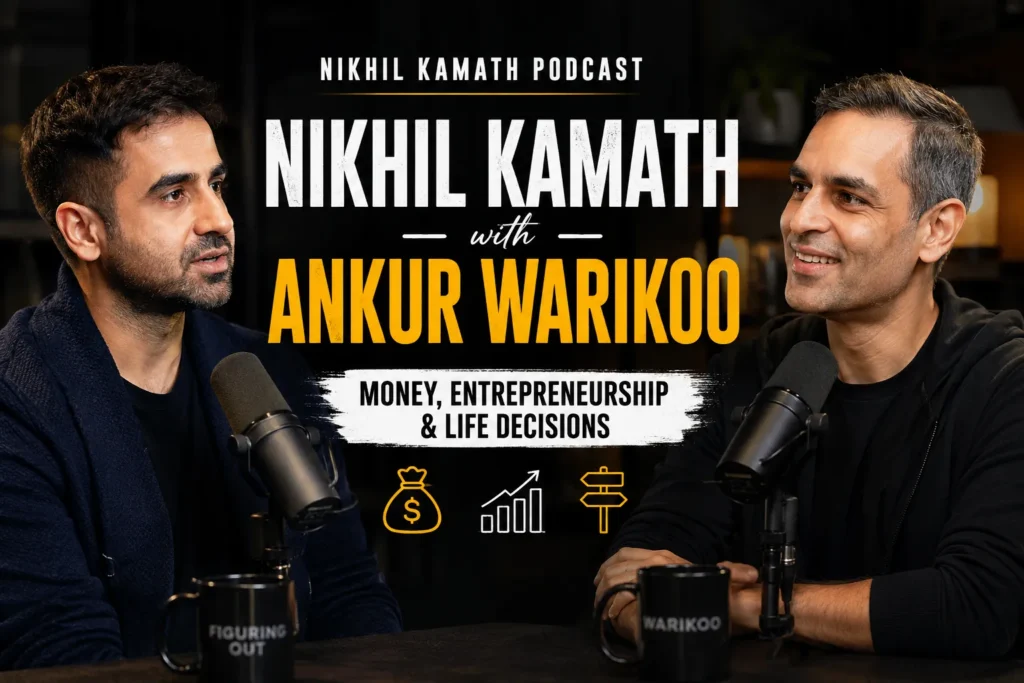
It’s rare that when two people have both achieved remarkable careers on the backbone of financial clarity that a conversation can truly live up to the expectation of being worth a deep dive. Nikhil Kamath’s conversation on Ankur Warikoo’s Figuring Out podcast is just that conversation.
Nikhil Kamath has not only co-founded Zerodha-India’s biggest retail stockbroker-without any external funding and built it into an empire, but also one of India’s youngest self-made billionaires. Over the course of his career, he has made it his mission to break down the mystery around finance and investment for everyday Indians and through his own platform, WTF is, he has gained an enormous following with his intellectually sound and candid content on the topic.
Ankur Warikoo has built a reputation for being financially candid. He is open about his money mistakes from early on in his life, the ups and downs he experienced during the initial years of Nearbuy, and has an in-depth understanding of what genuine financial intelligence looks like in the lives of regular Indians striving for financial security and liberty.
The outcome of a conversation between the two is what anyone young and earnest about finance is in desperate need of hearing.
The Genesis – Two Diverse Paths to Financial Acumen
The conversation between the two founders kicks off with their individual recollections about what their initial financial inclinations have been, and the contrast in their paths are what provide valuable insights.
Nikhil Kamath’s journey toward financial acumen started with the markets. He learned to trade in his teenage years, lost quite a bit of money, but used those experiences to acquire a fundamental understanding of how the financial market works internally, from the inside. Money for him has always been an analytical topic to be deconstructed rather than a dogma to be followed.
Conversely, Ankur Warikoo’s perception of money was forged by its scarcity in his early life. Growing up in a house where every penny counted, money developed into an emotionally complex phenomenon for him-an amalgamation of fear, desire, and an unshakeable need to not ever feel vulnerable about it again. He admits that his relationship with money had him make some decisions that he shouldn’t have years back simply due to emotional conditioning.
The combination of their analytical and emotional take on money create a productive tension throughout the entire discussion.
Redefining Financial Intelligence
One of the highlights of the podcast is when both speakers expand on the concept of what financial intelligence really is-beyond the ability to make shrewd investment decisions or maintain a strict budget.
Nikhil believes that the one most valuable thing most individuals lack in the field of financial intelligence is not investment knowledge, but what he calls financial patience. It’s the ability to form a plan, follow it with discipline, and resist the impulse to second-guess every single decision every time the market fluctuates or behaves unexpectedly. Sounds like a straightforward concept, but when dealing with your own money and a feeling of genuine fear, staying the course is a feat only a few manage to achieve.
Warikoo approaches financial intelligence by understanding one’s own emotions towards money-one’s triggers, so to speak, so that you’re able to make a decision with clarity as opposed to anxiety or greed. He reveals the numerous traps that lead intelligent people to make regrettable financial decisions-lifestyle inflation, social comparisons, FOMO, and equating a hefty net worth with a large self-worth.
The two of them agree that at its core, healthy finance is actually quite boring and extremely unglamorous: the need to spend less than you earn, to invest consistently in a diverse range of assets for a prolonged duration, and to avoid drastically altering decisions based on momentary market behavior or a social media fad.
The Real Curriculum of Entrepreneurship
Both Nikhil Kamath and Ankur Warikoo are pioneers in building highly successful businesses, so it is natural that their discourse on entrepreneurship is anything but theoretical.
Kamath talks about the discipline acquired by starting Zerodha without any outside investors. When you are your own source of funding, every decision regarding products, pricing, and the growth of the business is essentially a battle for survival. He argues that this particular restriction is what fosters genuine clarity and analytical thinking among founders unlike startups that are often cash-rich due to venture funding, which allows them to avoid asking difficult questions about their business viability and revenue streams.
Warikoo’s experience with entrepreneurship is different; he raised funds and expanded his business rapidly, dealing with external stakeholders and investor expectations. He doesn’t shy away from admitting how outside investment altered his perspective on his business decisions-sometimes positively, and at other times in ways that were detrimental.
His biggest entrepreneurial takeaway from his days with Nearbuy is one that he widely disseminates: that the most common mistake aspiring entrepreneurs make is that they can’t distinguish activity from actual progress. It’s easy to be busy, but to make real progress-to move the needle with regards to the important metrics that determine whether your business will survive-you have to be ruthlessly focused, a skill that most people find inherently challenging.
Life Decisions – The Framework You Actually Need
In this extended discussion segment of the podcast, Ankur Warikoo reveals a practical approach he has developed throughout the years for making decisions about careers, relationships, and finance that will not have you looking back and having regrets. He draws heavily from Jeff Bezos’s well-known explanation of the same idea, asking whether one would regret not taking the opportunity more in ten years, as opposed to which one offers the most comfort at the present time.
Nikhil Kamath, in his characteristically analytic style, adds that when making big decisions most individuals aren’t privy to all the required information. He believes that rather than waiting for a “perfect” piece of information-which hardly ever presents itself-the correct course of action is to identify the data that is most likely to impact your decision and procure it before finalising anything.
Both agree that the outcome of your life choices hinges less on inherent intelligence or formal education and more on how well you’re able to refine your thinking process-a skill which anyone can master with a bit of conscious effort.
The Often Untalked-About Connection Between Money and Happiness
The most personal part of the conversation addresses the much-hyped relationship between money and happiness, and it’s on this topic that both speakers show an uncommon amount of candour in a discussion usually avoided by many public figures.
Nikhil Kamath has previously spoken and written about the declining benefits of acquiring more wealth once one already has sufficient; essentially, that although the difference between minimal comfort and abundance is monumental, that of abundance and extraordinary wealth is remarkably negligible. He opens up about how his outlook towards money has transformed over the years from viewing it as an avenue to achieving financial security and independence, to seeing it more as a means to extend benefit to others.
Ankur Warikoo is equally direct: the emotional relationship with money does not automatically improve as the amount of money increases. The anxiety, the comparison, the sense of inadequacy – these are internal patterns that respond to internal work, not to account balances. The person who cannot be at peace with modest financial security will not find peace at greater financial security either.
About Nikhil Kamath
Nikhil Kamath is the co-founder of Zerodha, India’s largest retail stockbroker, and True Beacon, an asset management firm. He is also the host of WTF is and People by WTF podcasts and an active investor and entrepreneur. With a net worth of over three billion dollars, he is one of India’s youngest self-made billionaires.
Nikhil Kamath Social Media Accounts
Why You Should Watch This Podcast
This episode is essential viewing for anyone trying to build genuine financial intelligence – not just investment knowledge but the emotional and psychological foundations that make good financial decisions possible and sustainable. Two of India’s most honest voices on money, in genuine dialogue, is a rare and valuable thing.
Conclusion
The Nikhil Kamath episode on Figuring Out delivers something that most financial content does not: an honest account of what the relationship with money actually looks like for two people who have navigated it thoughtfully over decades. The insights here are practical, personal, and genuinely applicable to anyone at any stage of their financial journey.
1. Who is Nikhil Kamath?
Nikhil Kamath is the co-founder of Zerodha and one of India’s youngest self-made billionaires. He is also a prominent podcaster and investor.
2. What does the podcast cover?
The conversation covers financial intelligence, entrepreneurship lessons, life decision frameworks, and the honest relationship between money and happiness.
Watch Full Podcast Here:
Nikhil Kamath Podcast with Ankur Warikoo – Money, Entrepreneurship & Life Decisions