|
Getting your Trinity Audio player ready...
|
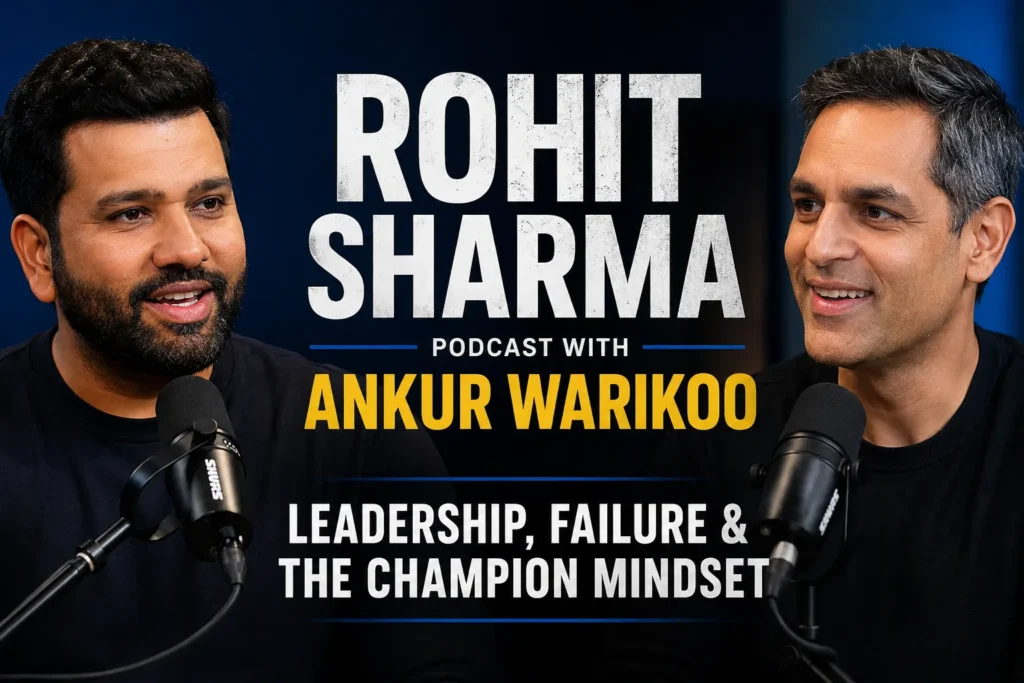
It’s very rare in Indian sport to have had a career with such an interesting arc as Rohit Sharma’s. For years he was the unbelievably gifted cricketer who hadn’t fulfilled his promise – someone whose talent was undeniable but whose performances were so wildly inconsistent as to be endlessly frustrating for fans and selectors alike. And then something changed. The man whose career was twice written off became one of the most successful limited-overs batsmen in the history of the sport and, ultimately, the man to lead India to the T20 World Cup in 2024.
His conversation with Ankur Warikoo on Figuring Out is perhaps the most candid discussion about leadership, failure and the psychology of high performance in the Indian digital space today-and it’s so much more valuable because of it comes from a man who has grappled with those questions at the very highest level and under the most intense scrutiny.
The Beginning – The Career that Could have gone so differently
The episode starts with Rohit Sharma discussing the early part of his career and it’s honesty and candor in this discussion that makes this part of the conversation so invaluable.
He talks about those years when his talent seemed undeniable yet wasn’t consistently matching it. He admits his relationship with his own game was more fragile than it seemed from the outside and that it was overly dependent on validation and not underpinned by any real certainty of his own capabilities.
He explains how things finally started to change – it wasn’t so much one thing as a gradual shift in the way he approaches pressure, preparation and the concept of control versus non-control. It wasn’t about things beyond his own direct control any longer but about perfecting the present process.
Ankur Warikoo then ties this back to a useful concept that he has evangelized extensively: the distinction between input goals and output goals. The batsman who focuses on output goals-i.e., scoring a hundred-is constantly setting himself up for pressure and frustration whenever he walks to the crease not having yet achieved it, whereas the one who focuses on process goals-playing each ball as it comes, staying present, executing his own game plan-is guaranteed a measure of control over his own output.
Leadership – What captaincy truly taught him
A significant chunk of the conversation deals with leadership and Rohit Sharma’s description of the lessons that captaincy has taught him is truly compelling reading.
He speaks of the difficult mental adjustment you need to make when your primary job shifts from being one of a performer to that of making all others in the team perform well. His focus in playing shifted from himself to the collective. That shift is perhaps not so easy and involves a real transformation in the way you look at every situation and in what every circumstance means to you – it’s not about what this means for Rohit, but what it means for us.
He touches upon the critical decisions in captaincy where he has made a real difference by being the composed, focused presence who assured his teammates they were supported-and readily admits he hasn’t always succeeded at this and it has been an ongoing learning process.
Public Failure – A Test no one can ever prepare for
The most relatable section in this whole episode is likely Rohit Sharma’s discussion about public failure and how he has learnt to live with it without letting it completely destroy him and his game.
He doesn’t sugarcoat how hard it is and how cricket in India is much more than just a sport. It is a national obsession and the sheer intensity of the scrutiny that comes with failure is unparalleled in most professions. Each unsuccessful series brings forth millions of online commentators and while social media is a great forum for many things, for some it only seems to bring out the negative critics. He is adamant that remaining level headed amid all this is something you need to cultivate over a lifetime.
The insight he shares is something that immediately clicks for Ankur Warikoo as well-what we really need to be taking from criticism is the accurate bit of it. Not all critics have valid points and distinguishing between the useful feedback which helps you grow, versus the general noise which seems to come naturally when your name is out there, takes experience and time.
He is also a firm believer in how a thorough preparation helps when you’re under the kind of pressure faced by any athlete, particularly at the international level. The prepared athlete, who has gone through every possible scenario that can befall them and knows exactly how they want to respond, has it so much easier.
The T20 World Cup – what the victory actually felt like
The latter half of the conversation centers around India winning the T20 World Cup in 2024 with Rohit Sharma at the helm. He speaks candidly about the mounting pressure that had followed India’s previous near misses and heart breaks in past World Cups-which had only increased with each ensuing tournament and the Cup itself becoming an almost mythical prize that always seemed to slip away at the last moment.
While he openly admits that finally winning felt wonderful on a personal level and served as huge validation for all the team had been trying to do; he admits the thing which meant the most was that the win proved the process the team had been adopting for a long time was correct.
The lesson he learned through all of this is universally true for anyone-that the process itself should be the most important thing, regardless of the result. The team that prepares, competes and supports each other should consider that a true success even before the silverware comes along, which ultimately only confirms the value it had created.
About Rohit Sharma
Rohit Sharma is one of the most revered figures in the history of Indian cricket and previously served as the captain of the Indian national cricket team. He holds numerous records, including most centuries in T20 internationals, and holds the record for the highest individual score ever in One Day Internationals. In 2024, he led India to victory in the T20 World Cup, a feat that cemented his legacy. He is celebrated worldwide for his immense technical skill and sharp tactical acumen as a cricketer.
Rohit Sharma Social Media Accounts:
Rohit Sharma Instagram Account
Rohit Sharma Twitter/X Account
Why you need to watch this podcast
Anyone who is interested in the psychology of performance under extreme pressure, the leadership traits required in stressful situations, or simply in how a person copes and returns stronger from public failure needs to watch this episode. Rohit Sharma is refreshingly honest, provides specific, insightful lessons throughout and makes this a compelling watch for anyone aiming for success in any field.
1. Who is Rohit Sharma?
Rohit Sharma is a former Indian cricket captain and one of the most celebrated batsmen in cricket history, known for leading India to the T20 World Cup in 2024.
2. What does the podcast cover?
The conversation covers leadership as a captain, handling public failure, the psychology of high performance, preparation, and the experience of winning the T20 World Cup.