|
Getting your Trinity Audio player ready...
|
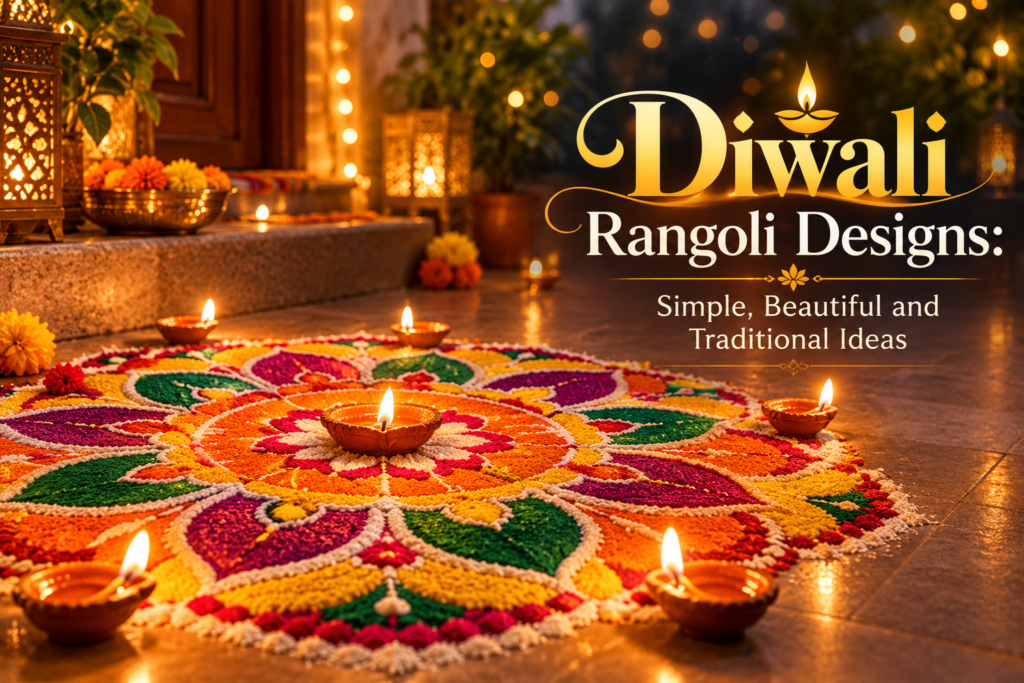
Diwali is one of the most loved festivals in India, celebrated with beautiful lights, colourful decorations, sweets, and family gatherings. One of the most popular traditions during this festival is creating rangoli at the entrance of the home. From simple geometric patterns to colourful floral designs, rangoli adds beauty to the surroundings and makes guests feel welcome.
If you are looking for Diwali rangoli designs that are easy to create, attractive, and suitable for different spaces, there are plenty of options to explore. You do not need professional artistic skills or expensive materials to make a beautiful rangoli. With a little creativity, some colours, and a few simple techniques, you can create a design that makes your home look festive.
In this guide, you will discover simple Diwali rangoli ideas, traditional patterns, flower rangoli designs, modern styles, and useful tips to help you create a beautiful decoration at home.
Why Is Rangoli Important During Diwali?
Rangoli has a special place in Indian festivals and cultural traditions. Families create rangoli at entrances, courtyards, and prayer areas to welcome guests and celebrate the festive occasion. In many traditions, rangoli is also associated with positivity, prosperity, and good fortune.
During Diwali, rangoli is often placed near the main entrance or around the area where people light diyas. Traditional designs may include lotus flowers, circles, footprints, peacocks, and symmetrical patterns. Some families prefer colourful designs, while others use rice flour, flower petals, or simple white patterns.
Today, rangoli has also become a creative way to decorate modern homes. People experiment with different colour combinations, stencils, decorative materials, and contemporary designs while keeping the traditional spirit alive.
1. Simple Diwali Rangoli Designs for Beginners
If you are making rangoli for the first time, start with a small and simple pattern. Basic shapes are easy to draw and can look beautiful when the colours are arranged neatly.
You can create a circle in the centre and surround it with petals, dots, or small triangles. Another easy option is to draw four or eight petals around a central point and fill each section with a different colour.
Bright shades such as pink, yellow, blue, green, and orange can make a simple design look attractive. You can also add a few flower petals around the border to give it a festive appearance.
Tips for beginners:
- Start with a small design near the entrance.
- Use chalk to outline the pattern before adding colours.
- Choose three or four colours that complement each other.
- Use a spoon or small paper cone to control the flow of rangoli powder.
- Keep a cloth nearby to clean accidental spills.
Simple rangoli designs are especially useful when you have limited time but still want to decorate your home for Diwali.
2. Traditional Diwali Rangoli Designs
Traditional rangoli designs remain popular because they reflect India’s rich cultural heritage. These patterns often use symmetry, repeated shapes, floral motifs, and bright colours.
A traditional design can feature a large central flower surrounded by smaller petals and decorative borders. Circular patterns are another popular choice because they are easy to adapt to different spaces.
You can also create traditional motifs such as lotus flowers, diyas, mango leaves, and paisley shapes. White outlines around coloured sections help make the design look neat and detailed.
For a classic appearance, use red, yellow, orange, green, and white. You can place small clay diyas around the rangoli, keeping enough space between the flames and any loose decorative materials.
Traditional rangoli works well at the main entrance, in an open courtyard, or near a designated prayer area. Choose a size that suits your available space rather than trying to make the largest possible design.
3. Flower Rangoli Designs for Diwali
Flower rangoli is a beautiful option for people who prefer natural materials instead of coloured powder. It is also a good choice for homes where children are helping with the decorations.
Marigold petals, rose petals, and other colourful flowers can be arranged into circles, petals, spirals, or simple geometric patterns. Yellow and orange marigolds create a bright festive appearance, while red and pink rose petals add contrast.
To make a flower rangoli, first mark the shape on the floor. Place the petals along the outline, then fill the inner sections with different colours. Green leaves can be used to create borders or separate individual sections.
A simple flower rangoli can be made in a circular tray or directly on a clean, dry floor. Using a tray is particularly convenient because you can prepare the design elsewhere and move it carefully into position.
Flower rangoli is best prepared close to the time when guests arrive, as fresh petals can lose their colour and freshness. Avoid placing flowers where people will frequently walk over them.
4. Small Diwali Rangoli Designs for Home Entrances
Not every home has a large entrance or an open courtyard. Fortunately, small rangoli designs can be just as attractive as larger patterns.
A compact lotus, a circular floral pattern, or a simple arrangement of dots and curves can decorate a doorway without blocking the walking space. You can also create a small rangoli beside the entrance rather than directly in the centre.
For apartments, narrow corridors, and compact homes, use a vertical or semicircular design against a wall. This makes better use of limited space and keeps the entrance practical.
Choose colours that stand out against the floor. For example, bright pink and yellow can look attractive on a dark floor, while darker shades and white outlines can provide contrast on lighter surfaces.
Keep the design away from door swings, stair edges, and frequently used walking paths. A smaller, well-finished rangoli often looks better than a larger design that feels crowded.
5. Diwali Rangoli Designs with Diyas
Combining rangoli with traditional clay diyas creates a warm and festive decoration. The colours of the rangoli complement the soft glow of the lamps, making the entrance or courtyard feel inviting.
Start with a circular or floral rangoli. Leave small spaces around the outer edge where you can place diyas. You can also arrange the lamps in a symmetrical pattern around a central flower.
Use yellow, orange, red, and white to create a traditional appearance. A white outline can separate the colours and make the pattern easier to see in the evening.
Safety is important when using real flames. Place diyas on a stable, non-flammable surface, keep them away from curtains and loose flower petals, and never leave them unattended. LED diyas are a practical alternative for homes with children, pets, or limited space.
Avoid putting lamps directly on loose rangoli powder, which can make them unstable. Arrange the lamps first or use suitable holders to keep them upright.
6. Peacock Rangoli Designs for a Colourful Look
Peacock rangoli designs are popular because their feather patterns allow you to use several colours creatively. Although detailed peacock designs can take time, simplified versions are suitable for beginners.
Begin with a basic outline of the peacock’s body and tail. Use blue and green for the body and feather sections, then add yellow, white, and purple details to create contrast.
If drawing the entire bird feels difficult, make a semicircular peacock-feather pattern instead. Repeated feather shapes arranged around a central point can create a similar effect without requiring detailed drawing skills.
Use chalk to establish the outline before filling it with colour. Work on one section at a time and clean the edges as you go.
Peacock rangoli is a good choice for larger entrances and courtyards where the details can be seen clearly. For smaller areas, a simple feather-inspired pattern may be more practical.
7. Lotus Rangoli Designs for a Traditional Appearance
The lotus is a familiar motif in Indian art and religious decoration. Its symmetrical petals make it suitable for both simple and detailed rangoli designs.
To create a lotus rangoli, draw a small circle in the centre and add a row of pointed petals around it. You can add a second row of larger petals to make the pattern fuller.
Use pink and white for the petals, green for the outer details, and yellow for the centre. Alternatively, choose a two-colour design for a clean and modern appearance.
A lotus rangoli works well near the entrance or in a suitable prayer area. It can also be combined with small diyas, floral borders, or simple geometric patterns.
For beginners, drawing the same petal shape repeatedly is easier than attempting an intricate freehand design. Keeping the petals evenly spaced will make the final result look balanced.
8. Modern and Minimalist Diwali Rangoli Ideas
Modern rangoli designs are ideal for people who prefer clean patterns rather than heavily detailed artwork. These designs often use limited colours, geometric shapes, and plenty of open space.
You can create a minimalist rangoli using white lines and a single bright colour. A symmetrical mandala, a series of connected circles, or a simple floral outline can look elegant without requiring a large amount of material.
Another option is to use stencils for precise shapes. Stencils can help beginners create repeated patterns around a central design, although they are not necessary for simple geometric artwork.
Try combining white with gold-toned decorative accents, pink with purple, or yellow with blue. The best combination depends on the colour of your floor and the decoration around the entrance.
Modern rangoli is particularly suitable for apartments, contemporary interiors, and smaller spaces. Its simplicity also makes it quicker to prepare before guests arrive.
9. Mandala Rangoli Designs for Diwali
Mandala rangoli uses repeated shapes arranged around a central point. The circular structure gives the design a balanced appearance and allows you to build details gradually.
Start with a small circle and draw guidelines extending outward. Add petals, dots, curves, and repeated geometric shapes in each section. Once the outline is complete, fill alternate sections with contrasting colours.
For a traditional look, use several bright colours. For a minimalist style, use white powder with one or two accent colours.
Mandala patterns can be as simple or as detailed as you want. Beginners can make a small design with two or three layers, while experienced artists can add more rings and decorative borders.
The most important part is maintaining symmetry. Light guidelines and evenly spaced dots can help you keep the pattern consistent.
10. Easy Rangoli Designs Using Stencils
Rangoli stencils are useful when you want a neat design without drawing every shape by hand. They are available in floral, geometric, diya, and other decorative patterns.
Place the stencil on a clean, dry surface and spread rangoli powder carefully over the openings. Lift the stencil slowly to avoid disturbing the design.
You can use one stencil to create a small rangoli or repeat the pattern to build a larger arrangement. Different colours can be used for each section to create a more detailed appearance.
Stencils are particularly helpful for children and beginners, as they reduce the time needed to prepare the outline. However, always supervise young children when using fine powders and keep materials away from their eyes and mouth.
For a more personalised look, add a hand-drawn border or flower petals around the stencilled pattern.
11. How to Make a Beautiful Diwali Rangoli Step by Step
Creating a beautiful rangoli becomes easier when you follow a simple process.
Step 1: Choose the location. Select a clean, flat area near the entrance, in a courtyard, or beside a suitable prayer space.
Step 2: Clean the floor. Remove dust, oil, and loose dirt. Allow the surface to dry completely before starting.
Step 3: Select a design. Beginners can choose circles, flowers, dots, or a small lotus. More experienced artists may prefer mandala or peacock patterns.
Step 4: Prepare the outline. Use chalk or a light pencil suitable for the surface to mark the design. Make sure the pattern fits the available space.
Step 5: Add the colours. Fill the larger sections first, then work on smaller details. Use a spoon, paper cone, or your fingers to distribute the powder neatly.
Step 6: Refine the borders. Clean uneven edges and add dots, petals, or decorative lines where needed.
Step 7: Add finishing touches. Place flower petals or LED diyas around the design. If using real flames, keep them stable and safely separated from flammable materials.
Following these steps helps you create a tidy rangoli without rushing through the process.
12. Best Colours and Materials for Diwali Rangoli
The colours and materials you choose can change the overall appearance of your rangoli.
Bright shades such as red, yellow, orange, pink, green, and blue are suitable for traditional designs. White is useful for outlines, while contrasting colours help individual shapes stand out.
Common materials include coloured rangoli powder, chalk, flower petals, rice flour, and reusable stencils. You can also use leaves and other natural materials to create borders and decorative details.
Before using a powder on a large area, check whether it is suitable for your floor and avoid products that cause skin or respiratory irritation. Keep fine powders away from children and pets.
If you prefer a natural decoration, fresh flowers and leaves are attractive alternatives. They also make it easy to create a design without using large quantities of coloured powder.
13. Tips to Make Your Diwali Rangoli Look More Attractive
A few small details can improve the appearance of even a simple rangoli.
- Choose a design that matches the size of your entrance.
- Use contrasting colours so the pattern is easy to see.
- Keep the outline clear and the sections evenly spaced.
- Avoid using too many colours in a small design.
- Add a neat border to give the rangoli a finished appearance.
- Use fresh flower petals when choosing a floral design.
- Keep the surrounding floor clean so the colours stand out.
- Take a photograph in good natural light before the powder or petals are disturbed.
You do not need an elaborate design to create a festive atmosphere. A neat, colourful pattern that suits your home is often the best choice.
FAQs
Which rangoli design is best for Diwali?
Simple floral, lotus, circular, and mandala rangoli designs are popular choices for Diwali. The best option depends on the available space, your experience, and the materials you prefer.
Which rangoli is easiest for beginners?
Circular patterns, dot rangoli, simple flower designs, and stencil-based patterns are generally easier for beginners. They require fewer details and can be completed in a short time.
Which colours are best for Diwali rangoli?
Red, yellow, orange, pink, green, blue, and white are commonly used for colourful Diwali rangoli designs. Choose contrasting shades to make the pattern stand out.
Can I make Diwali rangoli without coloured powder?
Yes. You can use marigold petals, rose petals, leaves, rice flour, or other suitable natural materials. Flower rangoli is a particularly attractive alternative to coloured powder.
Where should I make rangoli at home?
The main entrance, courtyard, balcony entrance, and suitable prayer areas are common locations. Choose a flat, dry space that does not obstruct people walking through the home.
How can I protect my rangoli from being disturbed?
Place the design away from busy walking paths, door swings, and areas where pets frequently move. You can also prepare flower rangoli in a tray and position it carefully in a suitable location.
Conclusion
Diwali rangoli is a simple and creative way to bring festive colour into your home. Whether you prefer traditional floral patterns, lotus designs, peacock motifs, mandalas, or minimalist geometric shapes, there is an option for every space and skill level.
Start with a design that feels manageable, select colours that complement your surroundings, and take time to keep the outlines neat. Add flowers or safely positioned diyas to complete the decoration.
With a little planning and creativity, even a small rangoli can make your entrance look welcoming and festive. Choose a design that reflects your style, enjoy the process with your family, and make rangoli a beautiful part of your Diwali celebration.