|
Getting your Trinity Audio player ready...
|
When people talk about India’s greatest scientists and inventors, names like C. V. Raman, Homi Bhabha, and A. P. J. Abdul Kalam often come to mind. Yet one extraordinary innovator remains surprisingly unknown to many Indians despite making revolutionary contributions to engineering, manufacturing, transportation, agriculture, and technology.
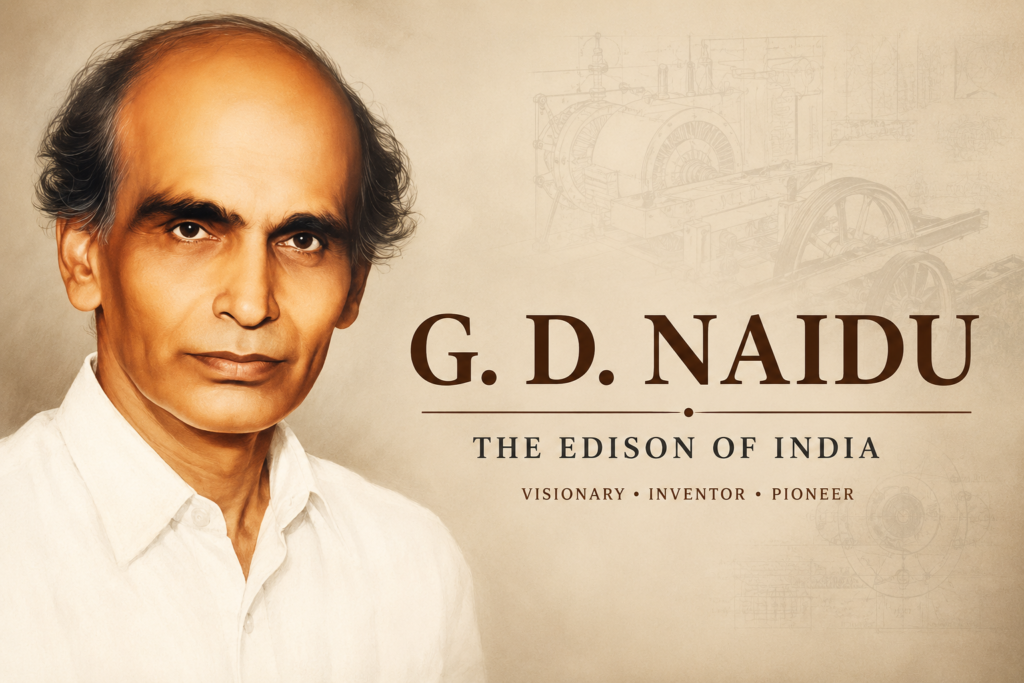
That man was Gopalaswamy Doraiswamy Naidu, popularly known as G. D. Naidu. Often called the “Edison of India” and the “Miracle Man of Coimbatore,” he was a self-taught inventor whose ideas were decades ahead of his time. From building India’s first electric motor to creating affordable automobiles and pioneering industrial manufacturing, G. D. Naidu played a crucial role in shaping modern India’s technological foundation.
Today, more than 50 years after his death, his legacy continues to inspire engineers, entrepreneurs, and innovators across the country.
Early Life and Birth
G. D. Naidu was born on 23 March 1893 in Kalangal village near Coimbatore, in what was then the Madras Presidency under British India and is now part of Tamil Nadu. He belonged to an agricultural family and spent much of his childhood in rural surroundings.
Unlike many famous scientists, Naidu was not academically successful. He disliked traditional schooling and dropped out after receiving only a basic education. His teachers often considered him troublesome because he preferred practical learning over classroom lessons. Yet this curiosity would later become the foundation of his genius.
As a young man, he became fascinated with machines and mechanical systems. He worked various jobs in Coimbatore and saved enough money to purchase a motorcycle. Instead of merely riding it, he dismantled it completely to understand how every component worked and then reassembled it. This hands-on approach became his lifelong method of learning.
From Mechanic to Industrial Pioneer
Naidu’s journey from a village boy to an industrial pioneer is one of the most inspiring success stories in Indian history.
After mastering mechanics, he entered the transport business. Around 1920, he purchased a motor vehicle and started operating passenger services between Pollachi and Palani. What began as a small venture soon expanded into one of India’s most efficient transportation networks.
He established Universal Motor Service (UMS), which became renowned for punctuality, maintenance standards, and customer service. At a time when transportation infrastructure in India was still developing, Naidu introduced systems that rivaled global standards.
His success in transportation generated the capital that would later fund his experiments and inventions.
Why He Was Called the “Edison of India”
The comparison with Thomas Edison was not accidental.
Like Edison, G. D. Naidu had little formal education but possessed extraordinary practical intelligence. He constantly experimented with machines, electrical systems, and manufacturing processes. He believed innovation should solve everyday problems and improve people’s lives.
Over his lifetime, he worked in:
- Electrical engineering
- Automobile engineering
- Agricultural research
- Manufacturing technology
- Photography
- Transportation
- Mechanical engineering
His ability to move across multiple disciplines earned him the title “Edison of India.”
India’s First Electric Motor
One of Naidu’s most significant achievements came in 1937, when he developed and manufactured one of the first electric motors produced in India.
At the time, most industrial equipment had to be imported from foreign countries. Naidu wanted India to become self-reliant in manufacturing.
The motor was produced through his company National Electric Works (NEW) in Coimbatore. This achievement laid the foundation for future industrial growth in South India and inspired generations of manufacturing entrepreneurs.
Many industrial organizations that later became major engineering companies were influenced by his work.
Revolutionary Inventions
G. D. Naidu’s inventions covered an astonishing range of industries.
Electric Shaver
Long before electric grooming devices became common, Naidu developed a motorized razor that operated using dry-cell batteries. This was considered a highly innovative product for its time.
Improved Camera Technology
He created a distance-adjustment mechanism for cameras that improved photographic precision and ease of use.
Fruit Juice Extractor
Naidu designed efficient extraction systems for fruit processing, helping improve productivity in food preparation.
Voting Machine
Decades before electronic voting became widespread, he developed a tamper-resistant vote-recording machine aimed at ensuring fair elections.
Kerosene-Powered Fan
In areas without reliable electricity, Naidu designed a fan powered by kerosene, demonstrating his focus on practical solutions for ordinary people.
Radio Manufacturing
In the early 1940s, he announced plans to manufacture affordable radio sets in India, making communication technology accessible to more citizens.
India’s Affordable Car Vision
One of Naidu’s most remarkable projects was the development of a low-cost Indian automobile.
In 1952, he unveiled a compact two-seater petrol-powered car priced around ₹2,000. His dream was to create an affordable vehicle for ordinary Indians, decades before the arrival of modern budget cars.
However, government licensing restrictions prevented large-scale production.
Many historians believe that if his project had received support, India might have developed its affordable automobile industry much earlier.
Contributions to Agriculture
G. D. Naidu was not limited to machines and engineering.
He conducted extensive research in agriculture and plant breeding. Through experimentation, he developed improved varieties of:
- Cotton
- Maize
- Papaya
His work aimed to increase productivity and help farmers achieve better yields.
This demonstrated his belief that technology should benefit every sector of society, not just industry.
Educational Contributions
Naidu strongly believed that India needed skilled technicians and engineers.
He invested heavily in technical education and vocational training. Many educational institutions in Coimbatore were influenced by his vision of practical learning.
Instead of focusing solely on theoretical knowledge, he emphasized hands-on experience, workshops, and industrial exposure.
Today, this approach is widely accepted in engineering education, but Naidu advocated it decades earlier.
Challenges and Struggles
Despite his brilliance, G. D. Naidu often faced obstacles.
Many of his inventions struggled to receive government approval or industrial support. Licensing issues, bureaucracy, and policy restrictions prevented several of his innovations from reaching mass production.
He frequently expressed frustration that India was not fully utilizing the potential of indigenous innovation.
Some historians argue that had he worked in Europe or America, many of his inventions would have received global recognition.
Death of G. D. Naidu
G. D. Naidu passed away on 4 January 1974 in Coimbatore, Tamil Nadu, at the age of 80.
Although his death marked the end of a remarkable era, his influence remained deeply embedded in Coimbatore’s industrial culture.
Today, the city is often called the “Manchester of South India,” and many credit pioneers like G. D. Naidu for helping create its manufacturing ecosystem.
Why India Still Remembers G. D. Naidu
More than five decades after his death, G. D. Naidu remains an iconic figure because of several reasons:
He Proved Education Is Not the Only Path to Success
Despite being a school dropout, he became one of India’s greatest inventors. His life demonstrates the power of curiosity, persistence, and practical learning.
He Promoted Self-Reliance
Long before the “Make in India” movement, Naidu advocated domestic manufacturing and technological independence.
He Was Decades Ahead of His Time
Many of his ideas—affordable cars, electronic voting systems, practical automation, and indigenous manufacturing—became mainstream years later.
He Built Industries
His contributions helped transform Coimbatore into one of India’s leading industrial cities.
He Inspired Future Innovators
Engineers, entrepreneurs, and inventors continue to draw inspiration from his unconventional approach to problem-solving.
G. D. Naidu Museum in Coimbatore
One of the best places to learn about his life is the G. D. Naidu Industrial Exhibition and Museum in Coimbatore.
The museum houses:
- Original inventions
- Machinery prototypes
- Engineering models
- Historical photographs
- Personal collections
Visitors can witness firsthand the remarkable creativity and vision of one of India’s greatest inventors.
Upcoming Biopic: “GDN” Starring R. Madhavan
A new generation is about to discover G. D. Naidu through cinema.
Watch Trailer here: G.N.D Trailer
The upcoming biographical film “GDN“ stars acclaimed actor R. Madhavan in the role of G. D. Naidu. Directed by Krishnakumar Ramakumar, the film aims to showcase the inventor’s extraordinary life, struggles, achievements, and contributions to India. The film is scheduled for release in July 2026 and has already generated significant interest through its trailer and promotional material.
The movie also features actors including Priyamani, Sathyaraj, Jayaram, Yogi Babu, and others. Industry observers believe the film could introduce Naidu’s story to millions of Indians who are unfamiliar with his legacy.
Much like Madhavan’s acclaimed portrayal of scientist Nambi Narayanan in Rocketry, expectations are high that GDN will bring deserved recognition to one of India’s most overlooked visionaries.
Conclusion
G. D. Naidu was far more than an inventor. He was a visionary entrepreneur, industrial pioneer, agricultural researcher, educator, and nation-builder. Born in a small village with minimal formal education, he transformed himself into one of the greatest innovators India has ever produced.
His inventions, industries, and ideas laid the groundwork for technological progress at a time when India was still finding its industrial identity. Yet perhaps his greatest contribution was proving that innovation comes not from degrees or titles, but from curiosity, determination, and the courage to think differently.
As the upcoming film “GDN” introduces his story to a wider audience, India has an opportunity to rediscover a genius who truly lived decades ahead of his time—the man rightly remembered as the Edison of India.