|
Getting your Trinity Audio player ready...
|
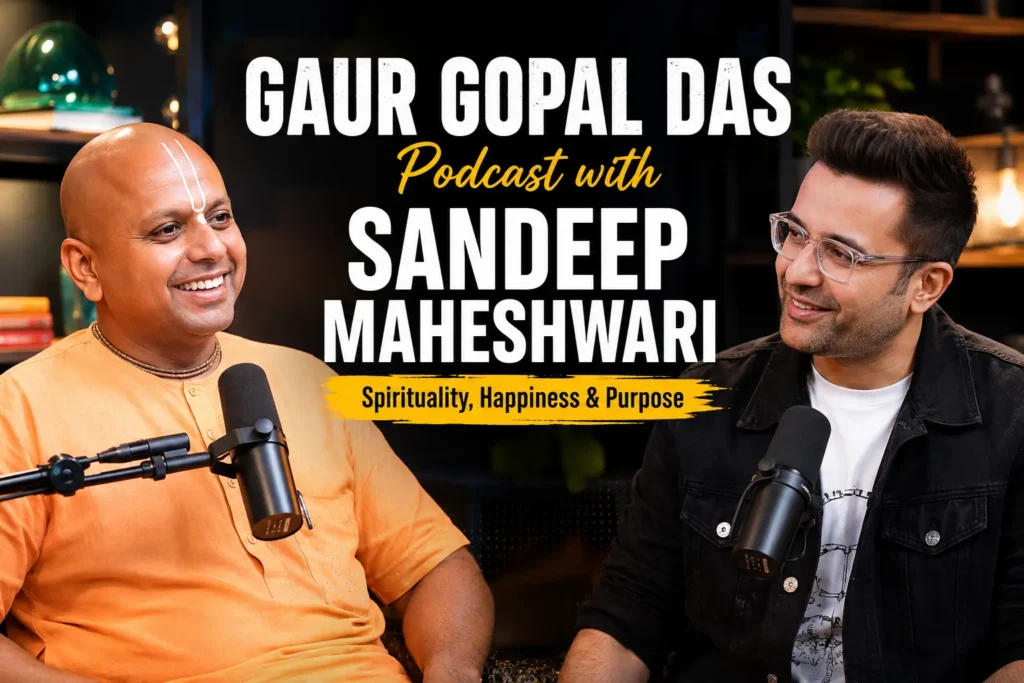
There are some conversations that just feel destined to be. Gaur Gopal Das meeting Sandeep Maheshwari is definitely one of those. The two have spent their lives trying to help the human race navigate their internal being – albeit starting at very different points, and looking through different means. Gaur Gopal Das comes from a vedic monastic order, translating the truths of ancient spiritual practice into language relevant to the modern human being. Sandeep Maheshwari comes from the field of entrepreneurship and experience, providing lessons learned through hardship, rather than book study.
Both men produced one of the best, most relatable conversations about happiness, purpose, presence, and true living that has captured the attention of millions across the spectrum of humanity.
This blog outlines the important takeaways and most meaningful parts of that interaction.
The Beginning – Two Paths to the Same Question
The episode begins with both speakers commenting on the question that has occupied each of their lives: What is happiness, and how can so many people achieve all the things that they believe will bring them happiness and yet still be dissatisfied.
Gaur Gopal Das’ response to this is through the lens of Vedic knowledge, which has been attempting to solve these issues for millennia, and has developed complex models for understanding external phenomena and their relationship with internal realities. His premise is one which has been stated through millennia and remains relevant; external things such as wealth, power, status, friends, success can never make you truly happy, simply because it is inherently temporary. So when your internal peace rests on external things that have an element of temporariness, it’s structurally unsound.
Sandeep Maheshwari shares his personal experience of how he’s spoken quite often of the time when he founded images bazaar and he was finally successful but still wasn’t satisfied the way he expected himself to be. His relief was palpable, he felt genuinely satisfied but was still not experiencing the kind of inner joy and fulfillment he thought success would bestow upon him.
The shared experience of that gap between external success and inner fulfillment establishes an immediate bond between the two speakers and helps determine the tone for the rest of the episode.
What Is Happiness – Really?
The most philosophically interesting part of the discussion is their long segment on defining happiness- what it really is and what it is not. Most of us do not understand happiness beyond pleasure, thrills, success, or satisfaction.
Gaur Gopal Das explains the Sanskrit distinction between sukha (happiness resulting from external factors) and ananda (happiness not reliant on our current circumstances). Our whole life is spent searching for sukha, and not,ananda. This search for ananda takes the form of working towards the next milestone, the next relationship, the next acquisition, etc. But this only fails to develop within us the capacity for ananda.
According to Das,anandais not acquired; it is revealed. It is the state of the mind when there is no agitation in the mind: no desire, no fear, no resentment, and no comparison. Spiritual practices-meditation, service, contemplation, worship-are really methods that work to remove the agitation from the mind until its natural state of ananda is revealed.
Sandeep Maheshwari then directly asks so everything that we do comes down to removing noise from within ourselves, and not seeking outside factors? The answer is indeed yes, Gaur Gopal Das affirms,and the profound impact of that statement, delivered in the middle of such a philosophically profound conversation, strikes viewers right away.
Finding Purpose – The Question That Cannot Be Avoided
Purpose is a very important topic that both speakers have a lot of integrity in.
Gaur Gopal Das talks about dharama, but not the purely religious sense, rather in the sense of the right kind of action, of living life according to your nature and actual responsibilities. The emptiness that a lot of us feel, Gaur argues, is that because we are not living in accordance with our dharama-we’re just doing what’s expected of us, or what will make us profit, or what seems more respected rather than what we are meant to be doing.
He is also critical of the idea of “purpose has to feel amazing”. In the Vedic system, dharma is not necessarily pleasant; it can be challenging and can be about things that feel uncomfortable. It requires discipline, sacrifice and doing things that are hard even if they do not feel rewarding simply because it is what needs to be done. The notion that purpose has to feel like it’s pure passion is a misrepresentation that causes a lot of people to abandon things they might have genuine purpose in.
Sandeep adds a pragmatic touch to how do we know what our purpose is if we don’t know what it is? Simple-start doing things and notice what feels hollow and what feels meaningful and let that point the way. Purpose rarely appears through a moment of divine enlightenment; it’s developed through active involvement.
Mindfulness and the Practice of Presence
So, much of the talk is around presence, and Gaur Gopal Das’s description of it, I think is among the most lucid and intuitive ones in Indian content.
He describes how the human mind naturally operates everywhere but the present, looping through the past, be it with regret or reminiscence, or the future, be it with fear or phantasy, completely neglecting the only reality it ever operates in – the current moment. The essence of mindfulness practice is simply noticing the wandering of the mind, and bringing it back to the present.
He is emphatic that it’s not a spiritual luxury, but a practical requirement. An unfocused mind cannot succeed in business, cannot establish deep human connections, cannot make quality decisions. The business benefit, he asserts, is at least as strong as the spiritual benefit of presence.
Sandeep Maheshwari gives his personal experience with meditation and presence, detailing the change in perceptions that occur with long-term practice-how intractable problems become manageable, how difficult relationships simplify, how even the quality of attention you bring to mundane tasks is radically transformed.
Relationships – The Mirror We Cannot Escape
The segment on relationships is one of the most insightful and goes far beyond generic “relationship advice” fare on the internet:
Gaur Gopal Das comments on how the nature of our relationships provides unparalleled insight into ourselves. In our most intimate relationships, the irritations, conflicts and disappointments we face are not really about the other person, but rather they provide information to us about our own unresolved patterns and issues- the wounds, expectations and defensive strategies we carry from our own past.
He speaks about the difference between reactive and responsive relating-acting from the conditioned emotional programs that have been implanted by our past versus operating from genuine choice and awareness. The work of cultivating this choiceful response is one of the most critical areas in life for anyone to cultivate.
Sandeep Maheshwari frames it simply: the quality of your relationships is an extension of the quality of your relationship with yourself. If you cultivate the internal, the external will transform.
Why This Conversation Resonated So Widely
This conversation between Gaur Gopal Das and Sandeep Maheshwari hit a massive nerve primarily due to it discussing questions that everyone asks, but not many public conversations engage with truly.
Questions around happiness, purpose, a ‘life well lived’ are not fringe philosophical questions, but they are the central questions of human life, and a generation of Indian youth, that has been assured that achievement = happiness, are beginning to discover, through personal experience, that that is not the case.
This episode gives words to that realization, with warmth, wisdom, and a practicality that allows ancient philosophy to be a usable guide for real life.
About Gaur Gopal Das
Gaur Gopal Das is a renowned Indian monk, life coach and motivational speaker. He completed his education from College of Engineering, Pune and has previously worked with Hewlett-Packard. Gaur Gopal Das left the corporate world and joined the ISKCON monastic order where he has lived and studied for more than twenty years. He is a bestseller author, TEDx speaker and is one of the most followed spiritual speakers on social media with tens of millions of followers on platforms like Facebook, Instagram, etc.
Gaur Gopal Das Social Media Accounts:
- Gaur Gopal Das YouTube Channel
- Gaur Gopal Das Instagram Account
- Gaur Gopal Das Twitter/X Account
- Gaur Gopal Das Website
Why You Should Watch This Podcast
This episode is mandatory watching if any one of you has ever experienced the phenomenon of feeling like you were lacking something even in your personal triumphs, if you are attempting to gain an insight into what truly constitute authentic happiness, or if you want to acquire knowledge on how time-tested spiritual wisdom can be relevant even in a very practical modern Indian situation.
Conclusion
The Gaur Gopal Das Sandeep Maheshwari discourse is one of the most subtle yet potent Indian digital content there has been; it does not try to enthrall, but to inform, and in doing so provide with something much greater than most pieces that attempt to satiate the audience.
1. Who is Gaur Gopal Das?
Gaur Gopal Das is an Indian monk, life coach and motivational speaker affiliated with ISKCON. He is revered for his profound simplicity in making ancient Vedic philosophy comprehensible in modern times.
2. What does the podcast consist of?
The conversation discusses various aspects of happiness, purpose, mindfulness, the act of present-moment consciousness and the art of sustaining authentic, emotionally stable relationships.