|
Getting your Trinity Audio player ready...
|
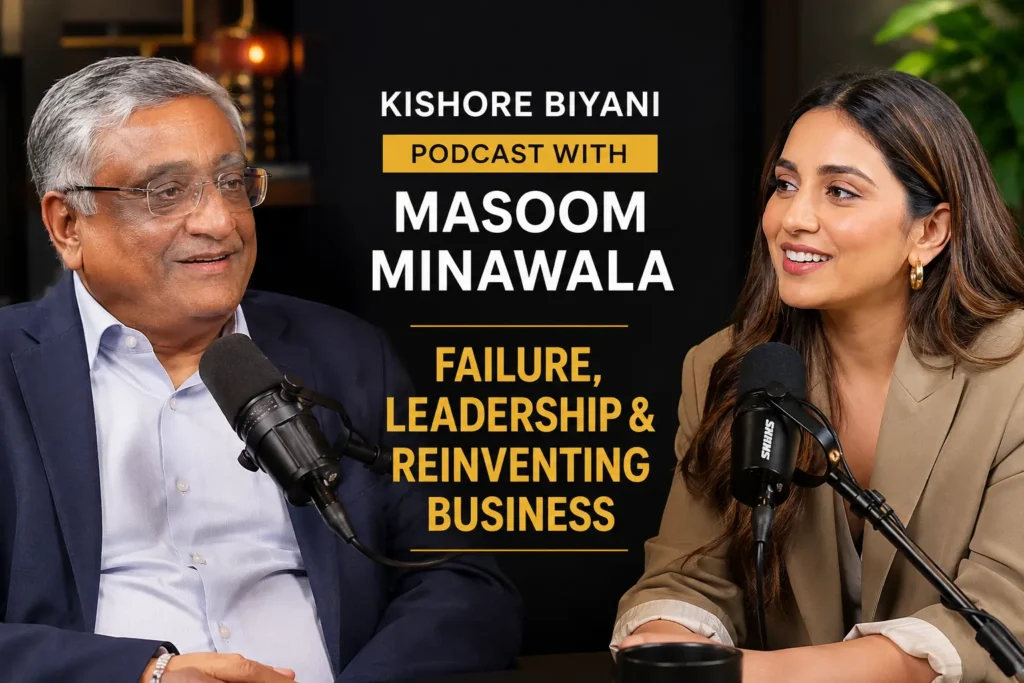
This was one of the most awaited episodes of The Masoom Minawala Show. It had one of the most influential businessmen of India and the visionary behind Future Group- Kishore Biyani. Biyani revolutionized the shopping behavior of Indians by becoming the founder of modern Indian retail and the pioneer of brands like Big Bazaar, Pantaloons, Central and Food Bazaar.
But what was more impactful than talking about success in this episode was the deep discussion about nothing less valuable than failure, resilience, reinvention, leadership and both wins and losses.
Most entrepreneurs have a tendency to talk more about success than failures, but Biyani spoke a different story. In conversation with Masoom Minawala, he relived both high and low points, the changing trend of retail in India, the struggle of leadership, evolving consumer demands, and key takeaways for every entrepreneur going through trying times.
This episode appealed to a lot of founders, business owners, students and future entrepreneurs for giving a true glimpse of business.
Starting the Conversation
Masoom started the conversation by welcoming Kishore Biyani to The Masoom Minawala Show and acknowledged his impact on the Indian Retail sector.
For decades, Biyani was the most talked about businessman in India. The visionary, whose company Future Group brought modern retail concepts to India, transforming the shopping habits of Indians.
But, moving away from accolades, the duo soon diverted the conversation to the lessons learned.
From the onset, Biyani ensured that entrepreneurship is never easy.
All entrepreneurs face uncertainties, failures, and self-doubts.
The Vision Behind Future Group
I thought one of the interesting parts was how Future Group was actually built up.
In a growing organized retail industry in India at the time Kishore Biyani took the opportunity to develop an experience for the Indian customer.
He didn’t necessarily import western ideas in the retail space but studied Indian taste and behaviour.
He believed this focus on the customer helped him establish what are some of the most well-known retail brands in India.
This story underscored how observing consumers is key and as Biyani put it, the greatest businesses in any sphere come not from trends, but from solutions to ordinary problems, a lesson for aspiring entrepreneurs in all fields.
Redefining Retail in India
The podcast went on to discuss the evolution of organised retail over the years. When Big Bazaar was launched many Indian consumers were new to such an experience where value, variety and convenience were brought under one roof. Biyani went on to talk about how having an understanding of the buying behavior of the Indian consumer helped the company a great deal. A key lesson that the conversation underlined was how businesses should be adapted to fit the needs of the Indian customer, many businesses may fail due to an unwillingness to break the mold and be Indian.
The Reality of Failure
One of the more effective portions of the podcast dealt with the idea of failure.
In the past few years, Future Group had endured several major financial and operational failures.
Biyani didn’t shy away from the subject.
In fact, he argued that failure is unavoidable for any entrepreneur.
Business leaders aren’t correct 100% of the time. Markets change. Consumer desires change. Unexpected disruptions happen and upend industries. The podcast explored the idea that adversity can, and should, be a source of knowledge.
Biyani posited that one learns more from failure than success. Achievement boosts confidence, while failure builds wisdom. The audience likely found this part of the podcast very relevant because it goes against the widely held perception that successful individuals never err.
Leadership Through Challenges
Leadership emerged as another central theme during the entire episode. Masoom asked Biyani how a leader should behave during uncertain times. He emphasized that leadership is the most critical during crises. Employees, customers, investors and stakeholders depend on leaders for reassurance and guidance when conditions are dire. Key leadership qualities discussed were the ability to remain calm, make informed decisions, and think with a long-term perspective.
Biyani argued that a leader doesn’t need all the answers, but instead needs to have a capacity to learn, adapt and guide teams through adversity. The insights shared during this part of the episode are especially pertinent to founders and entrepreneurs.
Entrepreneurship and Risk-Taking
One of the dominant parts of the conversation was on entrepreneurship.
Biyani stressed on the fact that entrepreneurship is nothing but taking calculative risks.
A lot of people tend to wait for the perfect moment before they start anything, but the opportunities may appear when things are not perfectly in place.
The talk was about how you can be positive and real at the same time, as far as entrepreneurship is concerned. You cannot simply depend on your aspiration, but also on knowing what market conditions are at present.
Biyani gave a lot of emphasis on curiosity and experimentation and the attitude to keep learning, this is something that distinguishes successful entrepreneurs from failures, which usually is a failure to learn or change.
Understanding the Consumer
The part where understanding the consumer has been a strength, Biyani had. How the expectations of the consumer have changed with time, what is it about the change in lifestyle, about technology and social media, e-commerce and a multitude of other things that have led to changes in retail.
Biyani said that companies are needed to change at all given times, in order to remain relevant in the market. When you fail to understand what the expectations are and what is expected of you then the company will always falter.
Reinvention and Second Chances
Reinvention was the key word throughout the discussion.
For most, failure represented the end of a dream.
For Biyani however, failures presented an opportunity to embark on new horizons.
It was discovered how entrepreneurship allows us to convert adversities into success and transform hardships into valuable lessons that build resilient characters and better business strategies.
Instead of accepting our failures as definitive endings, we should look at them as the right start to something better.
It was precisely the kind of advice that aligned with the spirit of The Masoom Minawala Show.
What Made This Podcast a Hit?
This episode of the Masoom Minawala Show has become one of the most well-received conversations among viewers as it intertwined business know-how with the truthful aspect of failures and growth. The viewers enjoyed listening to topics like:
- Lessons in Entrepreneurship
- Leadership knowledge
- Success in failure
- Retail revolution
- Customer behavior patterns
- Risk-taking plans
- Personal growth and development
This discussion truly touched the audience due to its honesty without sugarcoating any real success story.
About Kishore Biyani
Kishore Biyani is an Indian businessman, entrepreneur and founder of the Future Group. He is well-known to be a forerunner of the organized retail sector in India and was instrumental in revolutionizing retail trade. In his endeavor he successfully launched a number of landmark brands and emerged as one of India’s leading businessmen. His vision remains an inspiration for many businessmen, entrepreneurs and retailers throughout the country.
Kishore Biyani Businesses and Ventures:
- Future Group
- Big Bazaar
- Pantaloons
- Central
- Food Bazaar
- Future Lifestyle Fashions
- Future Consumer
- Retail Innovation Projects
Kishore Biyani Social Media Accounts:
- Future Group Corporate Platforms
- Business and Leadership Media Features
- Industry Conference Appearances
Why You Should Watch This Podcast
This episode is a must-listen for entrepreneurs, startup founders, students, business professionals, and people who are passionate about leadership and self-improvement.
From the conversation on business strategy to adaptability, risk-taking, customer behavior, resilience, you take away a multitude of insights that can help you in your business venture.
From starting a startup to scaling a business, you are all covered in this episode.
Conclusion
This interaction between Kishore Biyani and Masoom Minawala turned out to be one of the most enriching business-focused episodes of The Masoom Minawala Show.
Through conversations on retail innovation, leadership, failure, reinvention, entrepreneurship etc Biyani shed light on lessons that have importance beyond the domain of business.
His experience sharing both successes and failures provided a complete and realistic view of business.
The episode reminded viewers that failure is not the opposite of success—it is often part of the journey toward it.
That powerful lesson is exactly why the conversation continues to resonate with entrepreneurs and business leaders today.
1. Who is Kishore Biyani?
Kishore Biyani is an entrepreneur and founder of Future Group, known for pioneering organized retail in India.
2. Why did this podcast become popular?
The podcast became popular because it explored entrepreneurship, leadership, business failures, resilience, and the evolution of Indian retail.
3. What was the main focus of the conversation?
The discussion focused on retail innovation, leadership, failure, consumer behavior, entrepreneurship, and reinvention.
4. What did Kishore Biyani say about failure?
He emphasized that failure is a valuable teacher and an essential part of every entrepreneurial journey.
5. Who should watch this podcast?
Entrepreneurs, startup founders, students, business leaders, and professionals interested in growth and leadership can benefit from watching this episode.
Watch Full Podcast Here:
Kishore Biyani Podcast with Masoom Minawala – Failure, Leadership & Reinventing Business