|
Getting your Trinity Audio player ready...
|
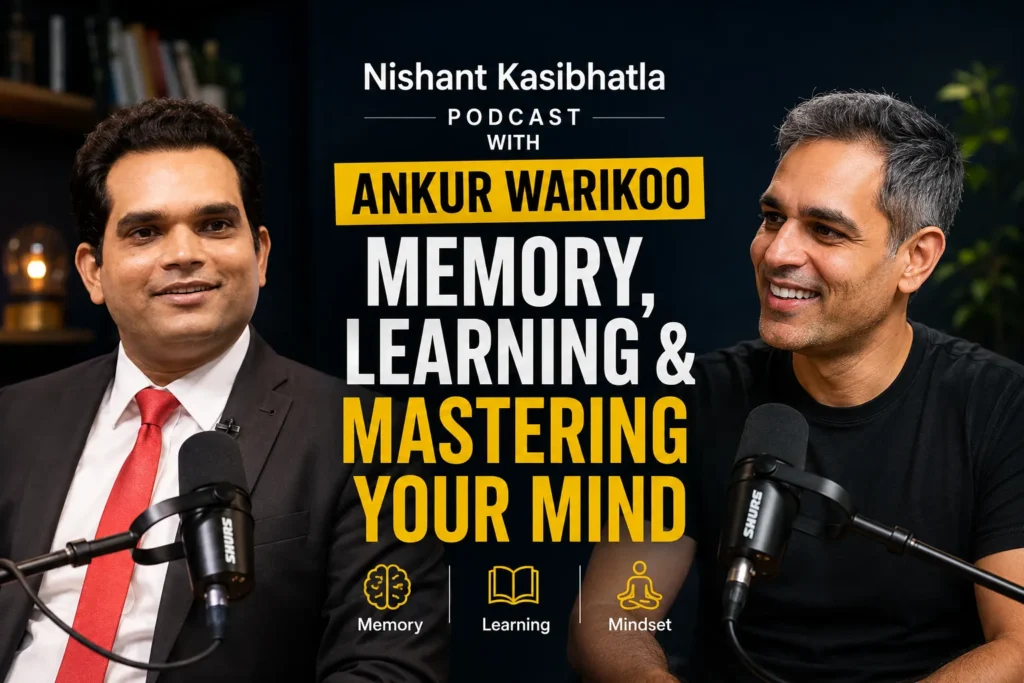
Many of us believe that memory is just some pre-defined capability that humans have. Some have excellent memories while some others do not. We are born with some ability to remember some things and some are born with the ability to remember certain things. We can’t really change it. However, this entire belief is completely wrong, and Nishant Kasibhatla is someone who has dedicated his life to proving this wrong.
Nishant Kasibhatla is a Grand Master of Memory. He is among a few elite individuals in the world who hold this title which is given on the basis of competitive memory performance. He is someone who has broken many world records, but he is also a teacher who has spent his years translating the knowledge of memory champions into usable tools which ordinary people can learn and use for better memory. People have used Nishant’s techniques for learning faster, improving their ability to retain information and maximizing the results of time spent learning a skill.
The discussion with Ankur Warikoo on the show Figuring Out is one of the most interesting episodes in the entire run of the show. It’s an episode which you will find educative as you will learn a lot about how our minds work and what our potential can be if we start working with our mind rather than against it.
The Beginning: Memory Is A Skill, Not A Talent.
The show begins with Nishant Kasibhatla, in his own clear style, telling the most fundamental point of his entire work which is the concept that memory is not a fixed ability with which we are born. It is something that we can improve through proper understanding and the correct practice.
Nishant also tells us how he became a world-record-holding memory champion. From a typical student who didn’t possess any special ability for remembering things to this level, he went on to prove that it is something anyone can do by applying the correct methods. This was not an overnight process, but his remarkable journey shows that his techniques, used in competitive environments, are directly transferable to help anyone enhance their everyday memory and learning abilities.
Ankur Warikoo asks the question his audience is probably thinking: “If memory is a learnable skill then why doesn’t everyone know this?”. Nishant explains that the education system focuses on learning through revision and passive memorization without ever teaching the techniques that actually work. People thus waste their years struggling to use their memory in an ineffective manner.
How Memory Actually Works: The Science Behind The Techniques
The entire podcast also focuses in detail on the neuroscience behind memory. It delves into what makes things memorable and others not and how to use this information to enhance learning.
According to Nishant Kasibhatla, our brain works like a machine that identifies patterns and associations. It doesn’t store information like a computer does, i.e., as separate files. Instead, our brain stores information in association networks. When we get new information, it is linked to what we already know. We are more likely to remember something when it is linked with emotion, senses, and spatial locations.
The implications for practical memory are immense. We find it much harder to remember isolated facts like a list of dates, or an order of things. This is in contrast to when information is made memorable through a story or by linking it to a prior knowledge base or by associating it with a striking image or emotion. Techniques of memory champions are nothing but an organized way of forming such associations more effectively.
The show demonstrates some techniques like the memory palace method in which one associates things with locations on a known path and substitution method that transforms something abstract to an image that is easier to recall.
LEARNING FASTER: Applying Memory Techniques in the real world
The part that stands out most in this conversation is when Nishant Kasibhatla talks about applying memory techniques for real world learning contexts that we really care about. For example, how memory techniques could be revolutionary for language learning, professional development or academic studying by reducing the time taken to learn and increasing the knowledge we acquire and retain. Traditional academic learning methods which only rely on passive rereading and repetition are inefficient compared to this new way of active recall and association.
He makes sure to draw a clear line between the use of memory techniques for learning and for just memorizing. The understanding needs to come first through genuine learning and the memory techniques are tools which will help in storing that information for recall when needed. He also links it to his own principle of learning where one must first acquire knowledge, then recall it and finally use it for practice, all of which are enhanced with memory techniques.
MASTERING YOUR MIND: Beyond Memory
In the later part of the conversation, the discussion goes beyond the specifics of memory to encompass the larger idea of mastering one’s own mind. This includes mental control, precision of thought and all-around enhancement of cognitive functioning not limited to just memory.
Nishant explains how concentration, memory, and performance are related. To pay adequate attention while learning anything new or trying to solve something. This ability to focus is extremely rare in today’s digital world, and hence is a highly valued commodity. Practices such as meditation and mindfulness help in strengthening our attentional capacities, whereas it is also important to have ‘offline time’, and to control our information intake so that our brain does not get overstimulated.
Ankur Warikoo connects these points with his belief in intentionality and explains how success comes when individuals are precise about where they invest their focus, energy, and time.
What Schools Need To Teach (But Are Not):
One of the most memorable parts of the show is the mutual frustration expressed by the speakers regarding how education systems continue to approach learning as a passive phenomenon rather than as an active skill to be learned and improved.
Nishant Kasibhatla outlines what a scientific system of education should ideally include: teaching explicit memory techniques, using spaced repetition as a standard method of practice, actively recalling information rather than just reviewing it passively, and understanding how sleep, nutrition, and exercise influence cognition.
Ankur Warikoo, bringing in his own viewpoint of the importance of financial literacy, points out the lack of its teaching in schools. Both of them believe that the existing gap between what education systems provide and what they could provide is one of the biggest challenges in India’s human capital development.
About Nishant Kasibhatla:
Nishant Kasibhatla is a Grand Master of Memory, and a world record holder in this discipline. He is a renowned speaker, best-selling author and trainer who has spent years helping people use memory champion techniques to enhance their brain power. He resides in Singapore and has helped many people across Asia achieve more from their potential.
Nishant Kasibhatla Social Media Accounts:
- Nishant Kasibhatla YouTube Channel
- Nishant Kasibhatla Instagram Account
- Nishant Kasibhatla Website
- Nishant Kasibhatla Facebook Account
Why You Should Watch This Podcast
A ‘must watch’ for students, professionals and for any one who wants to get better at learning and memory. Nishant Kasibhatla covers the science as well as the practice of memory with immense clarity and passion, and the techniques are easily implementable.
Conclusion
The Nishant Kasibhatla episode on Figuring Out is one of those few conversations that genuinely expands your world, changing how you view a concept you thought you already understood. So many of us are operating with a faulty, limiting model about our memories and capacities for learning which has simply no evidence to back it up. This conversation provides you with an accurate one, and an empowering one.
1. Who is Nishant Kasibhatla?
Nishant Kasibhatla is a Grand Master of Memory and world record holder, whose life’s work has been in making memory and learning techniques available to the common man.
2. What is discussed in the podcast?
The episode discusses: how our memory truly works, memory techniques and tricks to increase retention, application of memory skills to real-life situations, increasing attention spans and focus, and what children should be taught in schools about learning.
3. Can anyone actually improve their memory significantly?
Yes – and in this episode you will learn how. Learning to remember is a skill and can be taught as one to anyone with the right instructions and practice.