|
Getting your Trinity Audio player ready...
|
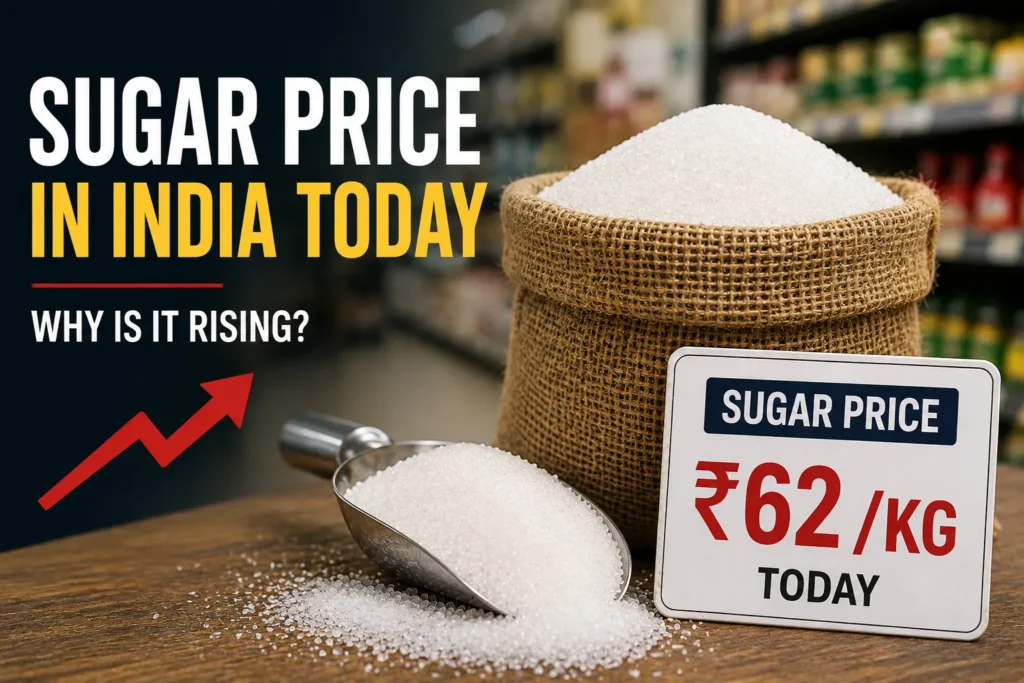
Sugar Price in India Today: Sugar prices have climbed sharply across India, with the latest government data showing the All-India average retail price of sugar at ₹62.47 per kg as of August 23, 2026. The price is significantly higher than the ₹48.18 per kg recorded on July 20. In some markets, retail prices have reportedly reached ₹65–₹70 per kg.
The sudden increase has raised concerns among households, sweet manufacturers, bakeries, beverage companies and other businesses that use sugar as a major ingredient.
The Central Government has responded with several measures, including 10 lakh metric tonnes of duty-free raw sugar imports, stock limits for bulk consumers and tighter monitoring of sugar inventories.
But why has sugar become so expensive, and will prices come down? Here is the latest update.
Sugar Price in India Today
According to the Department of Consumer Affairs’ Price Monitoring System, the latest available All-India average retail price of sugar was:
₹62.47 per kg
Data date: August 23, 2026
This is an average across monitored markets, so the actual price paid by consumers can vary depending on the city, retailer, quality and local supply conditions. The government monitors sugar prices daily across hundreds of market centres.
Sugar Price Trend in India
| Date | Average Retail Sugar Price |
| July 20, 2026 | ₹48.18/kg |
| August 20, 2026 | ₹55.70/kg |
| August 23, 2026 | ₹62.47/kg |
The latest figure shows that sugar prices have moved substantially higher in a matter of weeks.
1 Kg Sugar Price in India
The average 1 kg sugar price in India is currently around ₹62.47, based on the government’s latest national retail-price data.
However, consumers may see different prices in local markets.
In some cities and markets, sugar has reportedly reached ₹65–₹70 per kg, particularly where local supply is tighter.
Therefore, ₹62.47 should be understood as the national average, not a fixed retail price applicable to every shop.
Why Are Sugar Prices Rising in India?
The recent sugar price increase is being attributed to several factors rather than a single cause.
1. Lower Sugar Production
One of the biggest concerns is lower-than-expected domestic sugar production.
The government’s latest estimate puts sugar production for the current season at around 306 lakh tonnes, significantly below the earlier estimate of about 343 lakh tonnes.
Lower production has increased concerns about future availability, particularly as demand rises during the festival season.
2. Red Rot Disease Is Affecting Sugarcane
Red Rot, a fungal disease that affects sugarcane, has damaged crops in important sugar-producing regions.
The Centre has identified crop damage from Red Rot and other agricultural problems as one of the factors behind the lower production outlook.
Union Food and Consumer Affairs Minister Pralhad Joshi has also pointed to Red Rot and weather-related factors while explaining the current sugar-price situation.
3. Weather Conditions and El Niño
Weather is another important factor affecting sugarcane production.
Sugarcane requires substantial water, making the crop vulnerable to both excessive rainfall and inadequate rainfall. Weather-related crop damage has contributed to concerns about domestic sugar availability.
The government has also cited El Niño-related conditions as one of the factors affecting agricultural output.
4. Festival Season Demand
India’s festival season is approaching, and sugar consumption normally rises during this period.
Demand increases for:
- Sweets and mithai
- Biscuits
- Cakes and bakery products
- Soft drinks
- Desserts
- Chocolates
- Ice cream
- Packaged foods
The combination of stronger seasonal demand and concerns about lower production is putting additional pressure on sugar prices.
5. Hoarding and Speculation
The government has also raised concerns about hoarding and speculative trading.
According to the Ministry of Consumer Affairs, some traders and market intermediaries have held excessive stocks or engaged in speculative transactions, creating an artificial perception of shortage.
To address this, the government introduced stockholding restrictions and required dealers to report their inventory regularly.
Is There a Sugar Shortage in India?
Not necessarily.
This is an important point because rising prices do not automatically mean that India has run out of sugar.
The government has said that sufficient sugar is available to meet domestic consumption requirements. Its concern is that supply is becoming tighter relative to demand and that stockpiling and market behaviour may be contributing to price volatility.
So the current situation is better described as a price and supply-management problem, rather than a complete nationwide shortage.
Is Ethanol Responsible for the Sugar Price Rise?
The role of ethanol has become a major political and economic debate.
Some critics have argued that diversion of sugarcane and sugar towards ethanol production has reduced the quantity of sugar available for consumers.
However, the Central Government has rejected the claim that ethanol diversion is the main reason for the current price increase.
The government says the share of sugar diverted for ethanol has actually declined from around 12% in 2022–23 to about 9% in 2025–26. It attributes the current price rise mainly to lower production, crop damage, festival demand, tighter supplies and hoarding/speculation.
Therefore, it would be inaccurate to say that ethanol alone caused the current sugar price rise.
What Is the Government Doing to Control Sugar Prices?
The government has introduced several measures to increase availability and discourage stockpiling.
10 Lakh Tonnes of Duty-Free Sugar Imports
The Centre has allowed 10 lakh metric tonnes of raw sugar to be imported without the usual import duty, with the quota available until October 31, 2026.
This is a significant policy move because India has not undertaken sugar imports of this scale for nearly a decade.
The objective is to increase domestic availability and reduce upward pressure on prices.
Stock Limits for Bulk Consumers
The government has also tightened inventory rules for large sugar consumers.
From September 1 to November 30, 2026, bulk consumers using more than 10 tonnes of sugar per month will be restricted to holding approximately 15 days of inventory.
The aim is to prevent excessive stockpiling ahead of the festival season.
Stock Limits for Dealers
Stockholding limits for sugar dealers have also been imposed.
The government introduced these restrictions from August 1 through November 30, 2026, with dealers required to declare their stocks and update their positions regularly.
The government says the measure is intended to curb hoarding and speculative trading while ensuring that sugar reaches the market.
Monitoring Sugar Stocks
Authorities are also checking inventories held by sugar mills and monitoring market conditions.
The objective is to determine whether adequate physical stocks are available and to prevent artificial scarcity.
What Is the Government’s Current Sugar Production Estimate?
The government’s latest production outlook is around 306 lakh tonnes, compared with the earlier estimate of roughly 343 lakh tonnes.
That represents a significant downward revision and is one of the main reasons market participants are concerned about supplies.
The reduction has been linked to crop damage, Red Rot, weather conditions and other agricultural factors.
How Are Higher Sugar Prices Affecting Consumers?
For consumers, the increase directly affects household grocery expenses.
But the impact goes beyond buying sugar.
Sugar is a major ingredient in many everyday food products. If prices remain high, manufacturers may face higher production costs.
Potentially affected products include:
- Sweets
- Biscuits
- Cakes
- Pastries
- Soft drinks
- Chocolates
- Ice cream
- Desserts
- Packaged foods
The upcoming festival season could make the impact more noticeable because demand for sweets and bakery products normally increases during this period.
How Are Sweet Makers and Food Businesses Being Affected?
The increase is particularly significant for businesses that use large quantities of sugar.
Sweet manufacturers, bakeries, beverage companies, restaurants and food-processing businesses are facing higher input costs.
In Gujarat, for example, sweet makers have reported sugar prices around ₹60 per kg, adding pressure to the cost of traditional sweets and confectionery products.
If sugar remains expensive, some businesses may eventually increase the prices of finished products.
Will Sugar Prices Come Down?
It is difficult to predict exactly when sugar prices will decline.
Prices could moderate if:
- Duty-free imports increase domestic supply
- Sugar mills release sufficient stocks
- Hoarding decreases
- Government stock restrictions work effectively
- Festival demand stabilises
- Domestic production expectations improve
The arrival of imported sugar will also be important. Some shipments from Brazil are expected to reach India closer to October because of shipping and processing timelines.
Until additional supply reaches the market, prices could remain volatile.
Sugar Price in India Today: Latest Update
As of August 24, 2026, the latest official All-India average retail price data available is for August 23, showing sugar at:
₹62.47 per kg
This is the best current national-average figure for consumers to use rather than older ₹48 or ₹55 figures that appeared in earlier reports.
At the same time, actual retail prices are higher in some locations, with reports of ₹65–₹70 per kg in certain markets.
Consumers should therefore check their local market price before assuming that ₹62.47 is the exact price at every shop.
Sugar Price in India: Key Details
| Detail | Latest Information |
| Latest official average retail price | ₹62.47/kg |
| Price data date | August 23, 2026 |
| July 20 price | ₹48.18/kg |
| August 20 price | ₹55.70/kg |
| Some local market prices | ₹65–₹70/kg |
| Current production estimate | Around 306 lakh tonnes |
| Duty-free imports approved | 10 lakh metric tonnes |
| Import deadline | October 31, 2026 |
| Main crop concerns | Red Rot, weather damage and lower output |
| Demand pressure | Festival season |
| Government action | Imports, stock limits and stock monitoring |
Frequently Asked Questions
1. What is the sugar price in India today?
The latest available government data shows the All-India average retail sugar price at ₹62.47 per kg as of August 23, 2026. Local prices can be higher or lower.
2. What is the 1 kg sugar price in India?
The current national average is approximately ₹62.47 for 1 kg of sugar. Some markets are reporting prices of ₹65–₹70 per kg.
3. Why is sugar becoming expensive in India?
Lower sugar production, Red Rot disease, weather-related crop damage, festival-season demand, tighter supplies and concerns about hoarding are among the major factors behind the increase.
4. Is sugar really ₹70 per kg in India?
Not everywhere. The latest national average is ₹62.47/kg, but some local markets have reported prices reaching ₹65–₹70/kg.
5. Is there a sugar shortage in India?
The government says India has adequate overall sugar availability and that the current situation should not be interpreted as a complete nationwide shortage.
6. What is the government doing about rising sugar prices?
The government has approved 10 lakh tonnes of duty-free raw sugar imports, imposed stockholding limits and increased monitoring of sugar stocks to improve availability and curb hoarding.
7. Did ethanol cause sugar prices to rise?
The government says ethanol diversion is not the primary reason for the current increase. It has instead pointed to lower production, crop damage, festival demand, tighter supplies and hoarding/speculation.
Conclusion
Sugar prices in India have risen sharply in August 2026, with the latest official national average reaching ₹62.47 per kg on August 23. In some local markets, consumers are already paying ₹65–₹70 per kg.
The increase is being driven by a combination of lower sugar production, Red Rot and weather-related crop damage, stronger festival-season demand, tighter supplies and concerns over hoarding.
The Central Government has responded by allowing 10 lakh tonnes of duty-free raw sugar imports, imposing stock limits and strengthening market monitoring.
Whether prices fall in the coming weeks will largely depend on how quickly additional sugar reaches the domestic market, how much stock mills and traders release, and how strong festival-season demand remains.
Latest Update: This article is based on information available up to August 24, 2026. Sugar prices can vary by city, market and retailer and may change as new government price data becomes available.