|
Getting your Trinity Audio player ready...
|
In Indian media, which has been completely reshaped and transformed by demands of eyeballs, political bias and business interest to such an extent that genuine journalism seems to be almost impossible, Faye D’Souza has created her niche as a rare journalist who is credible irrespective of the political spectrum of the watcher, speaks articulately and without any performance, and has built a huge following purely out of intellectual honesty.
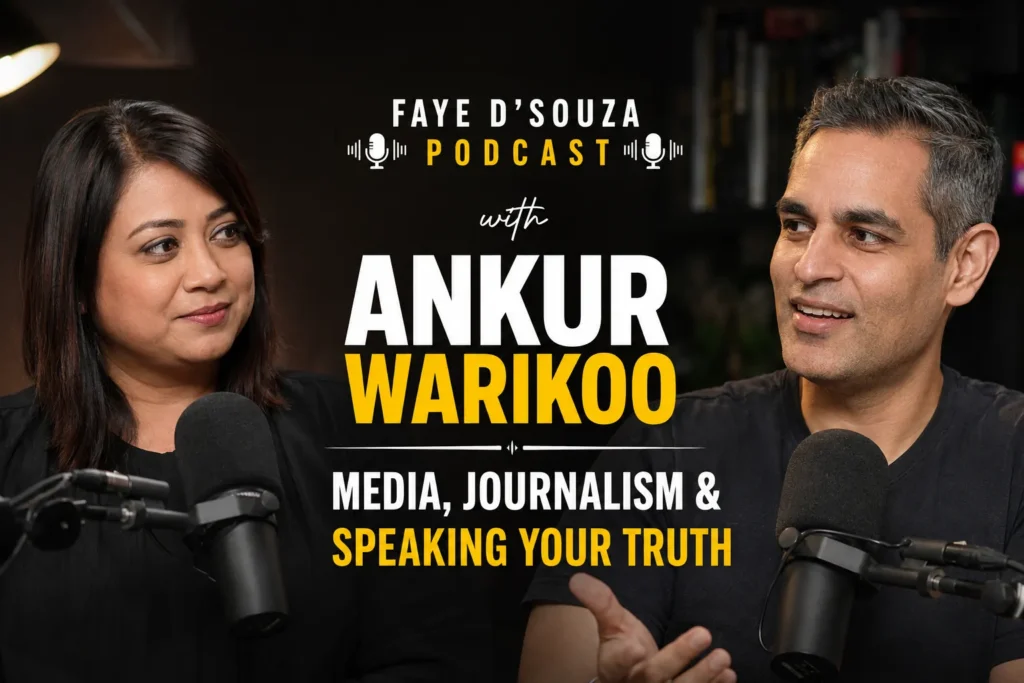
Her chat with Ankur Warikoo on Figuring Out is one of the most honest conversations about the state of Indian media, journalistic ethics, and what it really takes to build a credible career through intelligence, that India’s digital content space has thrown up so far.
The Beginning Why Journalism?
We begin with Faye D’Souza thinking about what made her get into journalism in the first place, and what’s kept her committed through a time when the profession’s under an unprecedented amount of stress.
Her response is simple, direct and heartfelt: she felt that what was being done when they wrote it well (that it was accurate, that it was fair, and that it was actually informing people) was among the most essential tasks that an individual could undertake for the success of a democracy. They have to be able to form good judgements about issues that impact their lives. When the information that’s delivered is corrupt, so is that judgement.
And that’s what carried her through. Carried her through times when the commercial pressures were in one direction, journalistic pressures in another, carried her through the backlashes which necessarily ensue from doing reporting on topics that weren’t easy, through the general sense of being against the current in an industry increasingly dominated by engagement rates rather than accuracy.
How a good story survives and thrives against the odds
This conversation is a fantastic exploration of how and why the media has changed in India in the last 20 years, and I have no doubt that Faye D’Souza has just the sort of informed and insider insights needed for this discussion.
The discussion revolves around the structural forces that have reshaped Indian journalism: erosion of advertising revenue leading to increased pressure from advertisers and owners; fragmented audiences and platform fragmentation leading to more niche reporting, and the proliferation of digital media platforms encouraging shorter and more simplistic news consumption; increased politicisation of media ownership; and the creation of perverse incentives within the journalism profession, which often reward sensationalism and aggression over responsible and nuanced reporting.
Faye carefully avoids falling into a narrative of journalistic decline: There is arguably more journalism being done now than ever before, and the variety of news platforms is greater, so one could make the case that the market for stories is also wider. But what she shows clearly is that the incentives shaping news, however, have shifted in ways that have made the practice of rigorous public interest journalism harder.
Her core argument is specific and backed by evidence: The stories that are most important for democracy are not always the stories which draw the largest audiences, and in this context, rigorous journalism needs either support from news consumers, who may be willing to pay more for high quality journalism, or from institutions which are insulated from commercial pressure.
How to build and maintain a career of integrity
The podcast offers an especially instructive section on how to maintain a journalism career on principles of integrity, not performance or affiliation.
Faye talks about several strategic decisions she has made during her career that may have cost her personally in the short term, but were vital in ensuring the trust she has earned, which ultimately provides everything. Among them are refusing to report on stories unless they were verified; turning down offers to take positions that might have compromised her editorial freedom; and taking responsibility publicly and being willing to retract mistakes in her reporting.
Ankur Warikoo offers an analogy from content creation: what one gives up for an endorsement on a single viral piece can outweigh the long-term reward of genuine connection and trust that would have formed had that person maintained journalistic integrity. The audience one should value most–those who can stick with an artist for many years to come–are the ones who will be looking closely for that integrity.
Personal brand in journalism
One unique and useful part of this discussion revolves around building personal brands in journalism. Traditionally, in this field, one was not expected to have a distinct presence, as the story always had to be paramount.
Faye shares her own evolution in how she came to believe that in a media landscape dominated by individual voices and followings, one’s personal brand can no longer be optional, but must be built on a stable foundation.
Her approach to personal brand building in journalism focuses on three key principles: Be authentic, be specific, be transparent. This makes the personal brand enduring: In her case, what has been seen as integrity can only endure if it can withstand the test of reality.
The most durable personal brands are those which truthfully represent genuine people who hold honest, transparent, verifiable values; other brands which only offer performance, which can be uncovered by fact-checking at any point in time.
Speaking difficult truths
Perhaps the most impactful segment of the podcast is when Faye shares how one finds the courage to speak difficult truths, especially in a media landscape where incentives continually reward conformity and easy affirmation.
She speaks about those times when speaking difficult truths involved confronting the personal costs and social sanctions that follow such acts – particularly those whose opinions generated significant backlash and had to be stood up to. Her advice and insights on those moments may even transcend journalism. The ability to be brave doesn’t mean having it within oneself in specific isolated moments of courage. It refers to cultivating an inner and consistent relationship with one’s values that ensures one acts ethically even when that is difficult and uncomfortable. This is one action that gets easier to repeat as it has been practiced.
About Faye D’Souza
Faye D’Souza is an award-winning Indian journalist and television anchor, best known for her work on Mirror Now and her widely followed social media presence. She has been recognized for her clear, fair, and analytically rigorous approach to news coverage and has built a significant personal audience among viewers who trust her commitment to accuracy and integrity.
Faye D’Souza Social Media Accounts:
Why You Should Watch This Podcast
This episode is a must-watch for everyone interested in what is wrong with the Indian media and who wants to understand this from the inside, everyone pursuing a career that relies on trust and every individual who wishes to see the price of establishing a credible career based on performance versus integrity.
Conclusion
The Faye D’souza episode of Figuring Out: “Who Is This Person, Faye Dsouza And Why Should We Hear Her Out?” It reminds us that real journalism (written with care and honesty) is of great importance. The conversation she has with Mr. Vasu is a testament to all that she speaks about and establishes the case for having and making a career with honesty as the cornerstone.
1. Who is Faye Dsouza?
Faye D’ Souza is a renowned Indian journalist, and news anchor who has earned accolades in India for being straightforward, just, and analytically precise while writing/speaking on issues and for analyzing them critically.
2. What does the podcast discuss?
It discusses what’s going wrong with the Indian media, its professional ethics, why one needs to pursue an honest profession and not simply build an image, about constructing a career based on personal branding, and the nerve it takes to openly disseminate inconvenient facts.