|
Getting your Trinity Audio player ready...
|
India’s currency has undergone several transformations over the years. From the introduction of the iconic Mahatma Gandhi Series to the redesigned banknotes launched after demonetization, the Reserve Bank of India (RBI) has continuously worked to improve the security, durability, and efficiency of Indian currency.
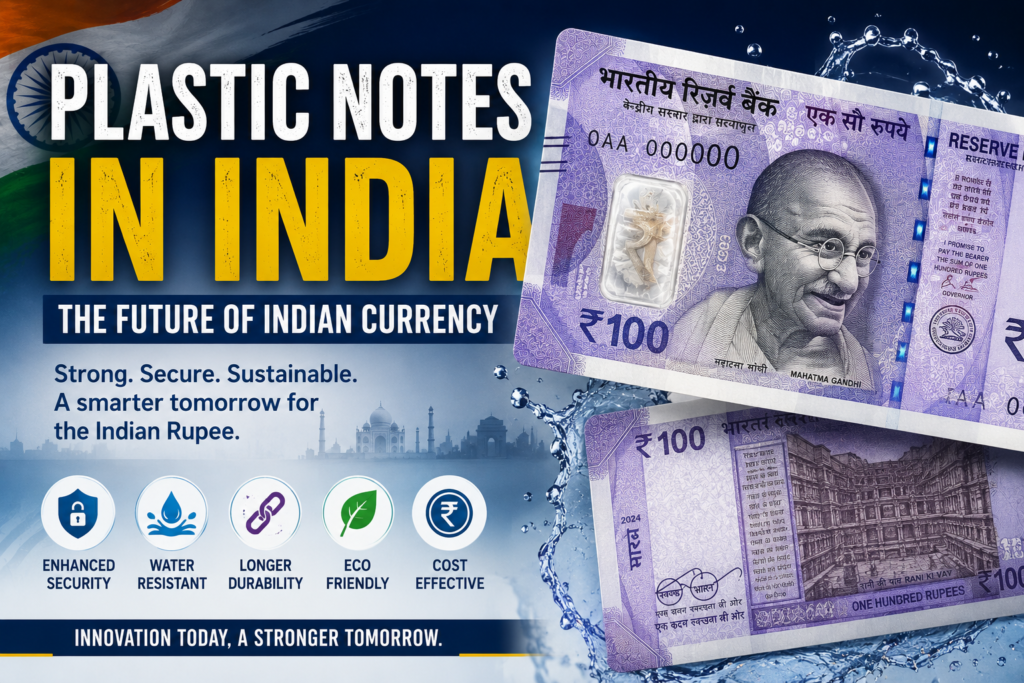
Now, a new possibility is generating interest among economists, policymakers, and citizens alike—plastic currency notes.
Also known as polymer banknotes, plastic notes are increasingly being adopted by countries around the world because of their durability, enhanced security features, and environmental advantages. Nations such as Australia, Canada, the United Kingdom, New Zealand, and Singapore have already transitioned to polymer currency with considerable success.
As India continues its journey toward modernization and financial innovation, discussions around introducing plastic notes have resurfaced. Could polymer currency become the next major evolution of the Indian Rupee? What advantages would it offer, and what challenges would India face in making such a transition?
Let’s explore how plastic notes could shape the future of Indian currency.
- What Are Plastic Notes?
- The History of Polymer Currency
- Why India Is Considering Plastic Notes
- Advantages of Plastic Notes
- Environmental Impact of Plastic Notes
- Challenges of Introducing Plastic Notes in India
- Countries That Successfully Switched to Polymer Notes
- Could India Introduce Plastic Notes Soon?
- Impact on Businesses and Citizens
- The Future of Cash in India
- FAQs
What Are Plastic Notes?
Plastic notes are banknotes made from a special type of polymer substrate rather than traditional cotton-based paper.
Despite being commonly called “plastic notes,” they are not made from ordinary household plastic. Instead, they use a durable polymer material specifically designed for currency production.
Polymer banknotes look similar to conventional notes but offer several unique characteristics:
- Greater durability
- Water resistance
- Enhanced security features
- Longer circulation life
- Improved cleanliness
These notes can withstand harsh environmental conditions, making them particularly useful in countries with humid, wet, or tropical climates.
The History of Polymer Currency
The concept of polymer currency was first developed in Australia during the 1980s.
In 1988, Australia became the first country in the world to issue a polymer banknote. The move was primarily intended to combat counterfeiting and improve the lifespan of circulating currency.
The success of Australia’s experiment encouraged many other countries to adopt polymer notes. Today, more than 60 countries use polymer currency in some form.
Some notable examples include:
| Country | Polymer Currency Status |
|---|---|
| Australia | Fully Polymer |
| Canada | Fully Polymer |
| United Kingdom | Fully Polymer |
| New Zealand | Fully Polymer |
| Singapore | Polymer Notes in Circulation |
| Vietnam | Polymer Notes Widely Used |
| Romania | Fully Polymer |
Their experiences have demonstrated that polymer notes generally last longer and provide stronger protection against counterfeiting.
Why India Is Considering Plastic Notes
India handles one of the largest volumes of cash transactions in the world.
Although digital payments have grown significantly through UPI, cash remains an essential part of daily life, particularly in rural areas and smaller towns.
Traditional paper notes face several challenges:
- Wear and tear
- Moisture damage
- Dirt accumulation
- Counterfeiting risks
- Frequent replacement costs
Plastic notes offer potential solutions to these issues.
The RBI has periodically studied the feasibility of polymer currency as part of its efforts to modernize India’s monetary system.
Given India’s diverse climate conditions, from humid coastal regions to dusty inland areas, a more durable form of currency could deliver significant long-term benefits.
Advantages of Plastic Notes
Longer Lifespan
One of the biggest advantages of polymer notes is their durability.
Traditional paper notes often become damaged after repeated handling. Torn edges, faded printing, and worn surfaces require frequent replacement.
Polymer notes can last up to three to four times longer than conventional paper notes.
For India, where billions of notes circulate daily, this could significantly reduce replacement costs over time.
Better Resistance to Water and Dirt
India experiences heavy monsoon seasons and varying weather conditions throughout the year.
Paper notes frequently become damaged when exposed to moisture. Polymer notes are highly water-resistant and maintain their quality even after repeated exposure to wet conditions.
Additionally, they accumulate less dirt, making them cleaner and more hygienic.
Enhanced Security Features
Counterfeit currency remains a concern for central banks around the world.
Polymer notes allow advanced security elements that are difficult to replicate.
Common security features include:
- Transparent windows
- Metallic holograms
- Complex optical effects
- Color-shifting elements
- Microprinting technology
These features make counterfeiting significantly more challenging.
Reduced Long-Term Costs
Although polymer notes cost more to manufacture initially, their extended lifespan often results in lower long-term expenses.
Fewer replacements mean:
- Reduced printing costs
- Lower transportation expenses
- Less frequent destruction and recycling
Over time, governments can achieve substantial savings.
Security Benefits for India
Security remains one of the strongest arguments in favor of polymer currency.
India has made significant progress in introducing sophisticated security features in recent years, but counterfeit notes continue to pose occasional challenges.
Polymer notes could strengthen security through:
Transparent Security Windows
A clear section within the note that is difficult to reproduce.
Holographic Features
Special reflective elements that change appearance when viewed from different angles.
Advanced Optical Effects
Security patterns that are visible only under certain conditions.
Machine Verification
Enhanced compatibility with banking and cash-handling systems.
These innovations could make Indian currency among the most secure in the world.
Environmental Impact of Plastic Notes
At first glance, using plastic for currency may seem environmentally unfriendly.
However, the reality is more complex.
Because polymer notes last much longer than paper notes, fewer replacements are needed.
This reduces:
- Raw material consumption
- Transportation requirements
- Energy usage during printing
- Waste generation
Many polymer notes can also be recycled at the end of their lifespan.
Several countries that have adopted polymer currency report positive environmental outcomes due to reduced overall production volumes.
Challenges of Introducing Plastic Notes in India
Despite their advantages, polymer notes are not without challenges.
Higher Initial Production Costs
Polymer notes are more expensive to manufacture than traditional paper notes.
A nationwide transition would require substantial investment from the RBI and currency printing facilities.
Infrastructure Upgrades
Banks, ATMs, vending machines, and currency sorting equipment may require adjustments to handle polymer notes efficiently.
This could increase implementation costs during the transition period.
Public Adaptation
Millions of Indians are accustomed to traditional paper currency.
Introducing a new type of note would require public awareness campaigns to educate people about:
- Security features
- Handling methods
- Authentication techniques
Climate Testing
Although polymer performs well globally, extensive testing would be required to ensure its effectiveness under India’s unique climatic conditions.
Countries That Successfully Switched to Polymer Notes
Several nations provide valuable lessons for India.
Australia
Australia’s polymer currency program is widely regarded as the global benchmark.
The country has experienced:
- Lower counterfeiting rates
- Longer note lifespan
- Improved currency quality
Canada
Canada introduced polymer notes to combat counterfeiting and reduce replacement costs.
The transition proved highly successful and improved public confidence in currency security.
United Kingdom
The UK gradually replaced paper banknotes with polymer versions of the £5, £10, £20, and £50 notes.
The move enhanced durability while incorporating advanced anti-counterfeit technology.
These examples demonstrate that large-scale transitions can be managed effectively with proper planning.
Could India Introduce Plastic Notes Soon?
The RBI has explored polymer banknotes in the past and has conducted studies on their potential implementation.
However, no nationwide rollout has been officially announced.
Experts believe that if polymer notes are introduced, the transition would likely occur gradually rather than all at once.
Possible approaches could include:
- Pilot projects in select regions
- Introduction of specific denominations first
- Parallel circulation alongside paper notes
- Gradual replacement over several years
This phased strategy would minimize disruption while allowing authorities to assess performance under real-world conditions.
Impact on Businesses and Citizens
For most people, the transition would be relatively seamless.
Benefits for citizens could include:
- Cleaner notes
- Stronger security
- Better durability
- Reduced note damage
Businesses may benefit from:
- Fewer damaged notes
- Improved cash handling
- Reduced counterfeit risks
Banks would likely experience greater efficiency due to lower note replacement requirements.
The Future of Cash in India
Despite the rapid growth of digital payments, cash continues to play a crucial role in India’s economy.
Millions of people rely on physical currency for daily transactions, particularly in regions where digital infrastructure remains limited.
Polymer notes could help ensure that cash remains secure, durable, and efficient in the coming decades.
Rather than replacing digital payments, plastic currency would complement India’s broader financial ecosystem by improving the quality of physical money.
Conclusion
Plastic notes represent a significant innovation in currency technology. With superior durability, enhanced security, and potential long-term cost savings, polymer banknotes offer compelling advantages for a country as large and diverse as India.
While challenges such as production costs and infrastructure adjustments remain, global experience suggests that the benefits often outweigh the initial investment.
As India continues modernizing its financial systems, polymer currency could eventually become an important part of the nation’s monetary future. Whether introduced gradually or through pilot programs, plastic notes may well represent the next major chapter in the evolution of the Indian Rupee.
FAQs
What are plastic notes?
Plastic notes, also known as polymer banknotes, are currency notes made from a durable polymer material instead of traditional paper.
Are plastic notes more secure than paper notes?
Yes. Polymer notes support advanced security features such as transparent windows, holograms, and optical security elements that are difficult to counterfeit.
Which countries use plastic currency?
Countries including Australia, Canada, the United Kingdom, New Zealand, Singapore, and Vietnam use polymer banknotes.
Has RBI announced plastic notes in India?
The RBI has studied polymer currency in the past, but a nationwide rollout has not yet been officially announced.
Why are polymer notes considered better?
They last longer, resist water damage, offer stronger security features, and can reduce long-term currency replacement costs.